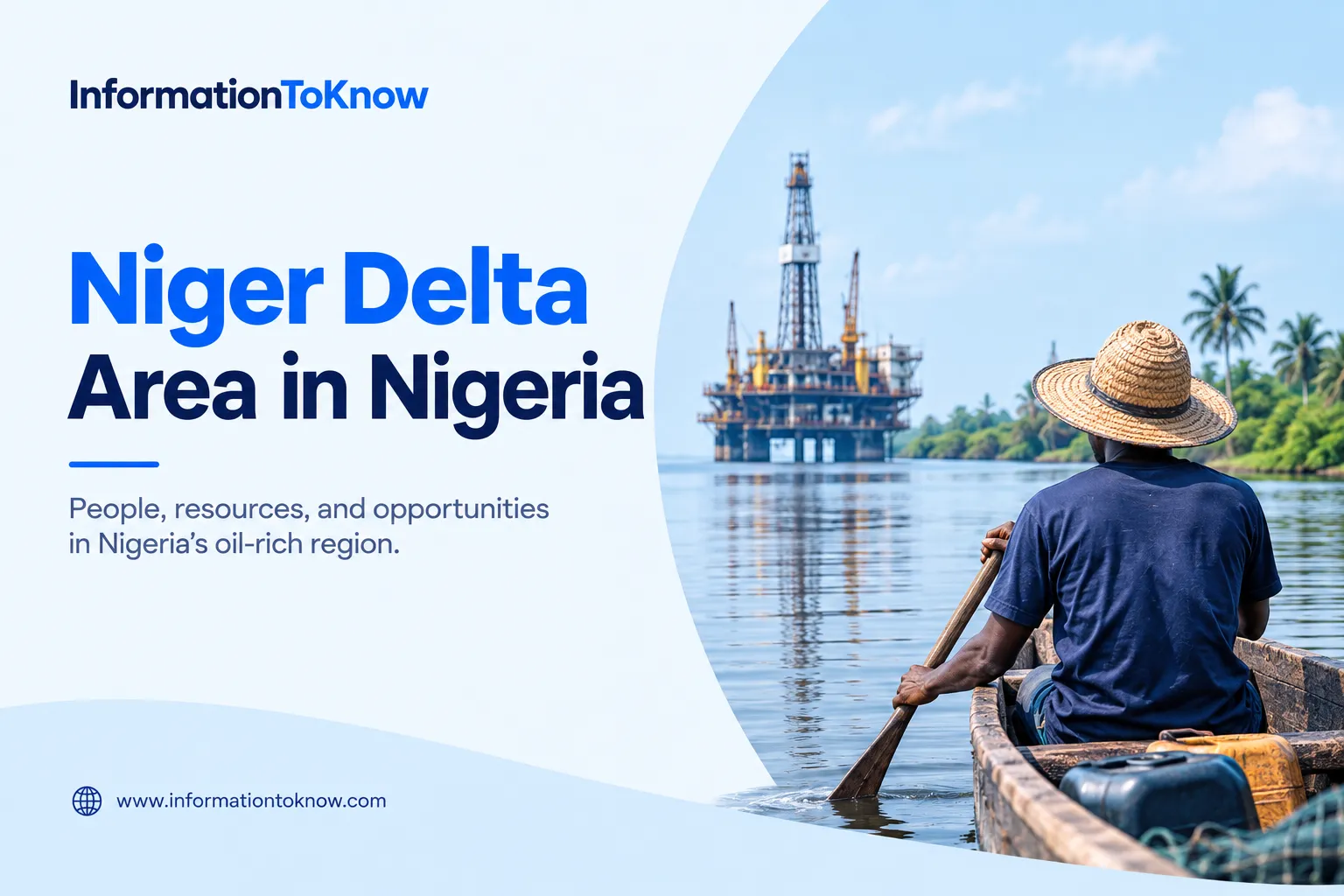
The Niger Delta area is the oil-producing region of southern Nigeria, built around the delta of the River Niger. Its core is three states — Bayelsa, Delta and Rivers. The official government definition covers nine states: those three plus Abia, Akwa Ibom, Cross River, Edo, Imo, and Ondo. It is home to an estimated 30 million people, produces roughly 95% of Nigeria’s oil and gas, and remains one of the country’s richest regions in resources yet poorest in living standards.
If you have searched this topic before, you already know the frustrating part: one site says the Niger Delta is three states, another says six, a third confidently lists nine, and half of them use the words Niger Delta and South-South as if they mean the same thing. They do not. This guide fixes that, then goes further into the people, the oil, the money, the pollution, and the history, so you leave with the full picture in one place.

Jump To
Where Is the Niger Delta Located? (And How Big Is It)
The Niger Delta sits in the far south of Nigeria, along the Atlantic coast, where the River Niger splits into a vast network of creeks, swamps, and rivers before reaching the sea. It is one of the largest river deltas in the world and the reason the region is so wet, so fertile, and so hard to police.
Its size is one of the most confusing things about it, because two different figures are both correct:
- The natural geographic delta — the physical fan of land the river builds up — is much smaller, and different sources put it anywhere from about 20,000 to 40,000 square kilometres depending on where they draw the boundary.
- The official Niger Delta region, as defined by the Nigerian government for development purposes, is much larger. Peer-reviewed 2025 research from Science Direct puts the delta at roughly 70,000 square kilometres spanning the nine states. This is about 7.5% of Nigeria’s landmass, given the country’s total area of roughly 923,768 km², ranking it among the largest wetland systems in the world.
So if two sources give you wildly different areas, they are usually not wrong. One is measuring the river’s delta, and the other is measuring the political region that stretches well beyond it. Keep that distinction in your head; it explains most of the conflicting numbers you will see.
How Many States Are in the Niger Delta?
It depends on which definition you use, and all three common answers are correct in their own context. This is the single most-searched question about the region, so here is the clean version. There is a geographic core of three states (the true delta), a six-state political grouping that people often confuse with the region, and a nine-state official development region. Both 3 and 9 are right; they just answer different questions.
NB: Slide left to view the table if you’re on mobile.
| Definition | States included | Count | When you’d use it |
|---|---|---|---|
| Geographic core (the actual delta) | Bayelsa, Delta, Rivers | 3 | Talking about the physical delta and the heart of oil production |
| South-South zone | Bayelsa, Delta, Rivers, Akwa Ibom, Cross River, Edo | 6 | Talking about the political/geopolitical zone |
| Official Niger Delta region (NDDC) | The 6 above plus Abia, Imo, Ondo | 9 | Talking about oil-bearing states and federal development policy |
The nine-state definition became the working standard after the government set up development bodies for the region and included every oil-producing state, even those that sit outside the geographic delta. If you want each state broken down individually, we have a full breakdown of the Niger Delta states.
Niger Delta vs. the South-South Geopolitical Zone: What’s the Difference?
No, the Niger Delta and the South-South are not the same thing; this is the mix-up that trips up most people. The South-South is one of Nigeria’s six geopolitical zones and has exactly six states. The Niger Delta is a development region defined by oil, and in its official form has nine.
All six South-South states (Akwa Ibom, Bayelsa, Cross River, Delta, Edo, Rivers) are part of the Niger Delta, but the Niger Delta also reaches into the South-East (Abia, Imo) and South-West (Ondo).
In short: every South-South state is in the Niger Delta, but not every Niger Delta state is in the South-South.
The People and Ethnic Groups of the Niger Delta
The Niger Delta is one of the most ethnically diverse regions in Africa, with no single dominant group, instead, dozens of peoples share the creeks and coast. This diversity is central to both its culture and its politics.
- The largest group is the Ijaw, spread across Bayelsa, Rivers, Delta, and beyond.
- Alongside them live the Urhobo, Isoko, Itsekiri, Ijaw, and Ukwuani peoples of Delta State
- The Ogoni, Ikwerre, Ekpeye, and Kalabari of Rivers
- The Efik, Ibibio, and Annang of Akwa Ibom and Cross River
- The Edo (Bini) of Edo State, and
- Igbo communities in Abia and Imo.
Many of these groups speak entirely different languages, and Nigerian Pidgin serves as the common tongue that ties the region together.
Much of the region’s history of agitation comes from small minority groups feeling their land produced the nation’s wealth while their voices were drowned out.
How Many People Live in the Niger Delta?
Honestly, nobody knows precisely. Nigeria has not conducted a full census since 2006, as Africa Check confirms, so every current figure is an estimate. The number you will see most often is around 30 million people, based on projections from the 2006 census, but treat it as a ballpark rather than a hard count.
The region is densely populated in its cities — Port Harcourt, Warri, Uyo, Benin City and Yenagoa — and thinly spread across remote creek communities that are only reachable by boat. Because there is no recent census, be sceptical of any source quoting an exact, up-to-the-year population. For how the same census gap affects the rest of the country, see our breakdown of population figures for Nigeria’s states.
Why the Niger Delta Matters: Oil, Gas and the Nigerian Economy
The Niger Delta matters because it is, quite simply, where Nigeria’s money comes from; almost the entire oil and gas industry sits here. The Bayelsa State Oil and Environmental Commission reports that close to 95% of Nigeria’s total hydrocarbon output is pumped from the region.
The heaviest producers are the coastal states. The Bayelsa Commission’s breakdown of national output puts Akwa Ibom first at about 30.6%, followed by Delta (about 21%) and Rivers (about 20.9%), with Bayelsa (about 17.6%) close behind. Together, those four states account for roughly 90% of Nigeria’s oil. Exact barrel-per-day rankings are hotly contested and shift year to year, partly because oil fields cut across state lines, so treat any single ordering as a snapshot rather than a permanent table.
That output funds the federal budget, and it is why so much of Nigeria’s infrastructure — refineries, export terminals and pipelines — is concentrated in the area. For the state-by-state picture, we’ve covered the oil-producing states in Nigeria and their barrels per day. The region also anchors several of Nigeria’s major seaports, and the sector’s pay scales show up in guides like our oil-and-gas salaries in Nigeria.

The Paradox: Oil Wealth and Deep Poverty
Here is the uncomfortable truth at the centre of the region: the states that produce the most oil are among the poorest places to live in Nigeria. This is the classic resource curse, and the data makes it stark.
In the National Bureau of Statistics 2022 Multidimensional Poverty Index report — a survey of more than 56,000 households across all 36 states and the FCT — Bayelsa recorded an 89% multidimensional poverty rate. This is one of the highest in the entire country, against a national average of 63%. Per head of population, Bayelsa’s oil output tops every other Nigerian state, yet it remains one of the country’s poorest.
Much of the anger centres on how oil money is shared. Nigeria’s constitution returns at least 13% of oil revenue to producing states through the derivation principle, but critics say it rarely reaches ordinary people. As environmental activist Mulade Sheriff put it in January 2026, the fund was meant to bring relief to host communities but instead sees massive diversion, mismanagement and misappropriation, with little or no impact on the lives of the ordinary people in the creeks. It is also why the region does not appear on lists of Nigeria’s richest states anywhere near where its oil output would suggest.
Environmental Cost: Oil Spills and Gas Flaring
Decades of oil extraction have left the Niger Delta one of the most polluted regions in the world, and the damage is still happening. Oil spills and gas flaring have poisoned farmland, killed fisheries, and shortened lives.
The scale is enormous. Data mined from the NOSDRA, National Oil Spill Detection and Response Agency’s satellite tracker, showed at least 589 oil spills in 2024, releasing roughly 19,000 barrels of crude. Although that was fewer incidents than in 2023, it points to a chronic, ongoing problem, most of it, NOSDRA notes, driven by oil theft and sabotage rather than equipment failure.
The burden is not shared evenly. The Bayelsa State Oil and Environmental Commission — an independent inquiry that reported in 2023 — estimated that Bayelsa alone bears about 25% of Nigeria’s oil pollution. Bayelsa Governor, Douye Diri, said that when the commission’s work concluded in October 2024, Bayelsa State bore 25% of Nigeria’s oil pollution.
Spills are only half the story.
Gas flaring, burning off the gas that comes up with oil, released about 229 billion cubic feet of gas in 2024, according to World Bank data compiled by the U.S. EIA, roughly 12% more than the year before. Worryingly, as international oil companies sell off onshore assets, local operators appear to be flaring more. In one large block around Port Harcourt, flaring volumes grew sevenfold between 2020 and 2024, according to satellite analysis reported by Climate Home News.
Individual spills still devastate whole communities. Reporting on a 2023 Trans-Niger Pipeline rupture, environmental campaigner Fyneface Dumnamene told Al Jazeera it was one of the worst spills in Ogoniland in 16 years, bursting into the Okulu River and displacing more than 300 fishers.
There is some progress on cleanup. The flagship effort follows a landmark 2011 UNEP report on Ogoniland, which recommended an initial $1 billion restoration fund. By its 2025 midterm scorecard, the government cleanup agency HYPREP reported 93% of mangrove restoration and 53% of shoreline remediation complete. Real movement, but slow, more than a decade after the report that triggered it.
A Short History: From the Oil Rivers to the Oil Boom
Long before oil, the Niger Delta was a trading powerhouse; its modern troubles are rooted in that history. Understanding the timeline explains why the region behaves the way it does today.
For centuries, delta kingdoms such as Bonny, Nembe, Calabar and the Itsekiri traded first in enslaved people and then in palm oil, which was so valuable to industrial Europe that the British named the area the “Oil Rivers” and, in the late 1800s, established the Oil Rivers Protectorate. That palm-oil trade — not petroleum — gave the region its first oil name.
Everything changed in 1956, when crude oil was discovered in commercial quantities at Oloibiri in present-day Bayelsa State. Exports began at the end of the decade, and by the 1970s, oil had become the foundation of the Nigerian economy. Over the following decades, the region was carved into new states, but political power and oil revenue stayed largely with the federal centre, setting up the grievances that would later boil over.
Militancy, MEND, and the Presidential Amnesty Programme
The gap between the region’s oil wealth and its poverty eventually erupted into armed conflict, which the government tried to end with an amnesty deal that still runs today. This is the backdrop to much of the region’s modern reputation for insecurity.
From the 1990s, protest movements demanded a fairer share of oil money and action on pollution. By the mid-2000s, this had hardened into armed insurgency, led most prominently by the Movement for the Emancipation of the Niger Delta (MEND), which attacked pipelines and kidnapped oil workers, at times slashing national production. In 2009, the federal government offered a Presidential Amnesty Programme: fighters who disarmed would receive training and a monthly stipend.
The programme brought a fragile peace but has become a permanent, costly fixture. Federal records tracked by GovSpend show the government disbursed at least ₦88.79 billion in stipends to former militants between 2018 and mid-2026. Lawmakers even raised the programme’s 2026 allocation to ₦115 billion, up from ₦65 billion in the two previous years. Its administrator, Dr Dennis Otuaro, pledged in 2024 to take it “beyond mere monthly payment of N65,000 stipend” toward training and reintegration. Peace remains uneven, and crude oil theft — often called bunkering — still drives many of the spills recorded each year.
Development Efforts Today: The NDDC and Where Things Stand
Federal development spending in the region flows mainly through the Niger Delta Development Commission (NDDC), and while the budgets are huge, the results are widely seen as disappointing. This is where what is being done about it gets its answer.
The NDDC is a federal agency created to fund roads, power, water, and other projects across the nine states. Its budgets are vast: the Senate approved a ₦1.75 trillion 2025 statutory budget in March 2026, including more than ₦1.6 trillion earmarked for development projects. Alongside it sits a dedicated federal ministry for the region. Yet critics — including the activists quoted earlier — argue that decades of spending have produced far less visible change than the numbers suggest, and abandoned or duplicated projects are a recurring complaint.
The honest summary of where things stand: the guns have largely fallen silent, money keeps flowing, pollution cleanup has finally started, but the underlying deal, oil wealth for local development, is still only half-kept.
Culture and Everyday Life in the Niger Delta
Beyond the oil headlines, the Niger Delta has a rich, water-shaped culture that rarely gets written about, and it is one of the most rewarding things to understand about the region. Life here revolves around the rivers.
Fishing and farming define daily life, and the creeks shape everything from transport (boats over roads in many communities) to festivals. Boat regattas — colourful canoe processions and races — are signature events, especially among the Ijaw and Kalabari. The region’s cuisine is famous nationwide: Banga soup (made from palm nut), fiery pepper soup, fresh seafood, periwinkles, and starch are staples that have travelled far beyond the delta. Music, masquerades, and vibrant textiles round out a culture that is distinct from anywhere else in Nigeria.
There is plenty to see, too. Cross River’s Obudu Mountain Resort is one of Nigeria’s best-known getaways, and Bayelsa offers riverine tourism and heritage sites. You can check things to do in Bayelsa State if you are planning a visit.
Use This Guide to Cut Through the Niger Delta Confusion
Next time a site tells you the Niger Delta is three states or nine states, you will know both can be right, and which one you actually need. For everyday geography or politics, use the six South-South states; for anything about oil, development, or the NDDC, use the official nine.
The bigger takeaway: the Niger Delta is not just an oil map. It is an estimated 30 million people, dozens of cultures, a painful environmental record, and a peace deal that is still being paid for every year.
Found this useful? Share it with someone who keeps getting the “how many states” question wrong, and drop your own questions in the comments.

Frequently Asked Questions About the Niger Delta
Which state is the heart or headquarters of the Niger Delta?
There is no single official capital, but Port Harcourt in Rivers State is the largest city and commercial hub and is often treated as the region’s unofficial centre. Yenagoa (Bayelsa) and Warri (Delta) are other major hubs.
Is Lagos part of the Niger Delta?
No. Lagos is in the South-West and is not an oil-producing state, so it is not part of the Niger Delta under any definition.
Are there oil refineries in the Niger Delta?
Yes. Nigeria’s state-owned refineries at Port Harcourt (Rivers State) and Warri (Delta State) sit inside the region, and a number of smaller modular refineries operate across the delta. The giant privately owned Dangote Refinery, by contrast, is in Lagos, outside the Niger Delta.
What is the 13% derivation fund?
It is the constitutional provision that returns at least 13% of oil revenue to the states where the oil is produced. Critics say much of it has not reached ordinary host communities.
Who are the Niger Delta Avengers?
The Niger Delta Avengers are a militant group that emerged in 2016, after the earlier MEND era, attacking oil infrastructure to demand a bigger share of oil revenue for the region. Their campaign briefly cut national oil output again before tensions eased.
Is the Niger Delta safe to visit?
Major cities like Port Harcourt, Uyo, and Yenagoa function normally, but parts of the creeks have a history of piracy, kidnapping, and unrest. Check current government travel advice and use local guidance before travelling.
What is the difference between the NDDC and the amnesty programme?
The NDDC is a federal agency that funds development projects across the region, while the Presidential Amnesty Programme pays stipends and trains former militants who disarmed after 2009. They are separate bodies with different goals.
What languages are spoken in the Niger Delta?
Dozens — including Ijaw, Urhobo, Isoko, Itsekiri, Ogoni, Ikwerre, Efik, Ibibio, Annang and Edo — alongside Nigerian Pidgin, which is widely used across the region as a common tongue.
What is the difference between onshore and offshore oil in the Niger Delta?
Onshore oil comes from wells on land and in the shallow creeks, where spills hit communities and farmland hardest; offshore oil is drilled from platforms out at sea. Much of Nigeria’s newer production has shifted offshore, which is also harder for oil thieves to tap.
Who cleans up oil spills in the Niger Delta?
Responsibility sits with the operating oil companies under the oversight of NOSDRA, while the Ogoniland cleanup is run by the government agency HYPREP, following the 2011 UNEP report.
What is bunkering in the Niger Delta?
Bunkering usually refers to illegal oil theft, tapping pipelines to steal crude, often refined in makeshift camps. It is a major cause of spills and lost government revenue.
Which universities are in the Niger Delta?
The region hosts several Nigerian universities, including the University of Port Harcourt, University of Uyo, Niger Delta University (Bayelsa), the Federal University of Petroleum Resources (Effurun), and the Nigeria Maritime University in Delta State.