You’re about to pay CAC, or you already have a business name, and then a client’s vendor form asks for your RC number. Maybe an investor wants to see your incorporation documents, or a tender says Certificate of Incorporation. This guide shows you which structure you actually need, what each one costs at CAC in 2026, and how to avoid paying to register twice.
TL;DR: Register a limited company (Ltd) if anyone you need money or work from (a corporate client, investor, government tender or regulator) asks for a Certificate of Incorporation, or if a debt or lawsuit could reach your personal assets. A business name (BN) is fine for solo, low-risk trading where nobody is asking for “Ltd”. Under CAC’s 2025 fee schedule, a small company with ₦1 million share capital costs about ₦11,000 in official CAC fees, while a business name costs ₦21,000.
Not sure which one fits your situation or need help registering your business on CAC? Message Jogee Business Services on WhatsApp. We can look at what your client or investor is asking for and file the right registration for you.
Jump To
What Is the Real Difference Between a Business Name and a Limited Company?
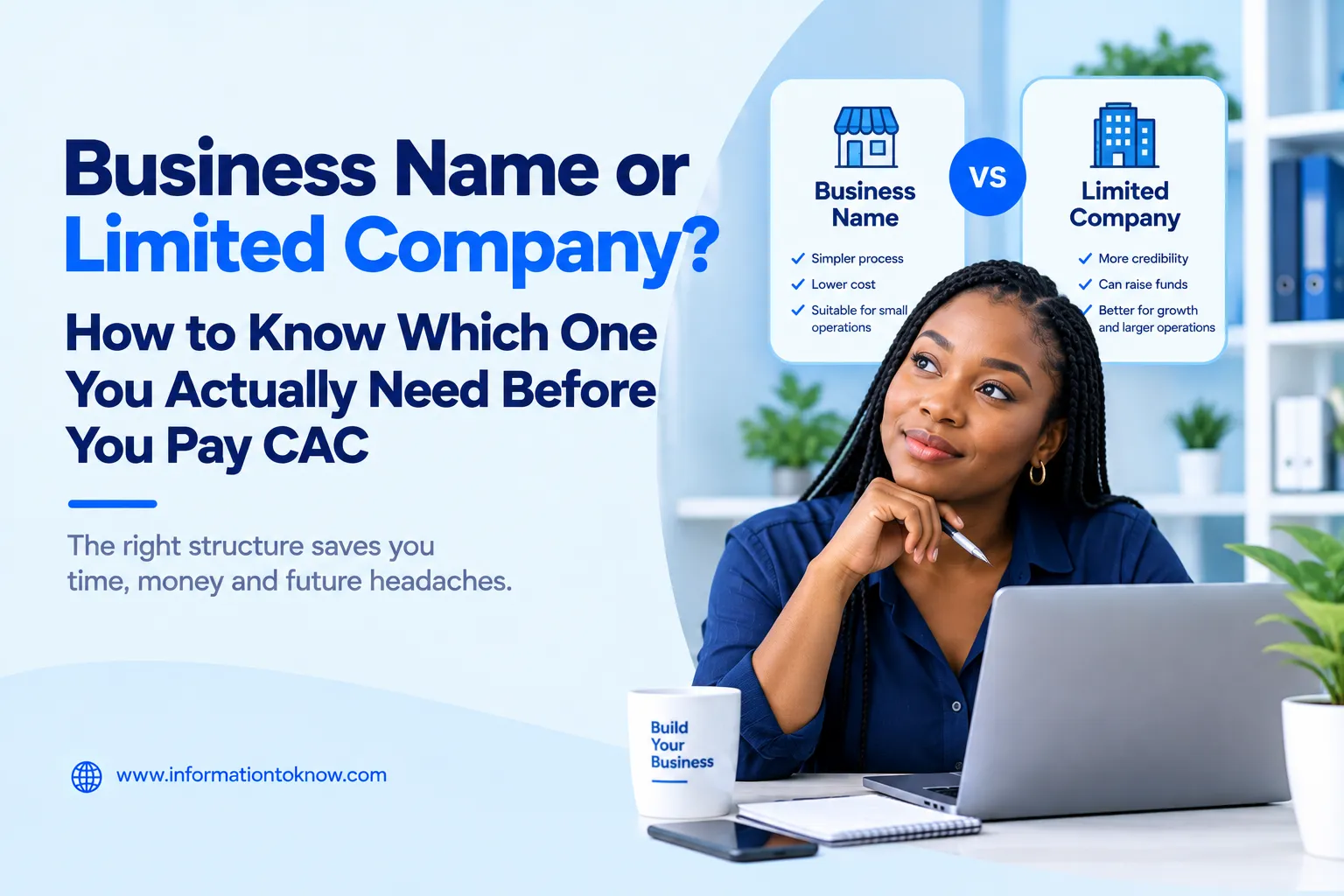
A business name is a trading name for you, the owner. A limited company is a business structure where the company exists as a separate legal entity from its owners and managers. Everything else follows from that: who carries the debts, how you’re taxed, and who will do business with you.
Under CAMA 2020, a business name has no legal existence apart from its owner. A business name is not a separate legal entity; the owner(s) bear unlimited personal liability for all debts and obligations. For instance, if “Ada Ventures” owes a supplier ₦4 million and can’t pay, that debt is Ada’s debt, and her personal savings, car, or land can be pursued for it.
A limited company is different. It can own property, sign contracts, borrow, sue, and be sued in its own name. As a rule, shareholders risk only what they put into the company.
In plain terms: Nigerians often say business names end with Enterprises or Ventures, and companies end with Ltd. Business names get a BN number and companies get an RC number. When a client asks for your RC number, they’re asking whether you’re a company.
Two myths keep people stuck on a business name when a company would serve them better:
- I need two people to form a Ltd: You don’t. CAMA 2020 allows single-shareholder private companies (Section 18(2)). For qualifying small companies, there is also no requirement to appoint a company secretary.
- I need millions in share capital: You don’t. Under CAMA 2020, Section 27(2), the minimum share capital for a private company is ₦100,000. That figure is the capital you declare. You don’t need to have it sitting in a bank account. Some regulated sectors set higher minimums.
There are lots of other differences between a business name and a limited company. This table shows the difference in full.
NB: Slide left to view the table if you’re on mobile.
| Feature | Business Name (BN) | Limited Company (Ltd) |
|---|---|---|
| Legal status | Not separate from the owner | Separate legal person |
| Liability for debts | Unlimited, personal | Usually limited to your shares |
| Registration number | BN number | RC number |
| Typical name ending | Enterprises, Ventures, Global Services | Limited / Ltd |
| Owners | Sole proprietor or partners | Shareholders (one is allowed) and director(s) |
| Can sell shares to investors | ❌ | ✅ |
| How profit is taxed | Owner’s Personal Income Tax | Companies Income Tax (0% if it qualifies as small) |
| Ongoing CAC compliance | Annual returns | Annual returns, statutory records, more director duties |
| Official CAC fee to register | ₦20,000 + ₦1,000 name reservation | ₦10,000 per ₦1m share capital + ₦1,000 name reservation |
Five Signs You Need a Limited Company, Not a Business Name
You need a limited company when someone you depend on for revenue, funding, or permission needs an incorporated entity, or when your business could create debts large enough to threaten what you personally own. If none of the five signs below apply to you, a business name may be enough for now.
1. A corporate client’s vendor form asks for a Certificate of Incorporation or RC number
In our experience, larger clients often run supplier checks that ask for company documents such as an RC number or Certificate of Incorporation. This isn’t a legal rule, and some clients accept a BN, so ask the procurement or finance contact in writing what they accept to be sure.
2. You want investors, or partners who want a defined stake
In practical terms, investors usually buy shares. A company can issue shares, and a business name, which is just you or your partnership trading under a name, has none to offer. If you plan to raise money for a company, bring in a co-founder with a fixed percentage, or give staff equity later, you need a Ltd.
3. You’re bidding for government contracts
Many public tenders ask for incorporation, but requirements vary by agency and by type of contract. For instance, Public tender notices published in October 2026 show there is a split:
- The Federal College of Fisheries and Marine Technology, Lagos, asked for Evidence of the Certificate of Incorporation issued by the Corporate Affairs Commission (CAC). It added that a Business Name with Form BN1 was also acceptable for consultancy services. For business names, it wanted Personal Income Tax clearance for all the partners.
- Notices from Obafemi Awolowo University and a Yobe College of Education listed a Certificate of Incorporation.
So confirm if the requirements list BN or RC before taking a step.
Expert tip: Incorporating today won’t automatically qualify you. Notices like this also ask for things like several years of tax clearance, audited accounts, and Bureau of Public Procurement registration. If tenders are your plan, register the company early so it builds that history.
4. Your activity needs a licence from a regulator
Some licences can only be issued to an incorporated company. The Nigerian Communications Commission is one example. Its licence eligibility rules say an applicant must be duly incorporated in Nigeria by the Corporate Affairs Commission (CAC). A registered business name can apply only for a Class Licence. Other regulators set their own rules, so check with yours before you register. If you plan to start a fintech company, expect to need a company.
5. A single bad debt or lawsuit could cost you your house
If you’re in construction, logistics, manufacturing, event management, or any trade where one failed contract could leave you owing millions, unlimited personal liability is a real risk. A company puts a legal wall between the business’s debts and your personal assets. That wall has limits, so get legal advice if your exposure is serious. No matter the level of your exposure, if you want to protect your personal assets, you have to incorporate.
When a Business Name Is Genuinely Enough
A business name is enough when you trade alone or with a trusted partner; your risk is low, and none of your customers, funders, or regulators are asking for Ltd. In that situation, registering a business name gives you a legal trading name and lets you open a business bank account without a company’s extra compliance work.
Good fits for a business name include:
- Solo service providers such as tailors, makeup artists, photographers, tutors, and consultants with individual clients
- Small retail and online shops selling to consumers
- Agents and operators, e.g. if you’re starting a POS business
- Freelancers whose clients pay individuals or small firms
- Anyone testing an idea before committing to a company
A business name still solves the most common early problem: customers who won’t send money to a personal account. With a BN certificate, you can open a business account in your business’s name.
Key takeaway: If nobody in your pipeline has asked for “Ltd” and you can’t see that happening within the next 12 months, a business name is a reasonable choice. If you can see it happening, read the next two sections before you pay.
One more thing: business names aren’t for non-profits. A church, foundation, association, or NGO should register as Incorporated Trustees, not as a BN or Ltd. Not sure which one fits your situation or need help registering your business on CAC? Message Jogee Business Services on WhatsApp.
How Much Does CAC Charge for a Business Name vs. a Limited Company in 2026?
By CAC’s official 2025 schedule, a business name costs ₦21,000 (₦20,000 registration plus ₦1,000 name reservation). A small limited company costs ₦10,000 for every ₦1 million of share capital, or part of it, plus ₦1,000 for name reservation. That makes a company with up to ₦1 million share capital about ₦11,000 in official fees.
NB: Slide left to view the table if you’re on mobile.
| Filing | Business Name | Small Limited Company |
|---|---|---|
| Name reservation | ₦1,000 | ₦1,000 (₦5,000 if the name has restricted words) |
| Registration / incorporation | ₦20,000 | ₦10,000 per ₦1,000,000 share capital or part of it |
| Annual returns | ₦5,000 per year | Confirm on the CAC portal (depends on company category) |
| Cessation (closing the BN) | ₦10,000 | n/a |
Note: These are federal CAC fees only. Stamp duty on share capital and any agent or professional fees are extra.
| What you register | Official CAC fees |
|---|---|
| Business name | ₦20,000 + ₦1,000 = ₦21,000 |
| Ltd with ₦100,000 share capital (legal minimum) | ₦10,000 + ₦1,000 = ₦11,000 |
| Ltd with ₦1,000,000 share capital | ₦10,000 + ₦1,000 = ₦11,000 |
| Ltd with ₦5,000,000 share capital | ₦50,000 + ₦1,000 = ₦51,000 |
Because the fee is charged per ₦1 million or part thereof, ₦100,000 and ₦1,000,000 of share capital cost the same CAC fee. That’s why many owners register with ₦1 million.
Expert tip: Before you pay, check any fee list you find online against the official schedule. Package prices quoted by agents also include their professional fee on top of what goes to CAC. Agents are allowed to charge for their work; just know which part is the official fee.
What Paying Twice Actually Costs You
If you register a business name now and a company later, you don’t upgrade anything. You pay for a brand-new incorporation, pay again to close the business name, and redo your bank, tax and client paperwork. On official CAC fees alone, the BN-first route can cost several times more than going straight to Ltd.
Business owners often ask whether upgrading a BN to a limited company is cheaper than registering a company from scratch. Based on the official fee schedule, it isn’t. There’s no conversion line on it, and the company is charged as a new registration. The table below compares the two routes for someone who needs Ltd within two years.
NB: Slide left to view the table if you’re on mobile.
| Cost item | BN first, then Ltd | Ltd from day one |
|---|---|---|
| Business name registration + reservation | ₦21,000 | — |
| BN annual returns (2 years × ₦5,000) | ₦10,000 | — |
| Company incorporation + reservation | ₦11,000 | ₦11,000 |
| BN cessation | ₦10,000 | — |
| Official CAC total | ₦52,000 | ₦11,000 |
That ₦41,000 difference is only the official fees. The costs that aren’t in the table are often higher:
- New bank details. In most cases, bank accounts have to be moved to the new company, so customers may need new payment details.
- Tax updates. Updating your TIN is part of the switch.
- Rebranding. New invoices, letterheads, website, contracts, and signage with Ltd and an RC number.
- Re-onboarding with clients. Every client who registered you as a vendor under the BN may need fresh documents. A deal can stall while that happens.
- Your time and agent fees if you hire help twice.
The entire process involves registering a genuinely new Limited Company at the CAC, then transferring your existing assets, contracts, and bank accounts across to it, updating your TIN, and formally winding down the old Business Name. It can have logistics implications.
Key Takeaway: If you’re fairly sure you’ll need Ltd within a year or two, registering a business name first usually costs you more and saves you nothing.
If you’re not sure, you can contact an experienced CAC registration expert.
How to Switch From a Business Name to a Limited Company
You can’t directly convert a business name into a company within the same registration. You incorporate a new limited company, using the same name plus Ltd if it’s available, move your operations into it, and then file for cessation to close the business name.
If you already have a BN and a client now wants Ltd, follow these steps in order:
- Bring the BN’s annual returns up to date. BN annual returns are ₦5,000 a year, and we recommend clearing them first so you aren’t closing a business name with filings outstanding. The CAC portal has said BN annual returns are open for names registered before July 2025, so check the portal if yours is newer. See how to keep your business active on CAC.
- Reserve the company name. You can propose your existing name with Limited added, e.g., “Ada Ventures” becomes “Ada Ventures Ltd”, but approval isn’t guaranteed, so have a backup name ready. Name reservation costs ₦1,000, or ₦5,000 if the name includes restricted words.
- Decide your share capital and shareholders. The minimum is ₦100,000, and ₦1 million costs the same CAC fee. One person can be the sole shareholder and director. If you’re bringing in a partner, agree on the split before you file.
- File the incorporation and pay. Use the CAC portal. Make sure IDs, addresses, and the description of your business match exactly so you avoid a CAC query.
- Set up the company’s banking and tax. Open a corporate account in the company’s name, register the company for tax, and then update your contracts, invoices, and vendor profiles with the new RC number.
- File cessation for the business name, which costs ₦10,000, once nothing is running through it anymore. If you keep the BN as a separate trading name instead, you must keep filing its annual returns.
Do you prefer to hand it off to a CAC expert? Jogee Business Services handles the full switch: name reservation, incorporation, and BN cessation if you want it, with documents checked to reduce the risk of a query. Message Jogee Business Services on WhatsApp.
The 2026 Tax Factor: Should Tax Decide Your Structure?
Tax can tip the decision, but it shouldn’t make it on its own. Under the Nigeria Tax Act 2025, a qualifying small company pays 0% Companies Income Tax. A business name doesn’t qualify because its profit is taxed as the owner’s personal income.
According to KPMG Nigeria’s analysis, a small company has a gross turnover of ₦100 million or less a year and total fixed assets of no more than ₦250 million, and is subject to tax at 0%. Baker Tilly Nigeria adds that such companies are fully exempt from Companies Income Tax (CIT), Capital Gains Tax (CGT), and the Development Levy.
For business names, Compos Mentis explains that a business name is not distinct from its proprietor, so the tax it pays is the owner’s Personal Income Tax. Limelight Attorneys concludes that business names are not eligible for the tax relief provided under Section 56.
Before you incorporate for tax reasons, keep these caveats in mind:
- Some other commentary, such as Limelight Attorneys, gives a ₦50 million threshold instead of ₦100 million. Confirm the current figure against the Act or with a tax adviser.
- Some businesses may not qualify. Limelight Attorneys notes that professional service businesses are not classed as small companies. Check with a tax adviser before relying on the exemption.
- 0% CIT doesn’t mean no tax obligations. A company still files returns, and staff pay, VAT and other rules can still apply.
- CAMA’s small company test is different from the tax test. For company-law purposes, a small company has turnover of up to ₦120 million and net assets of up to ₦60 million, per Edelweiss. Don’t mix the two up.
Expert tip: choose your structure based on clients, funding, and liability first, then let tax confirm or tip the decision. This section isn’t tax advice, so speak to an accountant about your actual numbers.
Whatever You Pick, Keep It Alive
Registering is only the first payment. A business name or company that stops filing annual returns can be marked inactive and struck off, and then you’ve paid for nothing.
CAC is actively clearing its register. Registrar-General Hussaini Magaji said “In 2025 alone, we deregistered over 400,000 companies from our records”. He described them as largely shell companies that hadn’t filed annual returns.
What this means for you:
- Business name: file annual returns every year at ₦5,000 each under the 2025 schedule.
- Limited company: file annual returns every year, keep your statutory records up to date, and report changes to directors or shareholders.
- If you keep a BN alongside a new Ltd, you have two sets of annual returns to file.
If your registration has already lapsed, here’s how to fix an inactive status on CAC.

Check These Three Things, Then Register Once
Choose based on who’s asking, what you’re risking, and where you’ll be in 12-48 months. Then register the right structure once.
- Ask in writing. Email the client, tender office, investor, or regulator and ask: “Do you accept a registered business name, or do you need a Certificate of Incorporation?” Their answer often settles it.
- Run the 12-month test. If any of the five signs above is likely within a year (a corporate client, an investor, a tender, a licence or serious liability), register a Ltd now. It costs about ₦11,000 in official CAC fees at ₦1 million share capital, compared with ₦21,000 for a BN, and you avoid paying twice.
- File it correctly. Follow our guide on how to register your business with CAC, or hand it off: message Jogee Business Services on WhatsApp to register a BN, incorporate a Ltd, or switch from one to the other.
Frequently Asked Questions
Is CAC registration free now?
Not generally. CAC’s gazetted fees still apply to standard filings. In February 2026, the Registrar-General said CAC had facilitated free MSME registrations through a SMEDAN programme in 2025, but uptake is unclear, so check whether a current free scheme exists and whether it covers your structure before relying on it.
What is the biggest disadvantage of a limited company?
More paperwork. A company keeps statutory records and files annual returns with financial information, and the CAC fee schedule applies late-filing penalties to the company and each officer, so the ongoing admin is heavier than for a business name.
What types of businesses can you register with CAC?
Three main families: business names (sole proprietorship or partnership), companies (private Ltd, public Plc, limited by guarantee, unlimited), and incorporated trustees for NGOs, churches and associations.
How do I register with CAC online?
Through the CAC Company Registration Portal (iCRP), you create an account, reserve a name, complete the registration form, pay, and track approval there. Follow our step-by-step CAC registration guide for the details.
What do BN number vs. RC number mean?
A BN number is issued to a registered business name; an RC number is issued to an incorporated company. Clients who ask for your RC number are asking for proof that you’re a company.
Can I keep my business name after registering a limited company?
Yes. They are separate registrations, so the BN stays on record until you file cessation. If you keep it, you must keep filing its annual returns.
What happens if I don’t file annual returns?
Late filings attract penalties (for a BN, the 2025 schedule lists a ₦5,000 penalty plus ₦100 a day; confirm on the portal), and a business can be marked inactive or struck off.
How much share capital should I register with?
The legal minimum for a private company is ₦100,000. Many owners choose ₦1 million because the CAC fee is charged per ₦1m or part. Regulated sectors can require more. You can increase share capital later through a CAC filing.
Does a small limited company need audited accounts?
CAMA 2020 gives qualifying small companies lighter reporting rules, including a possible audit exemption. Check eligibility with an accountant, because tenders and banks may still ask for audited accounts.
What is the difference between Ltd and Plc?
A Ltd is a private company that can’t offer shares to the public and needs at least ₦100,000 share capital; a Plc can offer shares publicly and needs at least ₦2 million, per CAMA 2020, Section 27(2).