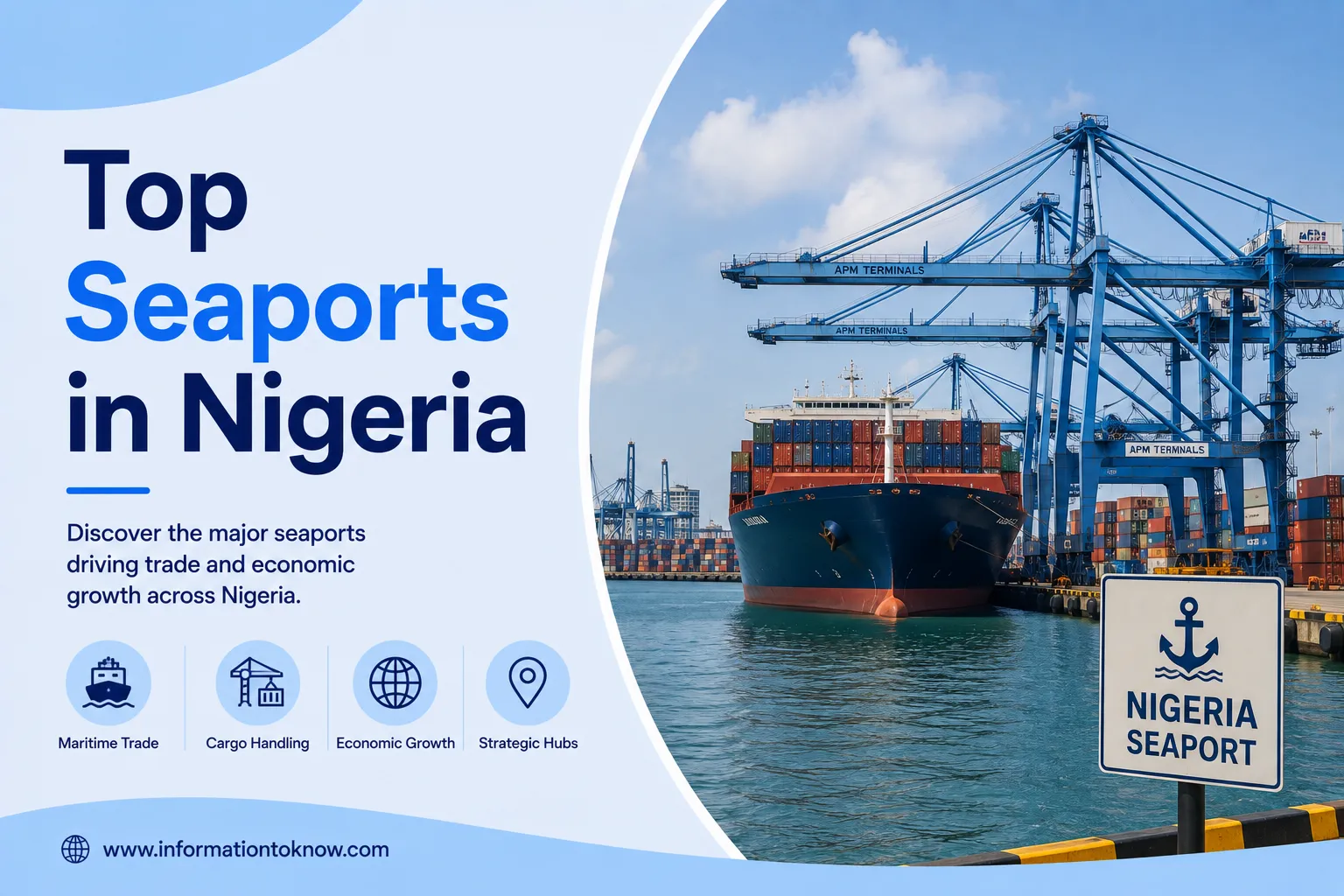
If you have searched this topic before, you already know the frustrating part: half the lists online still say Nigeria has six ports; most forget the country’s newest and deepest port entirely, and almost none tell you what each port actually does or which one is really the biggest. So let us fix that with current, sourced numbers instead of a recycled listicle.
Quick answer: Nigeria has seven major seaport complexes, all governed by the Nigerian Ports Authority (NPA): the Lagos (Apapa) Port Complex, Tin Can Island Port and Lekki Deep Sea Port in Lagos State; Onne Port and Rivers Port in Rivers State; the Delta Ports in Delta State; and Calabar Port in Cross River State. Lekki Deep Sea Port is the deepest (about 16.5 metres) and now leads the country by cargo volume, while Apapa remains the oldest and the busiest by trade value. The catch: biggest changes depending on whether you measure tonnage or naira, so this guide labels every claim with its metric.
Below you get the full list of Nigeria’s top seaports, where each sits, who runs it, what it handles, and the latest figures. You’ll also get a plain-English answer to the biggest, busiest, and deepest seaport debate, a look at the ports still being built, and what all of it means if you import or clear goods.

Jump To
How Many Seaports Does Nigeria Have?
Nigeria has seven major seaport complexes, and they are all owned and regulated by one federal agency – Nigerian Ports Authority (NPA). The NPA governs and operates the country’s ports: the Lagos Port Complex, Lekki Deep Sea Port and Tin Can Island Port Complex in Lagos State, the Calabar Port Complex in Cross River State, the Delta Ports in Warri, and the Rivers Port Complex and Onne Port Complex in Rivers State.
A few things worth clearing up:
- Seven complexes, many terminals: Inside those seven complexes sit roughly 25 individual terminals that are run by private operators under concession agreements. So the NPA owns and regulates, while companies like APM Terminals actually handle your cargo.
- This is why older lists say six: Lekki Deep Sea Port only became operational in 2023, so any article written before then or copied from one still lists six ports.
- Coastal south only: All the major ports sit in four southern states — Lagos, Rivers, Delta and Cross River — which is why the most-populated and most economically active states cluster around them.
- There are also inland ports: Away from the coast, dry/inland ports such as the Onitsha Inland Port exist to move containers inland and ease pressure on Lagos.
Top Seaports in Nigeria at a Glance
Here is the whole list in one view before we go port by port. Use it to spot which port serves your region and cargo type.
NB: Slide left to view the table if you’re on mobile.
| Seaport | Location (State) | Managed by | Best known for | Draft depth |
|---|---|---|---|---|
| Lagos (Apapa) Port Complex | Apapa, Lagos | NPA + private terminals | Oldest & busiest by trade value | 10.5 m |
| Tin Can Island Port Complex | Apapa, Lagos | NPA + private terminals | Highest ship-call frequency | 9–11 m |
| Lekki Deep Sea Port | Ibeju-Lekki, Lagos | NPA + Lagos Free Zone/Tolaram | Deepest; #1 by cargo volume | 16.5 m |
| Onne Port Complex | Onne, Rivers | NPA + private terminals | Oil & gas free zone hub | Deep-water |
| Rivers Port Complex | Port Harcourt, Rivers | NPA + private terminals | South-South general cargo | Shallower |
| Delta Ports (Warri) | Warri, Delta | NPA + private terminals | Bulk & oil servicing | Shallower |
| Calabar Port Complex | Calabar, Cross River | NPA + private terminals | Eastern gateway (needs dredging) | Shallow |
The Top Seaports in Nigeria
1. Lagos (Apapa) Port Complex
Apapa is Nigeria’s oldest and, by trade value, its busiest port. Its first four berths were commissioned in 1926. It has been the country’s flagship gateway ever since, sitting in the Apapa area of Lagos — the same district known nationally for its terminals and, unfortunately, its traffic.
By value, it still dwarfs everything else: National Bureau of Statistics trade data reported by Intel Point showed Apapa handling goods worth ₦25.79 trillion in the first quarter of 2025, which is over 71% of Nigeria’s entire international trade for the period. In volume terms, The Sun reported that Apapa Port in 2025 moved about 21.99 million metric tonnes of cargo and 800,943 twenty-foot equivalent units (TEUs), a 34% jump in container throughput over 2024. Its main limitation is depth: with a draft of about 10.5 metres, it cannot take the largest modern vessels, which is a big reason Lekki was built. It matters because Apapa is still where the bulk of the goods into Nigeria come through, reinforcing Lagos’s role as the country’s trade gateway.
2. Tin Can Island Port Complex
Tin Can Island is Apapa’s neighbour and Nigeria’s second Lagos powerhouse. Also located in Apapa, it handles a wide mix of cargo — liquid bulk, dry cargo, containers, roll-on/roll-off (vehicles) and breakbulk.
According to the NPA’s berth characteristics, the complex has 12 berths across multiple terminals on a 79-hectare site, with berth depths of roughly 9 to 11 metres. What stands out in the latest data is traffic frequency. According to the NPA’s 2025 Operational Performance Report, Tin Can recorded the highest frequency of ship arrivals among Nigerian ports, accounting for 22.7% of total ship calls. So while it is not the biggest by tonnage, it is arguably the most constantly active quay in the country, which is why so many freight and clearing companies cluster around it.
3. Lekki Deep Sea Port
Lekki is Nigeria’s deepest port and, by cargo volume, now its number one. Located in the Lagos Free Zone at Ibeju-Lekki, it has been fully operational since April 2023 as Nigeria’s first true deep seaport.
The headline feature is depth. The port has a draft of about 16.5 metres deep; as then-NPA managing director Mohammed Bello-Koko put it, that depth “enables bigger vessels and more cargo to come to Lekki Port with economies of scale, which will bring down the costs for business.”
It was built as a roughly $1.5 billion joint venture between the federal government (through the NPA), Lagos State, the Tolaram-owned Lagos Free Zone, and China Harbour Engineering Company. Phase 1 installed capacity is about 1.2 million TEUs, with a full quay design of around 2.5 million TEUs.
The payoff is already visible: per the NPA’s 2025 report, Lekki led the entire country with 40.6% of national cargo throughput. It matters because Lekki finally lets Nigeria receive the mega-ships that used to skip it, cutting the transhipment detours that raised costs for importers.
4. Onne Port Complex
Onne is Nigeria’s oil-and-gas port and one of the largest free zones of its kind in the world. Sitting near Port Harcourt in Rivers State, it is one of the largest oil and gas free zones in the world and the main base for servicing offshore exploration and production.
Its specialisation shows in the numbers. In 2024, the customs command at Onne processed over $953 million worth of non-oil exports and nearly doubled its revenue year on year. On overall cargo, the NPA’s 2025 report placed Onne second nationally with 19.1% of throughput. If your business touches energy, equipment, or the wider supply chain of the oil-producing states, Onne is the port that matters most.
5. Rivers Port Complex (Port Harcourt)
Rivers Port is the traditional general-cargo gateway for the South-South and South-East. Based in Port Harcourt, it handles general and bulk cargo for the eastern half of the country and predates the newer Onne facility beside it.
Its draft is shallower than that of the Lagos and deep-water ports, so it serves smaller vessels and regional trade rather than the mega-ships that now head to Lekki. The NPA does not publish a standalone public throughput figure for Rivers Port in the same headline way it does for the leaders, so it is best understood by role: a steady, historically important hub serving the wider Niger Delta states.
6. Delta Ports (Warri)
The Delta Ports are a cluster of terminals built around bulk cargo and oil servicing. Centred on Warri in Delta State (with related jetties at Koko and Sapele), they support industrial, agricultural and petroleum-related trade in the mid-western Niger Delta.
Like Rivers Port, the Delta Ports work with shallower drafts and smaller vessels, and detailed year-by-year throughput is not broken out publicly, so treat any specific tonnage claim with caution. The region’s maritime importance is real enough that the country’s dedicated Nigeria Maritime University sits in Delta State, training the next generation of port and shipping professionals.
7. Calabar Port Complex
Calabar is the eastern gateway port, held back mainly by depth. Located on the Calabar River in Cross River State, it serves the far south-east and has long-standing ambitions as a trade and tourism hub.
Its persistent challenge is a shallow channel that needs regular dredging to keep larger ships coming, which limits how much cargo it can capture from the Lagos ports. It remains strategically important for the region, but its scale sits well below the Lagos complexes and the deep-water ports.
Biggest, Busiest or Deepest? Settling the Debate
The confusion online comes from mixing up three different questions, so here is each one answered separately. The short version: no single port wins on everything.
NB: Slide left to view the table if you’re on mobile.
| Superlative | Winner | The metric behind it |
|---|---|---|
| Deepest port | Lekki Deep Sea Port | 16.5 m draft vs Apapa’s 10.5 m |
| Biggest by cargo volume (2025) | Lekki Deep Sea Port | 40.6% of national cargo throughput |
| Biggest/busiest by trade value | Lagos (Apapa) Port | 71%+ of international trade, Q1 2025 (NBS) |
| Most frequent ship calls (2025) | Tin Can Island Port | 22.7% of all ship arrivals |
| Oldest port | Lagos (Apapa) Port | First berths commissioned in 1926 |
In plain terms: if you mean the port that takes the deepest ships and moved the most tonnage in 2025, that is Lekki. If you mean the port through which most of Nigeria’s trade value flows, that is Apapa. Both statements are true at the same time; they just measure different things.
The Numbers Behind Nigeria’s Ports
Nigeria’s ports are not just growing; they recently posted some of their strongest figures on record. Taken together, the system moved far more cargo and earned far more money in 2024–2025 than in prior years.
- Cargo throughput. Per the NPA’s 2024 performance report, total cargo rose 45.1% to 103.3 million metric tonnes, with container traffic of 1,744,972 TEUs. The following year, the NPA’s 2025 Operational Performance Report put total cargo at 129.3 million metric tonnes (up 24.8%) and containers above 2.1 million TEUs.
- Revenue. NPA revenue climbed from ₦361 billion in 2022 to ₦501 billion in 2023, and then to ₦894.86 billion in 2024, with ₦400.8 billion remitted to the federation in 2024 alone.
- Why the surge. NPA managing director Abubakar Dantsoho described the 2025 jump as one of the most significant annual increases in Nigeria’s maritime history, driven largely by the rise of Lekki Deep Sea Port.
The Future: Ibom Deep Seaport and Nigeria’s Next Ports
Nigeria’s next big port is Ibom Deep Seaport in Akwa Ibom, but it is not built yet. As of early 2026, the project is still in the master-planning and pre-construction phase, so any list that calls it Nigeria’s largest operating port is wrong.
On paper, it is ambitious. Project plans reported by Business Day describe a port over 18 metres deep at its approach channel with a berth depth above 16 metres, at a projected cost near $4.2 billion; the design specifications put the channel depth at 18.24 metres and berth depth at 16.72 metres with about 7.5 km of quay. If completed as designed, Ibom would rival and even exceed Lekki on depth, a sign that Nigeria’s coastline is moving decisively toward deep-water capacity able to handle the world’s biggest ships.
What This Means If You Import or Clear Goods
Picking the right port is a practical decision, not a trivia question. Match your cargo and region to the port before anything else:
- Containers and large shipments increasingly favour Lekki or Apapa/Tin Can in Lagos
- Energy and oil-servicing cargo belongs at Onne, and
- Eastern or Niger Delta trade may route through Rivers, Delta, or Calabar.
Two things catch importers out.
First, cost and time: Nigerian terminals typically allow only a few free storage days before demurrage charges begin, and at busy Lagos ports those can add up fast. This is why working with a reputable clearing agent and shipping company pays off.
Second, duty: before you budget, check your customs duty online so port charges and levies do not surprise you at clearance.
Choose the Right Port for Your Cargo
Now that you can see the full picture, the practical takeaway is simple: Nigeria has seven major seaports, Lekki is the deepest and biggest by volume, and Apapa still carries the most trade by value, so the best port is the one that fits your cargo and your region.
If you are moving goods, do three things next:
- Match your shipment to the right port from the table above
- Check the customs duty you will owe before it lands, and
- Line up a trusted clearing or shipping partner early to avoid demurrage.
Found this useful? Share it with someone planning an import, and drop your questions in the comments.
Frequently Asked Questions on Nigeria’s Seaports
How many seaports does Nigeria have?
Nigeria has seven major seaport complexes governed by the Nigerian Ports Authority: Lagos (Apapa), Tin Can Island, and Lekki in Lagos State; Onne and Rivers in Rivers State; the Delta Ports in Delta State; and Calabar in Cross River State. Within them, about 25 terminals are run by private operators.
What is the biggest seaport in Nigeria?
It depends on the metric. By cargo throughput volume, Lekki Deep Sea Port led in 2025 with 40.6% of national cargo. By trade value, Apapa Port is the biggest, handling over 71% of Nigeria’s international trade in the first quarter of 2025, according to the NBS.
Which is the busiest seaport in Nigeria?
Apapa is the busiest by number of transactions and trade value, while Tin Can Island recorded the highest frequency of ship arrivals — 22.7% of all ship calls — in 2025. Lekki is the busiest by sheer cargo tonnage.
Which is the deepest seaport in Nigeria?
Lekki Deep Sea Port, with a draft depth of about 16.5 metres — deep enough for large vessels that cannot enter Apapa (about 10.5 m) or Tin Can (9–11 m).
Who owns and manages seaports in Nigeria?
The Nigerian Ports Authority (NPA), a federal agency, owns and regulates the ports, while private companies operate the individual terminals under concession agreements.
Where is Lekki Deep Sea Port located?
In the Lagos Free Zone at Ibeju-Lekki, Lagos State. It has been fully operational since April 2023 and is Nigeria’s first deep seaport.
What are the major seaports in Lagos?
Lagos hosts three of Nigeria’s biggest ports: the Lagos (Apapa) Port Complex, the Tin Can Island Port Complex, and the Lekki Deep Sea Port.
Which states in Nigeria have seaports?
Lagos, Rivers, Delta, and Cross River states host the major NPA port complexes. All of them lie along Nigeria’s southern coast.
What is the oldest seaport in Nigeria?
The Lagos (Apapa) Port Complex, whose first berths were commissioned in 1926, is Nigeria’s oldest and historically busiest port.
What is Onne Port known for?
Onne, near Port Harcourt, hosts one of the world’s largest oil and gas free zones and is Nigeria’s main hub for servicing oil and gas exploration. It processed over $953 million in non-oil exports in 2024.
Is Ibom Deep Seaport operational?
No. As of early 2026, it is still in the master-planning and pre-construction phase. When built, it is designed with a channel depth of about 18.24 metres and a berth depth of around 16.72 metres.
How much cargo do Nigerian ports handle each year?
Per the NPA, total cargo throughput rose to about 129.3 million metric tonnes in 2025 (up 24.8% from 2024), with container traffic passing 2.1 million TEUs.
Which port handles the most trade by value in Nigeria?
Apapa Port, which handled goods worth ₦25.79 trillion — over 71% of Nigeria’s total international trade — in the first quarter of 2025, according to NBS data.
Are there inland or dry ports in Nigeria?
Yes. Beyond the coastal seaports, Nigeria has inland container and dry ports, such as the Onitsha Inland Port, designed to move cargo inland and ease pressure on the Lagos ports.
Why is Apapa Port often congested?
Decades of concentrated cargo, limited access roads, and manual processes caused chronic gridlock. The NPA is rolling out automated gates and truck call-up systems, and Lekki was built partly to relieve the pressure on Apapa.