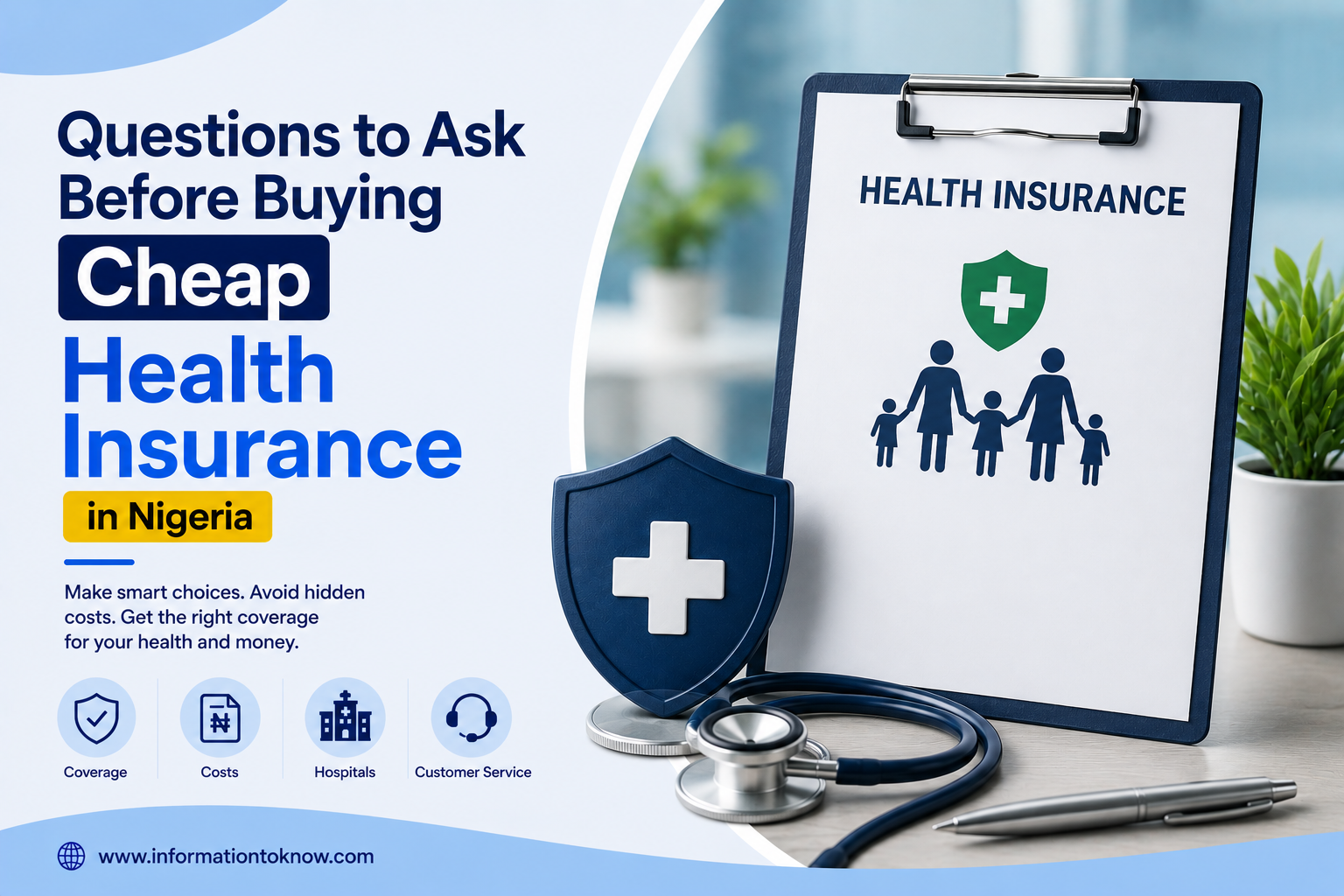
Cheap health insurance in Nigeria is not the problem; uninformed cheapness is. A low-premium plan can be one of the smartest money moves you make this year or a monthly deduction that quietly does nothing the day you actually need it. The difference comes down to the questions you ask before you pay. Get them right, and a ₦20,000-a-year plan can genuinely protect you. Skip them, and you’ll discover the hard way, at a hospital cash point, that your cover ran out three tests ago.
This guide walks you through exactly what to ask, why each question matters, and how to spot a plan that will fail you. No jargon, no sales talk. Let’s get into it.
Jump To
Why These Questions Matter More Than the Price
Here’s the short version: the stakes are high, and a cheap plan’s limits are easy to miss.
Health bills in Nigeria are brutal when you’re paying out of pocket. A single hospital admission for something like a complicated childbirth or a road accident can run from ₦600,000 to over ₦3,000,000 in private hospitals. Even routine care bites: a BusinessDay survey found malaria treatment topping ₦100,000 and serious hepatitis cases exceeding ₦150,000 in standard hospitals.
That’s why so many households get pushed into debt by illness. Out-of-pocket payments still make up a huge share of health spending in Nigeria. 58.3% according to the government’s National Health Accounts 2023–2024, and nearly 75% according to World Bank figures, and is among the highest rates in the world.
Insurance is meant to absorb that shock. But a cheap plan only absorbs as much as its limits allow, and those limits are exactly what the questions below are designed to expose.
What Cheap Health Insurance Actually Means in Nigeria
Cheap health insurance in Nigeria usually means a basic individual HMO plan with a low premium and, crucially, a low annual benefit limit.
To put real numbers on it: as of January 2025, the ten cheapest individual HMO plans ranged from roughly ₦18,500 to ₦50,000 per year, with some (like Reliance’s basic plan) starting around ₦3,500 a month. By 2026, basic individual outpatient plans broadly sit in the ₦30,000–₦80,000-a-year range, though exact pricing varies by HMO.
Here’s how it works. You pay a premium (monthly or yearly) to a Health Maintenance Organisation (HMO). In return, the HMO covers agreed treatments at hospitals in its network up to a maximum amount per year, called your annual benefit limit. Cheap plans keep the premium low by keeping that limit low and the network and benefits narrow.
One more thing worth knowing: cover is no longer optional on paper. The NHIA Act 2022 makes health insurance mandatory for all Nigerians and legal residents and requires employers with five or more staff to enrol their employees. As the NHIA’s Director-General, Dr. Kelechi Ohiri, puts it, the whole idea is solidarity: “those who are well subsidise those who are sick.” Yet coverage is still thin; only about 13% of Nigerians were enrolled by the end of 2025, up from just 7% before the Act.
So if you’re shopping for a cheap plan, you’re doing the right thing. Just do it with your eyes open.
The 10 Questions to Ask Before You Pay for Cheap Health Insurance in Nigeria
Ask every one of these out loud, to the agent or HMO rep before money changes hands. If they can’t answer clearly, that’s your answer.
1. What Is the Annual Benefit Limit, and What Happens When It Runs Out?
This is the single most important question, so ask it first: how much will the plan actually pay for your care in one year?
Cheap plans are cheap largely because this cap is low. As one comparison platform bluntly notes:
“Individual basic plans are often surprisingly affordable, but the cap on annual benefits is also low, which means a single hospitalisation can exhaust the limit.”
Line that up against the ₦600,000–₦3,000,000 a private admission can cost, and you see the risk: your cover can be swallowed by one bad week.
Follow up with: What happens after the limit is reached? On most plans, you simply pay the rest yourself. Know that number before you rely on the plan.
2. Exactly Which Hospitals Are in the Network, and Are They Near Me?
A cheap plan is only useful if you can reach a hospital that accepts it.
HMO plans work on a network; you get cashless treatment only at listed facilities, except in genuine emergencies. Cheap plans often have the smallest networks, sometimes skewed to lower-tier clinics. Ask for the full, current list in writing, then check that at least one or two hospitals you’d actually trust are on it and close to where you live and work. If none of the hospitals you’d want to use are covered, the low premium is a false economy.
3. What’s Excluded, Capped, or Sub-Limited?
Assume something you care about is excluded until proven otherwise; then ask what.
Every plan carves out exclusions and sets sub-limits (a smaller cap within your overall limit) on specific services. Maternity, surgery, chronic-disease management, dental, optical, and certain drugs are the usual suspects on cheap plans. A plan can advertise “comprehensive” cover and still cap dental at a token amount or exclude a scan you’ll likely need. Ask for the exclusions list and every sub-limit, in writing, and read it before you pay.
4. What Are the Waiting Periods, Especially for Pre-Existing Conditions and Maternity?
A waiting period is how long you must hold the plan before certain benefits actually work, and cheap plans lean on them heavily.
Typical periods in the Nigerian market, according to Avon HMO and others, look like this:
NB: The figures below are typical market ranges; confirm the exact periods on your specific plan.
NB: Slide left to view the table if you’re on mobile.
| Benefit | Typical waiting period |
|---|---|
| General/outpatient benefits | 30 days |
| Surgery, non-emergency admission | 3–6 months |
| Maternity | 9–12 months |
| Pre-existing & chronic conditions | 12 months (or excluded) |
| Dental, optical | 6 months |
If you’re planning a pregnancy or managing a chronic condition, this question outranks price. A plan that excludes your pre-existing condition or won’t cover maternity for a year may be worthless to you regardless of how little it costs.
5. How does the Plan Handle Authorization Codes and claims, and How Fast?
Ask how you actually get treated on a bad day, because this is where cheap cover most often breaks down.
This isn’t a theoretical worry. In the NHIA 2024 report, the NHIA sanctioned 47 HMOs and handled 3,507 complaints, 1,232 of them against HMOs, with the top issues being delays or denials of referral authorisation codes and slow payments to hospitals. Enrollees regularly report waiting hours for approval codes or being told a drug isn’t on the list.
So ask: how are authorisation codes issued, how fast, and who do I call at 2am? For reference, NIIRA 2025 requires NAICOM-licensed insurers to settle admitted claims within 60 days; HMOs are regulated separately by the NHIA but are expected to align with comparable timelines. Get the HMO’s own written claims turnaround.
6. Is the HMO NHIA-Accredited, and Has It Been Sanctioned?
Only buy from an HMO licensed by the National Health Insurance Authority, and don’t stop at licensed.
Nigeria had approximately 84 NHIA-accredited HMOs as of early 2025, but as the sanctions figure above shows, accreditation alone isn’t a clean bill of health. Verify the HMO on the NHIA register and ask whether it has faced sanctions or unresolved complaints. Accreditation is the floor, not the finish line.
7. Is It a Fee-for-Service or Capitation Plan, and How Do Referrals Work?
Ask which model the plan runs on, because it decides how freely you can move through the system.
Under capitation, you’re tied to an assigned primary hospital and must go through a referral chain to see specialists. Under fee-for-service, there’s often more flexibility, but potentially more approvals per service. Neither is automatically better, but not understanding yours is how people end up stuck at the wrong hospital or hearing “you need another approval” mid-treatment. Ask how referrals and specialist access actually work on your plan.
8. What Does Renewal Cost, and How Will Premiums Change?
Cheap in year one doesn’t mean cheap forever; ask about renewal before you commit.
Premiums move, and drug and treatment costs have been pushing them up across the sector. Ask what the renewal price is expected to be, how much it can rise, and whether your premium changes as you age or as you claim. A plan you can’t sustainably afford every year isn’t really protecting you.
9. What Happens if I Switch HMOs Later?
If you might change HMOs down the line, ask what you’d lose, because switching is rarely clean.
You can usually switch at the end of your annual cycle, but switching almost always resets your waiting periods on the new plan and can mean a new hospital network and ID number. That reset is where most Nigerians get caught out. If you’re only trying a cheap plan to test the waters, factor in that leaving isn’t free.
10. Can I See the Full Benefit Schedule in Writing Before Paying?
Finally, insist on the paperwork; never buy off a brochure headline.
Ask for the complete benefit schedule: the annual limit, all sub-limits, exclusions, waiting periods, the hospital network list, and the claims process. A trustworthy HMO or agent hands this over without fuss. If they dodge, stall, or say “don’t worry about all that,” walk away. The document is the only version of the plan that counts when you’re sick.
Cheap Plan vs Paying Out of Pocket: How to Do the Math
The honest way to decide is to compare your premium against what you’d realistically spend and against a worst-case bill.
Work it in three quick steps:
- Estimate your normal year. Add up your typical annual health spend — consultations, malaria episodes, tests, routine drugs.
- Add a worst case. Pick one realistic emergency (an admission, a surgery, a delivery) and its likely cost.
- Compare that to the premium and the benefit limit. A cheap plan wins when its premium is low, and its limit is high enough to blunt that worst case.
| Scenario | Out of pocket | Cheap HMO plan |
|---|---|---|
| Routine year (consults, malaria, tests) | You pay every bill in full | Covered up to plan limits, minus any co-payments |
| One serious admission (₦600k–₦3m) | You pay the full bill | Covered only up to the annual limit; you pay the rest |
| Predictability | None; bills arrive unplanned | Fixed premium; capped exposure |
The takeaway: a cheap plan with a realistic benefit limit beats paying out of pocket for most people. A cheap plan with a tiny limit just changes when the big bill hits you, not whether it does.
Red Flags That a Cheap Plan Will Fail You
If you spot these while asking your questions, treat them as a stop sign:
- No written benefit schedule. If you can’t get the limits, sub-limits, and exclusions on paper, you don’t know what you’re buying.
- A vague or unavailable hospital list. “Plenty of hospitals nationwide” is not a network list.
- “Everything is covered.” No cheap plan covers everything. This phrase signals either ignorance or a sales pitch.
- Not on the NHIA register. No accreditation, no deal.
- No clear claims or authorisation process. If they can’t explain how you get an approval code, expect delays when it counts.
- Pressure to pay immediately. A plan worth buying will still be there after you’ve read the document.
Your Next Move: Vet One Plan This Week
Don’t leave this as theory. Pick one cheap plan you’re considering and put it through the ten questions above, starting with the annual benefit limit and the written benefit schedule.
If the HMO answers clearly, is on the NHIA register, covers a hospital you trust, and hands over the document without fuss, you’ve likely found a cheap plan worth buying. If it dodges even two or three of those questions, keep looking. The right move isn’t spending more; it’s refusing to pay for cover you haven’t verified.
Found this useful? Share it with someone who’s about to sign up for a plan, and drop your own HMO experience in the comments; it might save the next reader from a costly mistake.
Frequently Asked Questions
Is cheap health insurance worth it in Nigeria?
Yes. If you’ve checked what it actually covers. A cheap plan is genuinely useful for routine care and small emergencies, but only worth buying once you’ve confirmed the annual benefit limit, hospital network, exclusions, and waiting periods in writing. Cheap and uninformed is where people lose money.
How much does cheap health insurance cost in Nigeria?
As of January 2025, the ten cheapest individual HMO plans ranged from roughly ₦18,500 to ₦50,000 per year, with some starting around ₦3,500 per month. In 2026, basic individual outpatient plans broadly run ₦30,000–₦80,000 a year, though exact prices vary by HMO.
What is an annual benefit limit and why does it matter?
It’s the maximum amount your HMO will pay for your care in a year. Cheap plans usually have low caps, and a single serious hospital admission, which can cost ₦600,000 to over ₦3,000,000 in a private hospital, can exhaust that cap, leaving you to pay the rest yourself.
What are the waiting periods on Nigerian HMO plans?
Waiting periods are the time you must wait before certain benefits are usable. Typically, general benefits start after about 30 days, surgery after 3–6 months, maternity after 9–12 months, and pre-existing conditions after around 12 months (or are excluded entirely). Always confirm these before paying.
Are pre-existing conditions covered by cheap plans?
Often not immediately. Pre-existing conditions usually carry about a 12-month waiting period, and some plans exclude them outright. If you have a chronic condition, this question matters more than the price.
How do I check if an HMO is accredited in Nigeria?
Confirm the HMO is licensed by the National Health Insurance Authority (NHIA) using its accreditation register at nhia.gov.ng. Nigeria had roughly 84 NHIA-accredited HMOs as of early 2025, but the NHIA also sanctioned 47 HMOs in 2024, so accreditation alone isn’t enough; check standing too.
Why do HMOs deny claims or delay treatment in Nigeria?
The most common issues are delays or denials of referral authorisation codes and slow payments to hospitals. In its 2024 report, the NHIA handled 3,507 complaints, 1,232 of them against HMOs. Ask exactly how authorisation codes are issued and how fast, before you enrol.
Is health insurance compulsory in Nigeria?
Yes. The NHIA Act 2022 makes health insurance mandatory for all Nigerians and legal residents, and employers with five or more staff are required to enrol their employees.
What’s the difference between an HMO and paying out of pocket?
With an HMO, you pay a fixed premium and the HMO covers agreed care up to a limit; out of pocket, you pay each bill in full yourself. Out-of-pocket spending still accounts for between 58% and over 75% of Nigeria’s health spending, depending on the data source — among the highest in the world — which is exactly the risk insurance is meant to reduce.
What does a basic HMO plan usually cover?
Basic plans typically cover general consultations, common lab tests, prescribed drugs, and some emergency and inpatient care, but with low limits and notable exclusions. Get the full benefit schedule in writing rather than relying on the brochure headline.
Can I switch HMOs later if I’m unhappy?
Yes, usually at the end of your annual cycle, but switching almost always resets your waiting periods on the new plan, and you may get a new hospital network and ID number. That reset is where many Nigerians get caught out, so factor it in before choosing.
Fee-for-service or capitation: which is better for a cheap plan?
Neither is automatically better; they just work differently. Capitation ties you to an assigned primary hospital and referral chain, while fee-for-service can be more flexible but may involve more approvals. Ask which model your plan uses and how referrals work, so you’re not surprised at the point of care.
How fast must an HMO pay a claim in Nigeria?
NIIRA 2025 requires NAICOM-licensed insurers to settle admitted claims within 60 days. HMOs are regulated separately by the NHIA and are expected to align with comparable timelines, so ask the HMO for its own written claims and reimbursement timeframe.
What should I get in writing before buying?
Ask for the full benefit schedule: the annual limit, sub-limits, exclusions, waiting periods, the hospital network list, and the claims/authorisation process. Never buy a plan based only on a headline price or a marketing brochure.
Does a cheaper premium mean worse care?
Not necessarily, but it usually means a lower benefit cap, a smaller network, and stricter exclusions. The goal isn’t to avoid cheap plans; it’s to choose the cheap plan whose limits genuinely fit your health needs and budget.