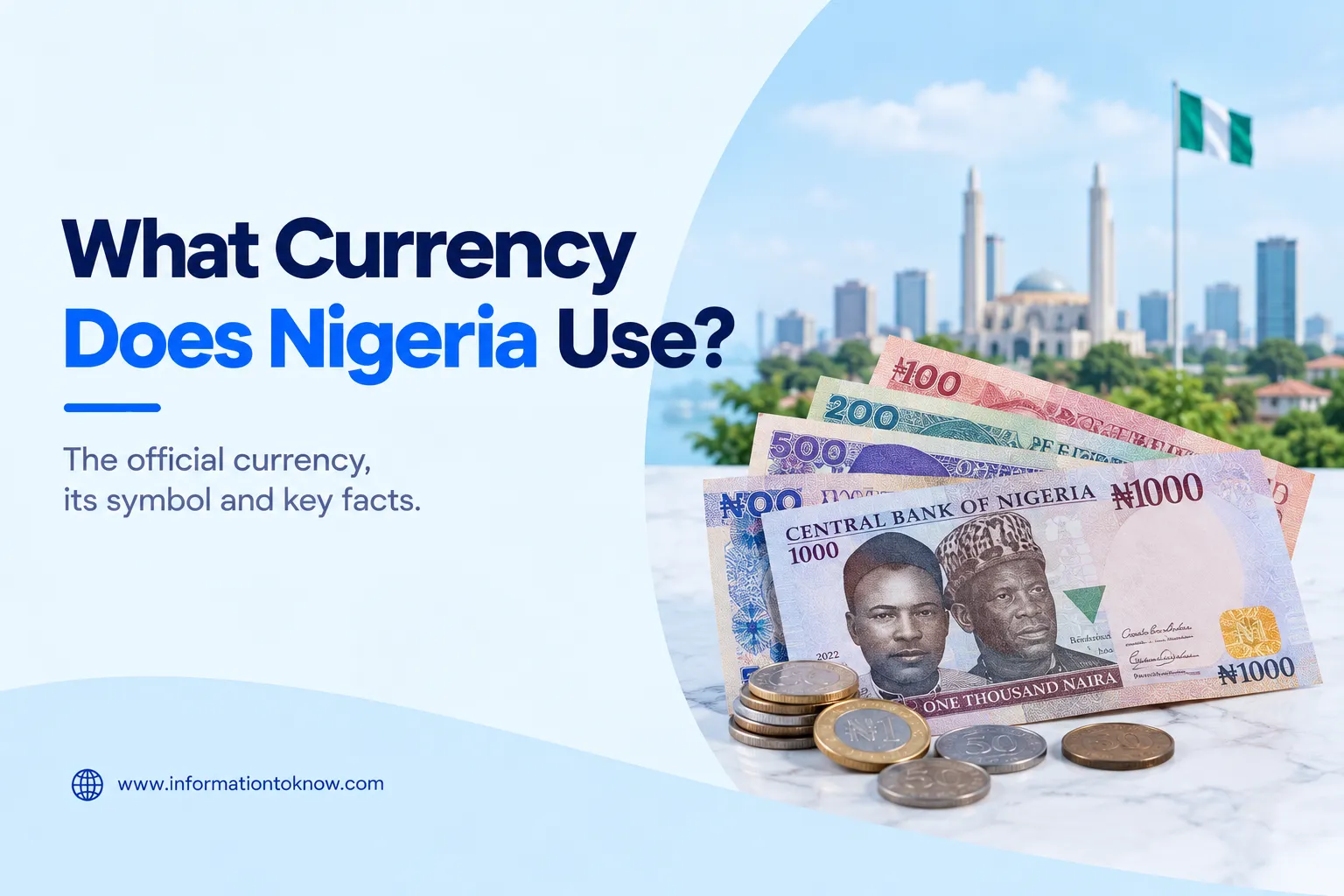
Nigeria uses the Nigerian naira, written with the symbol ₦ and the international code NGN. One naira is divided into 100 kobo, and it is issued by the Central Bank of Nigeria. It is the only legal tender across all 36 states and the Federal Capital Territory.
If you’re asking this question, you’re probably about to travel, send money home, or exchange some cash, so you don’t just need the name of the currency; you need to know what it’s actually worth and how to handle it. This guide gives you both the plain facts about the naira and the reality of its notes, its value, and how money really works on the ground in Nigeria.

Jump To
The Short Answer
Nigeria’s currency is the naira (₦), with the currency code NGN. As reference sources such as Britannica confirm, the naira is the monetary unit of Nigeria and is divided into 100 kobo. It is the sole accepted currency for payments throughout the country.
The Naira Symbol (₦) and Code (NGN)
The naira is written as ₦, and its ISO code is NGN. According to the Nigerian naira reference record, the currency sign is U+20A6 ₦, and the name itself is homegrown. Naira was coined from the word “Nigeria” by the statesman Obafemi Awolowo. In writing, you’ll see amounts shown as ₦500 or 500 naira, and bank statements still use kobo as the two decimal places (for example, ₦1,250.50 is one thousand two hundred and fifty naira, fifty kobo).
Naira Notes and Coins in Circulation
In everyday life, you will only ever handle banknotes. The banknotes in circulation are ₦5, ₦10, ₦20, ₦50, ₦100, ₦200, ₦500 and ₦1,000, while the coins still classed as legal tender — 50 kobo, ₦1 and ₦2 — are rarely used.
NB: Slide left to view the table if you’re on mobile
| Type | Denominations |
|---|---|
| Banknotes | ₦5, ₦10, ₦20, ₦50, ₦100, ₦200, ₦500, ₦1,000 |
| Coins (legal tender, rarely used) | 50 kobo, ₦1, ₦2 |
This set of denominations is confirmed in the Nigerian naira reference record.
Here’s the practical reality most guides skip: coins and kobo have effectively vanished from daily use. As the purchasing value of the naira has fallen over the years, the kobo is no longer commonly encountered, and coins are hard to come by, while the lower naira denominations have become impractical for most purchases. If you’re picturing pocketfuls of coins, don’t; expect notes and, increasingly, digital payments.
A Quick History of Nigeria’s Currency
The naira is younger than many assume. It was introduced on 1 January 1973, replacing the Nigerian pound. According to the Central Bank of Nigeria, the one naira — equivalent to ten shillings under the old system — became the major unit, while the kobo became the minor unit, one hundred of which make one naira. The changeover happened at a rate of £1 to ₦2 and, as the naira’s historical record notes, it made Nigeria the last country in the world to abandon the old pounds-shillings-pence system. In other words, the 1973 switch was as much a break from Nigeria’s colonial monetary past as a practical modernisation.
Who Issues and Controls the Naira?
Only one institution can legally create naira. As Britannica notes, the Central Bank of Nigeria has the sole authority to issue banknotes and coins. The CBN — whose broader role you can read about in our guide to the functions of the Central Bank of Nigeria — also manages monetary policy, inflation, and the currency’s value. The notes and coins themselves are produced by the Nigerian Security Printing and Minting Company (NSPMC), also called The Mint, which is the currency’s official printer and mint. That combination — a single issuer plus a national mint — is what keeps the naira a controlled, sovereign currency.
What Is the Naira Worth Today? (Dollar to Naira Exchange)
The dollar-to-naira exchange rate is a popular question among people who have dollars and want to exchange their money. There is no constant exchange rate for the dollar to naira because the rate is always fluctuating.
Read: Best Cross-Border Payment Companies in Nigeria (Updated)
The 2023 Naira Redesign and Cash Crisis
If you were in Nigeria in early 2023, you lived through one of the currency’s most turbulent chapters. In late 2022, the CBN redesigned the ₦200, ₦500, and ₦1,000 notes and moved to swap out the old ones quickly, which triggered a severe cash crisis. The squeeze was dramatic: according to currency-in-circulation data drawn from CBN figures, the amount of cash in circulation fell from ₦3.3 trillion on 31 October 2022 to ₦1.54 trillion on 31 January 2023 — a drop of about 53% — as people rushed to deposit old notes before the deadline.
The courts stepped in. Africanews reported that on 3 March 2023, the Supreme Court faulted the CBN’s redesign policy and ruled that the old ₦200, ₦500 and ₦1,000 notes would remain legal tender until 31 December 2023. The episode is a useful reminder for anyone holding naira: policy on notes can change fast, so keep an eye on official CBN announcements.
The eNaira — Nigeria’s Digital Currency
Nigeria also has a digital version of its money. The eNaira is the digital form of the naira, issued by the CBN and launched on 25 October 2021 as Africa’s first central bank digital currency, holding a fixed 1:1 value with physical cash. In theory, it works alongside cash, card, and mobile payments.
In practice, hardly anyone uses it. Tekedia reports that as of March 2024, the eNaira made up less than 1% of the total currency in circulation — ₦13.98 billion out of ₦3.87 trillion, or about 0.36%. An IMF study found that 98.5% of eNaira wallets were unused a year after launch. For now, if you’re spending money in Nigeria, physical naira and everyday bank and mobile apps matter far more than the eNaira.
Using and Exchanging Money in Nigeria (Practical Tips)
The naira is the only currency you can actually pay with. It is accepted for every kind of payment across all 36 states and the Federal Capital Territory.
Here are a few practical pointers:
- Expect two rates. The official bank rate and the parallel black market rate differ, and the parallel rate usually carries a premium; factor that in when budgeting.
- Change money through official channels. With a persistent gap between the official and parallel rates, you should only change money through a bank or a licensed bureau de change rather than a street dealer. Nigeria’s commercial banks and licensed operators are the safer route.
- Cards and transfers work in cities, and mobile money and fintech apps are widely used, but carry some cash, especially outside urban areas.
- Converting naira back is the hard part. It is far easier to change dollars or euros into naira than to change surplus naira back into hard currency, so only convert what you’ll realistically spend.
Check the Live Rate Before You Change a Naira
The bottom line hasn’t changed since the top of this page: Nigeria uses the naira (₦, NGN), split into 100 kobo and issued by the Central Bank of Nigeria. What does change — sometimes by the day — is what it’s worth.
So before you act, do these three things:
- Check today’s official rate from a reputable source rather than assuming last year’s number,
- Exchange only through a bank or licensed operator, and
- Keep a mix of smaller notes for everyday spending since coins and kobo are effectively out of use.
Get those right, and you’ll handle Nigerian money like a local.
Frequently Asked Questions on Nigerian Currency
What currency does Nigeria use?
Nigeria uses the Nigerian naira, symbol ₦, and ISO code NGN. It is the country’s only legal tender and is used across all 36 states and the Federal Capital Territory.
What are the symbol and code for the naira?
The symbol is ₦ and the international currency code is NGN. One naira is divided into 100 kobo.
How many kobo make one naira?
100 kobo make one naira, just as 100 cents make a dollar. In practice, Kobo has effectively disappeared from everyday use because almost nothing is priced below ₦1.
What are the current naira banknotes and coins?
Banknotes in circulation are ₦5, ₦10, ₦20, ₦50, ₦100, ₦200, ₦500, and ₦1,000. Coins (50 kobo, ₦1, and ₦2) are technically legal tender but are almost never used.
Who issues and controls the Nigerian naira?
The Central Bank of Nigeria (CBN) is the sole authority that issues naira notes and coins and sets monetary policy. The notes are printed by the Nigerian Security Printing and Minting Company (The Mint).
When was the naira introduced?
The naira was introduced on 1 January 1973, replacing the Nigerian pound at a rate of £1 to ₦2. This made Nigeria the last country in the world to move off the old pounds-shillings-pence system.
Why did the naira lose so much value?
In June 2023, the CBN floated the naira, ending its dollar peg; the currency then fell sharply — dropping over 50% in early February 2024 — before stabilising somewhat in 2026 as external reserves recovered. Persistent inflation (about 15.4% in August 2026) also erodes its purchasing power.
What is the difference between the official and black-market rate?
The official (NFEM) rate is the CBN-supervised bank rate; the parallel or black-market rate is what street and informal dealers charge, usually at a premium.
What was the 2023 naira redesign and cash crisis?
In late 2022, the CBN redesigned the ₦200, ₦500, and ₦1,000 notes and tried to swap out the old ones quickly, causing a severe cash shortage. Currency in circulation fell from ₦3.3 trillion to ₦1.54 trillion, and the Supreme Court ruled that old notes stayed legal tender until 31 December 2023.
What is the eNaira?
The eNaira is Nigeria’s central bank digital currency (CBDC), launched in October 2021 as Africa’s first. It holds a 1:1 value with the physical naira, but adoption has stayed very low, at under 1% of the currency in circulation.
Can I use US dollars or cards in Nigeria?
The naira is the only legal tender, though dollars are sometimes accepted in hotels and at airports at poor rates. Cards and bank transfers work widely in cities, but carrying some naira cash is wise, especially outside urban areas.