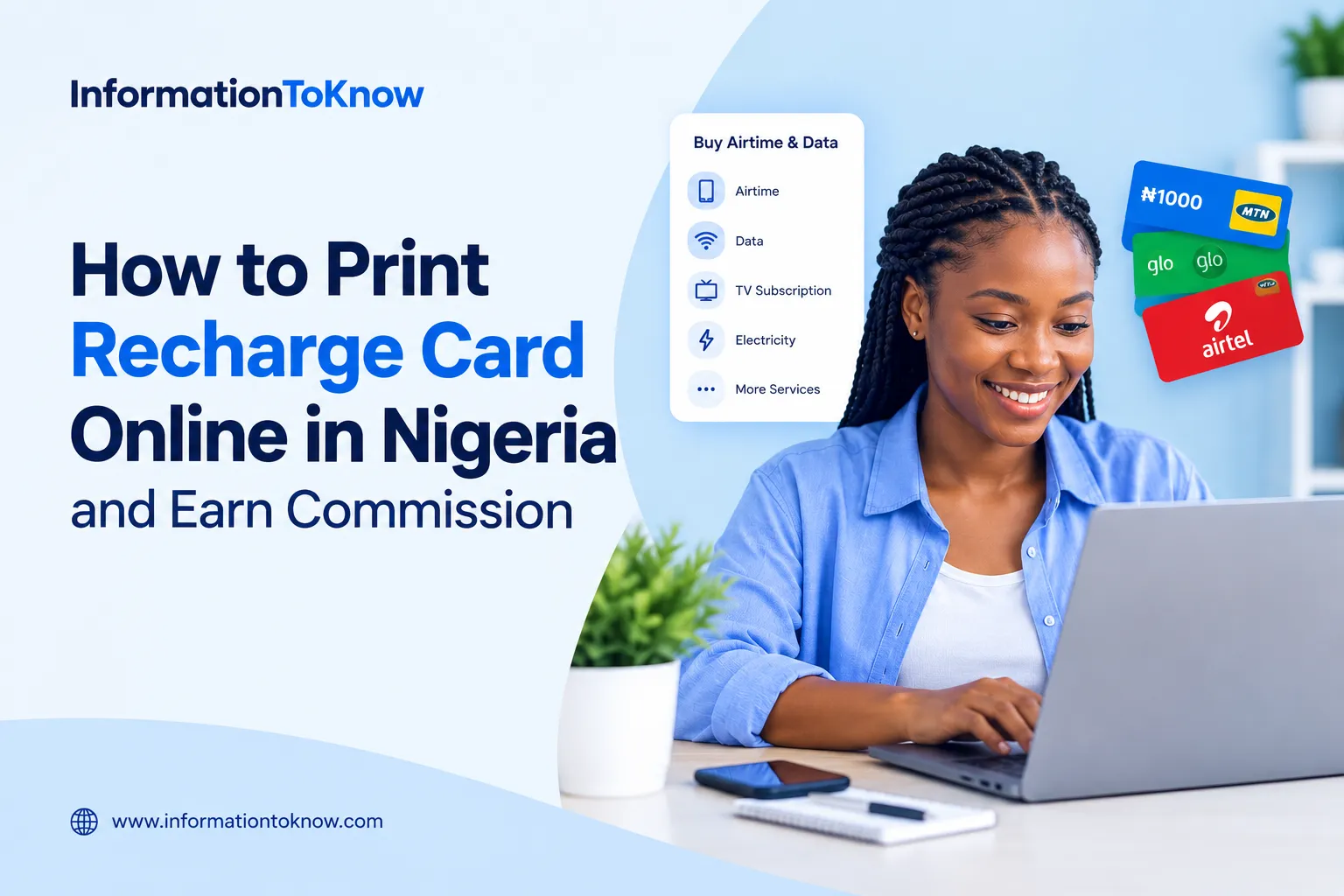
You print recharge cards online in Nigeria by registering on a licensed VTU or e-pin platform, funding a wallet, generating airtime PINs (e-pins), decrypting them with recharge-card printing software, then printing them on a small Bluetooth or A4 printer and reselling them. On every sale, you keep a commission of roughly 2–5%. That is the whole business in one sentence, and this guide walks you through each step, the tools and capital you need, the platforms to use, how much you can realistically earn, and how to avoid the scams that catch beginners.
Whether you want to top up your own line without leaving the house or build a side income you can run from your phone, everything you need is below.
Jump To
What Printing Recharge Cards Online Really Means (And the VTU Shift)
Printing recharge cards online means generating airtime PINs digitally and printing them as scratch cards you can resell. In recent years, most agents earn the same commission faster through VTU, with no printing at all.
Here are the three terms that matter:
- Recharge card: a printed voucher with a hidden PIN. The customer scratches it and loads the airtime themselves using a USSD code (for example
*555*PIN#). - E-pin (ePIN): the raw digital PIN you buy in bulk from a platform. Printing software turns e-pins into scratch cards.
- VTU (Virtual Top-Up): you credit a customer’s line directly from your wallet; no card, no scratching, no printing. The customer just gets an airtime alert.
Both methods pay you a commission. The difference is overhead: physical printing needs a printer, paper, and software, while VTU needs only your phone.
Is the Recharge Card Business Still Worth It?
Yes. The demand is enormous and recurring, but treat it as a volume-and-margin business, not a get-rich-quick scheme.
The customer base is about as large as it gets. According to Nigerian Communications Commission (NCC) data published on Vanguard, Nigeria’s active telecom subscriptions rose to 179.64 million by the end of December 2025, with MTN leading with 93.06 million subscribers (51.87%), Airtel with 60.89 million (33.94%), Globacom with 22.23 million (12.39%), and T2 with 3.23 million (1.80%). Every one of those lines needs airtime or data again and again, which is why there is always a buyer nearby.
Demand keeps climbing, too; active mobile lines reached about 182.23 million by January 2026, roughly 13 million more than a year earlier. The honest caveat: physical card printing is not the goldmine it once was. Nairametrics reports that the recharge card business is fizzling as fintechs and banks take control. One Lagos vendor who once cleared about ₦3,000 profit a day now hardly sells ₦1,000 worth of cards daily, because customers increasingly top up straight from their bank and fintech apps. That is exactly why choosing the right method — printing vs. VTU — matters.
Recharge Card Printing vs. VTU: Which Should You Choose?
Choose physical printing if your customers still want scratch cards (roadside kiosks, markets, rural areas); choose VTU if you want the lowest overhead and fastest turnaround. Many agents do both.
NB: Slide left to view the table if you’re on mobile.
| Factor | Physical Recharge Card Printing | VTU (Virtual Top-Up) |
|---|---|---|
| Equipment needed | Printer, paper, printing/decryption software | Just a phone or laptop |
| Startup cost | Higher (printer + software) | Very low |
| Best for | Markets, kiosks, customers who prefer cards | Anyone: friends, coworkers, WhatsApp customers |
| Speed per sale | Slower (print, hand over) | Instant credit |
| Commission | Same 2–5% range | Same 2–5% range |
If you are not sure, start with VTU because it costs almost nothing to test, then add printing once you have steady demand for physical cards. It also helps to understand related telco features your customers use, like how to transfer airtime between lines.
Tools and Capital You Need to Get Started
You need surprisingly little: a phone or laptop, internet, a printer (only if you will print physical cards), paper, printing software, a valid email, and some starting capital for e-pins.
Here is the full checklist:
- Smartphone or laptop — to access the platform, receive e-pins, and print or run VTU.
- Stable internet connection — needed to buy e-pins and manage your wallet.
- Valid email address — e-pins are usually delivered to your email.
- A printer (for physical cards) — a mini Bluetooth printer costs around ₦18,000–₦30,000 in online shops and is ideal for street-side vendors, while a laptop lets you print e-pins on A4 paper using any office printer.
- A4 or thermal paper — for the printouts.
- Printing/decryption software — to convert encrypted e-pins into printable cards.
- Starting capital — to buy your first batch of e-pins.
A rough starting budget:
NB: Slide left to view the table if you’re on mobile.
| Item | Approximate cost |
|---|---|
| First batch of e-pins | ₦5,000–₦20,000 |
| Mini Bluetooth printer (optional) | ₦18,000–₦30,000 |
| A4/thermal paper | ₦1,000–₦3,000 |
| Software activation (if required) | Varies by vendor |
If you only run VTU, you can realistically start with just your phone and a small wallet top-up.
How to Print Recharge Card Online Step by Step
The process is the same on most platforms: register, fund your wallet, generate the pins, decrypt, print, then sell. Here it is in order:
- Pick a reputable platform (see the next section) and create an account with your name, phone number, and email.
- Verify your account using the OTP or email link.
- Fund your wallet. Most platforms accept bank transfer, card, or USSD; you add funds from your dashboard, and reputable platforms credit your wallet almost instantly.
- Select the network, denomination, and quantity. Go to the recharge-card menu, choose the network (MTN, Airtel, Glo, or T2), pick the amount (₦100, ₦200, ₦500, and so on), enter how many pieces you want, and submit.
- Generate the e-pins. They are created instantly and usually emailed to you in encrypted form.
- Decrypt with printing software. Upload the e-pins into your recharge-card software, which turns them into readable, printable cards.
- Print. Use a mini Bluetooth printer from your phone, or print on A4 from a laptop.
- Sell to customers directly, or supply small vendors around you in bulk.
Prefer to skip printing entirely? Choose VTU on the same platform, enter the customer’s number and amount, and their line is credited instantly.
Best Websites and Apps to Print Recharge Cards and Earn Commission
The best platform is a reputable, established one with instant wallet funding, all four networks, transparent commission, and responsive support. Popular names include eBills.Africa, VTpass, Pairgate, SubBase, MobileVTU, and Airvend, among others.
Rather than chasing whichever site promises the cheapest pins, judge a platform on:
- Track record and reviews — how long it has operated and what agents say.
- Instant funding and delivery — your money and pins should reflect quickly.
- Coverage — MTN, Airtel, Glo and T2 (9mobile) all in one place.
- Transparent commission — you should see the exact rate before you buy.
- Support — a real channel to reach when a transaction fails.
To fund your wallet, you will often use everyday payment apps; if you want to understand your options, see our guides to the top fintech companies in Nigeria and mobile money operators.
How Much You Can Earn (Realistic Commission Math)
Expect a commission of about 2–5% per transaction. So on ₦100 of airtime, you keep roughly ₦2–₦5. The money comes from volume, not from any single sale.
Do the math honestly. If you sell ₦100,000 of airtime in a month at a 3% commission, you earn ₦3,000. Sell ₦1,000,000, and you earn ₦30,000. That is why location, reliability, and a growing customer list matter far more than the billions-per-day hype you will see elsewhere. An active VTU agent in Nigeria can make between ₦10,000 and ₦100,000 or more per month, depending on the volume of sales and commission structure.
Two practical notes: commission rates differ by platform and network, so confirm the current rate before you buy, and remember your real profit is commission minus any paper, printing, and data costs.
How to Avoid Recharge Card and E-pin Scams
The golden rule: never send money to an unverified dealer, especially one promising unusually cheap pins. Use regulated, established platforms and guard your PIN security.
Beginners lose money in a few predictable ways, so protect yourself:
- The vanishing dealer. A well-known pattern is a dealer who promises to email cheap pins wherever you are, then disappears the moment you pay; so never pay an unknown seller you have not verified in person or through strong, independent reviews.
- Too cheap to be true pins. Prices far below the going rate are bait. Legitimate margins are thin, so absurdly cheap pins usually mean fraud.
- Free-software traps. “Universal recharge card software free download” offers often hide paid activation codes or malware. Get software only from the platform you are actually buying pins from.
- Guard your PIN’s security. Bulk e-pins are sent in encrypted (PGP) form protected by a passphrase; treat that passphrase like cash, because your pins are your capital.
- Log out of shared devices. If you print at a cybercafé, always log out of your email so the next person cannot grab your PINs.
How to Grow and Formalise Your Recharge Card Business
Once sales are steady, grow by adding products, recruiting sub-vendors, marketing consistently, and formalising the business.
Practical ways to scale:
- Add data and bill payments. Data demand is booming; internet usage in Nigeria rose to over 1.38 million terabytes by January 2026, so selling data, cable TV, and electricity tokens through the same wallet multiplies your income per customer.
- Supply sub-vendors. Sell printed cards in bulk to smaller kiosks and take a slice of their volume.
- Market where people are. A fixed spot near a busy junction, plus WhatsApp status updates, keeps you top of mind.
- Register with CAC. As you grow, registering your business with the Corporate Affairs Commission makes it more credible and easier to bank. See our guide on how to register your business with CAC.
- Layer in agent banking. Many recharge sellers also run cash-in/cash-out services; if that interests you, read how to start a POS business in Nigeria.
Start Printing and Earning Today
You now have the full playbook: register on one reputable platform, fund a small test wallet, generate a handful of e-pins, and either print them or run VTU. The core takeaway is simple: this is a low-cost, high-demand business where your earnings track your sales volume and your reliability, not luck.
Your concrete next step: pick a single trusted platform today, load a small amount you can afford to lose, sell to the people already around you — family, coworkers, your street — and reinvest your first commissions to grow. Start small, stay consistent, and let the volume build.
Frequently Asked Questions on Printing Recharge Cards Online
How do I print recharge cards online in Nigeria?
Register on a licensed VTU/e-pin platform, fund your wallet, choose the network, denomination, and quantity, generate the e-pins, decrypt them with recharge-card printing software, then print them on a Bluetooth thermal or A4 printer and sell.
How much do I need to start a recharge card printing business?
You can start small — roughly ₦5,000–₦20,000 covers your first batch of e-pins and paper if you already own a phone. A mini Bluetooth printer costs about ₦18,000–₦30,000, and an A4 office printer also works.
How much commission can I earn?
Most platforms pay agents about 2%–5% (commonly 3–3.5%) per transaction, so you keep roughly ₦3–₦5 on every ₦100 of airtime. Active agents typically earn ₦10,000–₦100,000 or more a month depending on volume.
Is recharge card printing still profitable in 2026?
Yes, but it is a volume business, not a windfall. Demand is huge — Nigeria had about 179.6 million active mobile lines at the end of 2025 — but margins are thin, and many agents now earn faster through VTU than through physical card printing.
What is the difference between a recharge card and VTU?
A recharge card is a printed scratch card with a hidden PIN that the customer loads manually. VTU (virtual top-up) credits a customer’s line directly with no card or PIN. Both earn you commission; VTU has almost no printing overhead.
Can I print recharge cards with just my phone?
Yes. Register on a platform’s app or mobile site, fund your wallet, generate e-pins, then connect a mini Bluetooth printer to print — or run VTU with no printer at all.
What tools do I need to print recharge cards?
A smartphone or laptop, stable internet, a valid email, a printer (Bluetooth thermal or A4), paper, recharge-card printing/decryption software, and starting capital to buy e-pins.
What is universal recharge card printing software, and is it free?
It is software that decrypts and prints bulk e-pins (usually sent in encrypted PGP format). Some can be downloaded for free but require a paid activation code. Be cautious: “free download” offers are a common scam hook.
Where can I buy bulk e-pins safely?
Buy only from reputable, established platforms or verified dealers. Never send money to an unknown dealer promising unusually cheap pins by email; that is a well-known scam pattern.
Which networks’ recharge cards can I print?
All major Nigerian networks — MTN, Airtel, Glo and T2 (formerly 9mobile). MTN and Airtel have the largest subscriber bases, so they usually sell the fastest.
Do I need to register my recharge card business with CAC?
Not to start small. But once you grow, supply sub-vendors or open a shop, registering with the Corporate Affairs Commission (CAC) makes the business more credible and easier to bank.
How do I find customers for my recharge cards?
Start with people around you — family, coworkers, students, your street — then use WhatsApp status and a fixed selling spot near a busy area. Reliability and availability keep customers coming back.