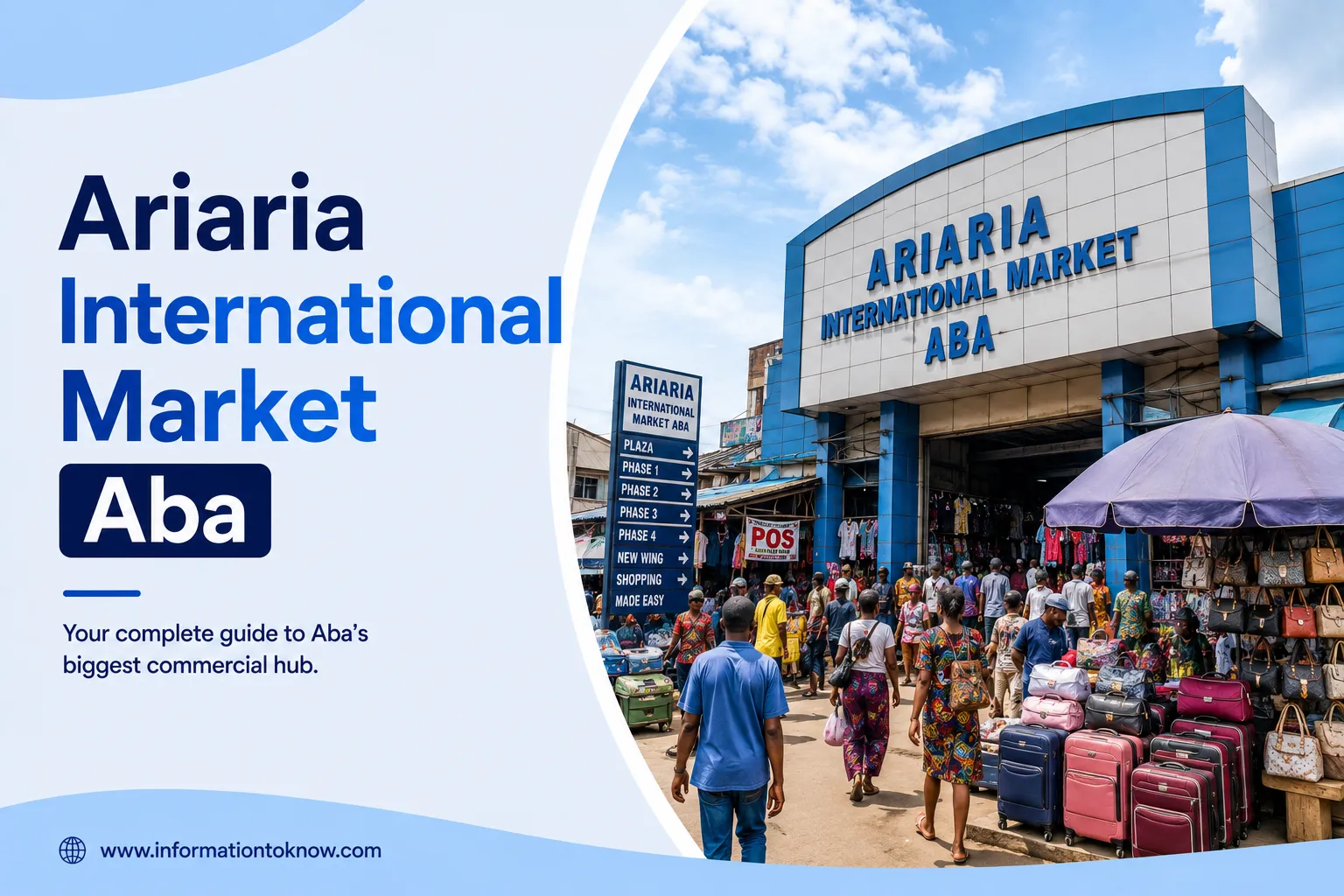
Planning to shop, source stock, or simply understand Ariaria International Market in Aba? This guide gives you everything in one place: where it is, what it sells, when to go, how to buy safely, and what the much-talked-about new Ariaria makeover actually means for you.
Quick Answer: Ariaria International Market is an open-air wholesale market in Aba, Abia State, in Nigeria’s South-East. It is one of the largest markets in West Africa and is famous for shoemaking and leather works — the heart of the “Made in Aba” trade. It spans three local government areas, runs daily (quietest on Sundays and often disrupted on Mondays), and is currently being remodelled into modern multi-storey shopping blocks.
Jump To
What Is Ariaria International Market?
Ariaria International Market is a sprawling, open-air wholesale market in Aba that ranks among the biggest in West Africa. In short, if you want locally made shoes, bags, belts, and garments in bulk, this is one of the most important places on the continent to get them.
The market earned the nickname “China of Africa” because of how much it manufactures and sells locally, from footwear to fabrics, rather than simply reselling imports. Recent Daily Trust reporting describes it as one of the largest markets in West Africa, with around 37,000 stalls and at least two million traders, with up to three people sharing a single stall. Those figures are estimates, but they capture the sheer scale of the place.
What makes that scale real is how the trade is clustered. The market is organised into about 90 zones, and a single shoemaking zone alone is said to host up to 200,000 traders — a concentration of one craft that few markets anywhere can match. It’s also famously accessible: many traders started out with as little as ₦10,000, which is a big part of why Ariaria became a magnet for hustlers and small manufacturers from across the South-East.
Ariaria isn’t new. It was established in 1976 after a fire destroyed the old Ekeoha Market in Aba, and it grew from a swampy plot into the commercial engine of the city. Nearly five decades on, it remains the beating heart of Aba’s reputation as a manufacturing town. It’s the place where the “Made in Aba” label was built and, as you’ll see below, it’s now in the middle of its biggest transformation yet.
Where Is Ariaria International Market Located?
Ariaria is in Aba, a commercial city in Abia State, in Nigeria’s South-East. The most commonly cited address is 108 Aba-Owerri Road, Aba, and it sits at roughly 5.11°N, 7.33°E, along the Aba–Port Harcourt–Enugu Expressway corridor.
One thing that surprises many first-timers: the market is so large that it cuts across three local government areas — Aba North, Aba South and Osisioma. That’s why directions can feel confusing; different entrances lead into different sections and “lines.” Locals will usually direct you by the name of a line (for example, the shoe lines) rather than a street address.
Getting there is almost always by road, along the Aba–Owerri and Enugu–Port Harcourt axis. If you’re flying in, the nearest major airport is Port Harcourt (roughly an hour and a half to two hours away by road, depending on traffic), followed by the drive into Aba. From within Aba, shared taxis, keke (tricycles), and okada (motorbikes) all run to the market. Expect congestion around the market’s edges; the access roads have long been a pain point, though that is now being addressed (more on that shortly). If you’re driving, park at a secure, paid lot rather than on the roadside, and be ready to continue on foot, as the interior is pedestrian-dense.
Read: How to Register Your Business With CAC in Nigeria (Step-by-Step, 2026)
What Is Ariaria Market Known For?
Above everything else, Ariaria is known for shoes and leather. It is one of the largest shoe- and leather-making markets in West Africa. Made in Aba footwear from here is sold across Nigeria and into neighbouring countries. What sets Ariaria apart from a typical market is that much of what’s on sale is made on site. You’ll find the workshops, the cobblers, and the leatherworkers in the same clusters as the display stalls, and many will produce a design to your exact specification if you order in quantity.
But it’s far from a one-product market. Alongside the shoemakers and leatherworkers, you’ll find ready-made garments and menswear, fabrics and textiles, bags, belts and accessories, jewellery and cosmetics, household goods, and even pharmaceutical items. Crucially, Ariaria is a resellers’ market; most buyers come to purchase wholesale and resell elsewhere, which is why prices reward bulk buying and hard bargaining.
Its pull reaches well beyond Nigeria. Traders and market leaders say buyers come from countries such as Mali, Cameroon, and Senegal to source Aba-made goods in bulk. This is one reason the International in the market’s name isn’t just for show.
Here’s a quick map of what you’ll typically find and where, so you can head straight for the right part of the market.
NB: Slide left to view the table if you’re on mobile.
| If you want | Head for | Good to know |
|---|---|---|
| Shoes, sandals, boots | The shoe/leather lines (Ariaria’s flagship trade) | Best prices come with bulk orders; custom production is common |
| Bags, belts, leather accessories | Leatherworks section | Often made in the same clusters as the shoes |
| Garments & fabrics | Clothing/textile lines | Mix of locally sewn and imported stock |
| Ready-made menswear & suits | Tailoring/garment clusters | “Made in Aba” suits and shirts; custom sewing available |
| Cosmetics & jewellery | Accessory/cosmetics stalls | Check authenticity and expiry on cosmetics |
| Household goods | General-goods lines | Handy for resellers stocking a shop |
| Pharmaceutical & sundry items | Dedicated stalls scattered across zones | Check quality and packaging carefully |
Read: Top FMCG Companies in Nigeria: The 2026 Ranked List (Updated)
The New Ariaria: Inside the Market’s Modern Makeover
The biggest Ariaria story right now is its physical transformation; the market is being rebuilt into modern, multi-storey shopping blocks. If you last saw Ariaria years ago, the before and after is dramatic.
The redevelopment replaces cramped, flood-prone rows with two-storey buildings. According to reporting on the remodelled A-Line, each block holds roughly 480 shops fitted with electronically operated doors, fire alarms, and elevators to move goods to the upper floors. This prompted a developer to say, “What we are building is a mall; it is no longer a market.” In practice, that means wider walkways, proper drainage under the blocks, and lock-up shops that look far closer to a shopping centre than the open sheds many people picture when they think of Ariaria.
The push has continued under the Abia State Government. In 2025, the state approved the remodelling of Ariaria to an international standard, with plans covering improved road networks, fire-safety infrastructure, drainage systems and digital-commerce integration, handled by contractor Checkbest International Limited. The digital-commerce angle matters: the aim is a market where Made in Aba traders can sell online and reach buyers far beyond the physical stalls, not just a cosmetic facelift. If you trade there, the most reassuring detail is this: the government has clarified that the A-Line remodelling is not meant to displace existing traders. The phased approach is designed to rebuild sections while keeping the market trading.
For a shopper or reseller, the practical takeaway is simple: expect ongoing construction in parts of the market, cleaner and safer blocks where work is complete, and a market that increasingly looks and functions like a shopping complex. If you’re visiting during the works, ask locally which lines have reopened in the new blocks and which are still operating from temporary spaces, so you don’t waste time hunting for a relocated dealer.
Opening Hours and the Best Time to Visit
Ariaria generally trades daily from early morning around 6–7am until roughly 6pm, but the day you choose matters far more than the hour.
Two rules will save you a wasted trip. First, Sundays are quiet, with many stalls shut. Second, and more importantly, Mondays are frequently disrupted: traders in Ariaria have been observing the South-East “sit-at-home”, which regularly keeps much of the market closed at the start of the week. The observance can vary week to week, so if a Monday trip is unavoidable, confirm with a dealer beforehand rather than assuming the market will be fully open.
The sweet spot is Tuesday to Saturday, arriving mid-morning when stalls are fully open but the heat and crowds haven’t peaked. If you’re buying in volume, earlier is better; you’ll have time to compare lines and negotiate before traders get busy.
Timing also shifts with the calendar. The ember months and the run-up to Christmas are Ariaria’s peak, when footwear and garment demand spikes, prices firm up, and the lines get packed. If you want the calmest shopping and the most negotiating room, aim for the quieter first quarter of the year. Whenever you go, treat the middle of the day as your buying window and leave before dusk, as the surrounding roads and transport get harder to navigate after dark.
How to Shop and Buy Wholesale in Ariaria (Without Getting Burned)
Ariaria rewards preparation. The direct answer: come knowing what you want, be ready to bargain hard, and sort out how you’ll pay before you arrive.
A few field-tested tips:
- Bargain always. Opening prices assume you’ll negotiate. Ask several stalls before committing, and don’t show too much enthusiasm for a single item; it weakens your hand.
- Buy in bulk for the real prices. As a wholesale market, Ariaria’s best rates are for quantities, not single pieces. If you only need a few items, expect to pay closer to retail.
- Know your quality tiers. Ask plainly whether you’re buying first-grade Aba-made stock, standard grade, or imported/second-hand; the price gap is real, and so is the difference in durability.
- Use a trusted dealer or middleman. For large orders or custom production, a known contact protects you on quality, timelines, and price, and can chase up a job while you’re back home.
- Sort logistics early. For bulk purchases, agree on how goods will be packed and shipped. Market transport unions and haulage/park operators move loads to other cities, so confirm cost and delivery timelines before you pay.
- Plan your payments. Carry some cash, but don’t flash it. Card and transfer acceptance is uneven, so it helps to understand how POS agents and the fintech apps Nigerian traders use work before you go. Knowing the main commercial banks in Nigeria and their reach in Aba is useful for larger transfers, and a working bank transfer often beats carrying large amounts of cash into the crowd.
- Mind the touts. Friendly guides who latch onto you at the entrances may steer you to stalls that pay them a cut. Politely decline, or go with your own dealer.
- Inspect before you pay. Check stitching, soles, zips, and packaging; quality varies stall to stall, and returns are rarely straightforward once you’ve left.
Challenges to Know Before You Go
Ariaria is rewarding, but it has real, well-documented challenges; going in aware makes your trip smoother.
Flooding has hit the market repeatedly; in 2022, after severe flooding, the state government ordered the relocation of traders and goods from the A-Line. Then-Governor Ikpeazu later named the perennial flooding and the attendant loss of goods as a key reason to reconstruct Ariaria, noting that the market lies at the lowest level of Aba. Fire outbreaks and overcrowding have also been recurring problems, worsened by poor drainage and congested access roads.
It isn’t only floods. Traders also point to poor roads and drainage in the old sections, unreliable electricity, and patchy internet and mobile networks as day-to-day frustrations. These are issues serious enough that some say customers have drifted to markets in other cities. For a visitor, the practical read-across is simple: card terminals and transfers can fail when the network drops, so keep a cash fallback, and don’t be surprised by generator noise and power cuts in the un-remodelled lines.
The good news is that these are exactly the issues the current works target. In 2024, Governor Alex Otti approved the rehabilitation of the Enyimba–Ariaria road running from inside the market to the Enugu–Port Harcourt Expressway, aimed at easing the chronic overcrowding and access problems. Paired with the new drainage and fire-safety infrastructure in the remodelling plan, the market is slowly being re-engineered against its oldest weaknesses.
Is Ariaria Worth Visiting? Safety and Practical Tips
Yes. If you want authentic, locally made goods at wholesale prices, few places match it. But treat it like any large, busy market and take sensible precautions.
On the safety side:
- Keep valuables secure and out of sight in crowds
- Agree on prices before handing over money
- Avoid displaying large amounts of cash.
- Carry your phone in a front pocket or a zipped bag
- Keep bags closed and in front of you
- Be wary of anyone creating a distraction in a tight crush.
- If you’re new to Aba, go with a local or a trusted dealer who knows the lines; it speeds up buying and keeps you out of the wrong corners.
- A little Igbo or Nigerian pidgin goes a long way in the negotiation, though English is widely understood.
On the practical side:
- Wear comfortable, closed shoes that you don’t mind getting dusty or muddy
- Dress modestly
- Bring water and plan for heat
- Give yourself more time than you think you’ll need; the market is genuinely huge.
- Avoid Mondays where you can
- Aim to finish before dusk
- If you’re moving bulk goods, arrange your transport and a secure holding point in advance rather than on the fly.
If you’re building a wider trip, Aba pairs well with the rest of the region. It’s worth browsing the tourist attractions and things to do in Abia State and the festivals in Abia State, and if you’re travelling the South-East, you can add things to do in nearby Anambra State, home to Onitsha’s famous markets.
Ariaria in Nigeria’s Economy
Ariaria isn’t just a market; it’s a symbol of Nigeria’s local-manufacturing story. The Made in Aba brand of shoes, bags, and garments has helped position Aba as one of the country’s key industrial cities and Abia as one of Nigeria’s most developed states. For a lot of young people across the South-East, a stall or workshop in Ariaria is a first rung into manufacturing and trade; a low-barrier entry point that turns craft skills into a livelihood.
The market’s clientele stretches well beyond Nigeria, with buyers coming from across West Africa. Traders cite customers from Mali, Cameroon, and Senegal, though market leaders warn that infrastructure gaps have cost them some of that patronage. That tension — huge output and demand on one side, roads, power and drainage problems on the other — is exactly why the ongoing remodelling matters for the wider economy, not just for shoppers.
While you’ll see eye-catching turnover figures quoted online, most date back years and aren’t reliably verifiable today, so it’s best to judge Ariaria by what’s measurable — its scale, its output, and its role in why Abia keeps featuring among the richest states in Nigeria. As the modern blocks come online and digital-commerce tools are built in, their economic weight is set to grow, not shrink.

Plan Your Ariaria Buying Trip the Smart Way
Now you know the essentials: Ariaria International Market in Aba is West Africa’s China of Africa for shoes and leather. It’s modernising fast into a mall-style complex, and the day you visit can make or break your trip. Your next step is simple: pick a day between Tuesday and Saturday, line up a trusted dealer if you’re buying in bulk, and sort your cash-plus-POS payment plan before you set off. Do that, and you’ll shop Ariaria like a seasoned Aba trader rather than a first-timer.
Frequently Asked Questions About Ariaria International Market
Where is Ariaria International Market located?
It’s in Aba, Abia State, in Nigeria’s South-East, commonly addressed at 108 Aba-Owerri Road. It spreads across three local government areas: Aba North, Aba South, and Osisioma.
What is the Ariaria market known for?
It’s best known for shoemaking and leather works — one of the largest leather-and-shoe markets in West Africa — plus garments, fabrics, household goods and some pharmaceuticals.
Which state is Ariaria in?
Abia State, in Nigeria’s South-East.
Which local government is Ariaria market in?
It cuts across three: Aba North, Aba South, and Osisioma.
Why is Ariaria called the “China of Africa”?
Because of its versatility in mass-producing wears and leather goods locally, much like a manufacturing hub rather than just a reseller of imports.
How big is Ariaria International Market?
It’s regarded as one of West Africa’s largest markets, with about 37,000 stalls and an estimated two million traders, according to recent reporting.
What are Ariaria Market’s opening hours?
It generally opens daily from about 6–7am to around 6pm, though Sundays are quieter and Mondays are frequently disrupted by the South-East sit-at-home.
Is Ariaria open on Mondays?
Often not fully; many traders observe the Monday sit-at-home, so plan to visit between Tuesday and Saturday.
What is the new Ariaria market?
It’s the ongoing modernisation of the market into multi-storey shop complexes with electronic doors, fire alarms and elevators described by developers as “a mall, not a market.”
Who is remodelling Ariaria market?
The Abia State Government approved the remodelling, with Checkbest International Limited handling the A-Line phase; the government says traders won’t be displaced.
Is Ariaria market safe to visit?
It’s a busy, crowded market, so guard valuables, agree on prices before buying, and ideally shop with a trusted local dealer for bulk purchases.
Can I buy wholesale at Ariaria?
Yes, it’s primarily a resellers’ wholesale market where buyers come from across Nigeria and neighbouring countries to buy in bulk.
How do I get to Ariaria market?
By road via the Aba–Owerri and Enugu–Port Harcourt axis, the nearest major airport is Port Harcourt, then a road trip into Aba.
When was Ariaria market established?
In 1976, after a fire destroyed the old Ekeoha Market in Aba.
Is Aba the biggest market city in Nigeria?
Aba is one of Nigeria’s most important commercial and manufacturing cities, and Ariaria is among West Africa’s largest markets, though the biggest depends on whether you measure by land area, number of traders, or turnover.