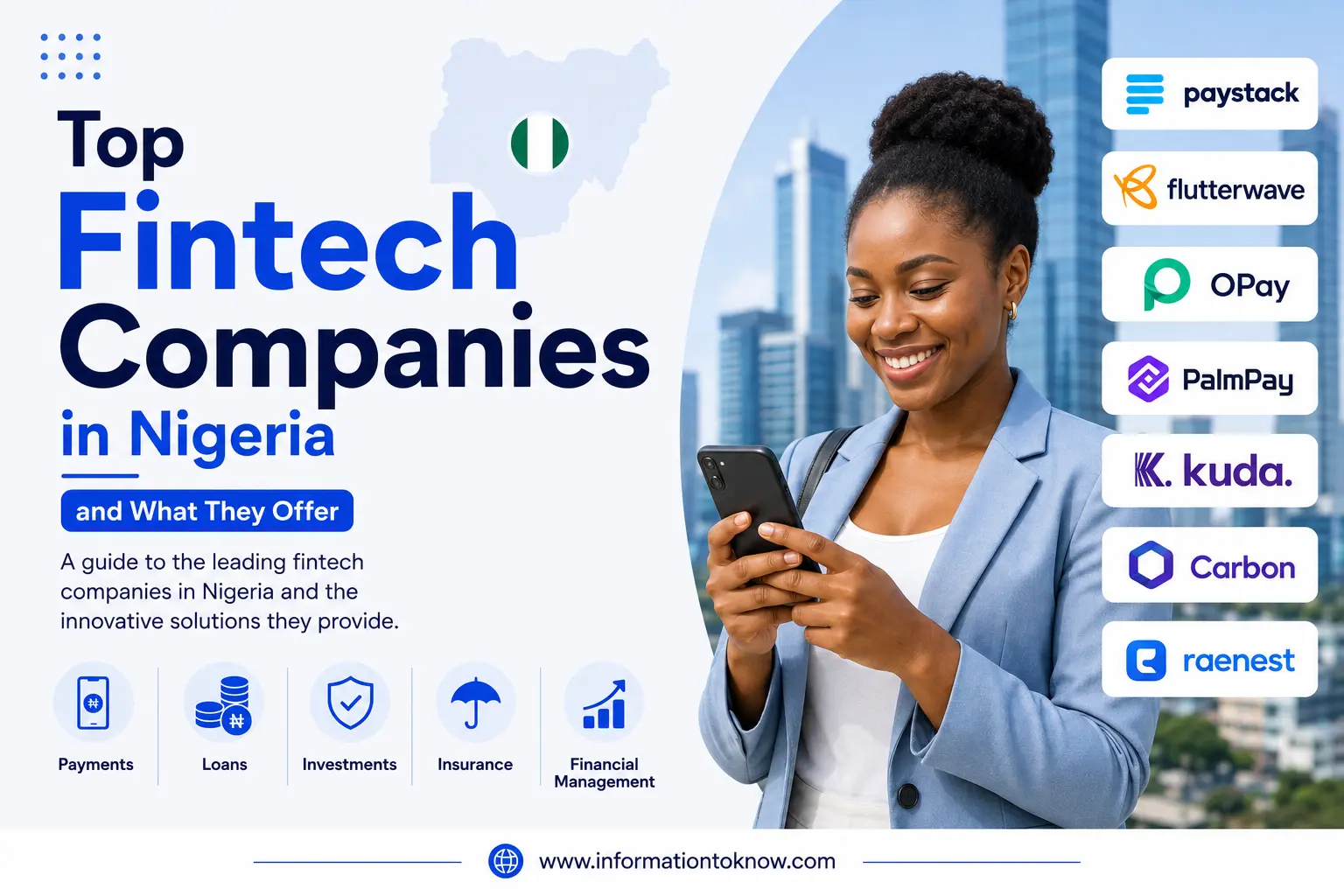
Are you looking for the top fintech companies in Nigeria and, more importantly, trying to figure out which one is actually right for your money? The leading names today are Paystack, Raenest, Moniepoint, OPay, PalmPay, Flutterwave, Paga, Kuda, PiggyVest, Cowrywise, FairMoney, Carbon, Interswitch and Remita, but the “best” one depends entirely on whether you want to accept payments, bank digitally, save, borrow, or get paid in dollars.
So instead of dumping a plain list on you, this guide does two things: it tells you what each company does, and it gives you a clear “Best for” verdict so you can pick the right app in minutes.
Jump To
How to read this list
Every company below comes with a short description, a recent fact, a link to its official homepage, and a Best for line telling you exactly who it suits. If you just want the quick answer, jump to the use-case table further down.
The Top Fintech Companies in Nigeria (2026)
1. Paystack — payments infrastructure for businesses
If you run an online business in Nigeria, Paystack is probably how you get paid. Founded in 2015 by Shola Akinlade and Ezra Olubi, it lets businesses accept card, bank transfer, USSD and mobile-money payments through a clean checkout, shareable payment links, invoices and developer-friendly APIs. It was the first Nigerian startup accepted into Silicon Valley’s Y Combinator, and merchants from small stores to names like MTN and Bolt run on it. Its 2020 acquisition by global payments giant Stripe (for a reported $200M+) — the biggest startup exit in Nigeria’s history at the time — cemented Paystack as the country’s flagship payments name, and it still operates independently with a reputation for reliability and fast settlements.
Best for: Online businesses and merchants that need a reliable, developer-friendly way to accept payments.
2. Raenest (formerly Geegpay) — global banking for freelancers and remote workers
If you earn in foreign currency, Raenest deserves your close attention, which is why it sits second on this list. Raenest is a Lagos-based fintech that solves one of the most painful problems for Nigeria’s growing army of freelancers and remote workers: getting paid in dollars and other foreign currencies, quickly and cheaply.
Founded in 2022 by Victor Alade, Sodruldeen Mustapha and Richard Oyome, the company started as an Employer of Record service before pivoting to global banking for Africans. Its consumer product, Geegpay, gives users virtual USD, GBP, and EUR accounts, multi-currency wallets, currency conversion, and physical and virtual dollar cards. As co-founder Victor Alade put it, the pain point was simple:
“A U.S. company might not care if a payment is delayed by five days, but for someone in Nigeria or Kenya, that’s a big deal.”
The traction backs up the pitch. In February 2025, Raenest raised an $11 million Series A led by QED Investors, bringing its total funding to $14.3 million. By its October 2025 US launch, the company reported over one million customers and more than $2 billion in processed transactions. Crucially for trust, Raenest is licensed in Nigeria as an International Money Transfer Operator (IMTO) by the CBN and as a Money Services Business (MSB) in Canada — meaning it operates within a regulated cross-border framework rather than a grey zone.
On cost, Raenest has leaned into affordability: as of late 2025, it introduced a pricing update with several free monthly deposits across its USD, GBP and EUR accounts before a small flat fee, and it waives conversion and naira-withdrawal fees on many transactions. Fee structures evolve, so check the current pricing on raenest.com before you commit. You will find this Raenest review article helpful; it details the fees, pricing, what people say about the product, who it’s for, and who it’s not for.
Best for: Freelancers, remote workers, creators, and digital businesses who need to receive, hold, and spend USD, GBP, or EUR without losing money to conversion and slow transfers.
Read: Best Cross-Border Payment Companies in Nigeria (Updated)
3. Moniepoint — business banking and agent networks
Moniepoint (formerly TeamApt) powers a huge share of Nigeria’s small-business economy, from current accounts and business loans to the ubiquitous POS machines you see at neighbourhood shops and roadside agents. It became a unicorn in late 2024 after raising over $120 million in Series C funding — including a $10 million investment from Visa — and now processes over a billion transactions a month, according to TechCabal, having crossed $100 billion in annual payments. It also made TIME’s 100 Most Influential Companies list. During Nigeria’s cash crunches, Moniepoint’s agent network became a lifeline for people who couldn’t get cash from banks — a big reason it’s now a default tool for informal traders and SMEs.
Best for: Small businesses and merchants that want business banking plus reliable POS and agent-banking tools.
4. OPay — everyday consumer payments at scale
OPay is one of the apps Nigerians reach for daily to send money, pay bills, buy airtime, and transact with agents. Launched in 2018, it exploded in popularity during the 2023 cash scarcity, when its huge agent network and near-instant transfers kept commerce moving while bank apps struggled. Today it claims over 50 million users and a million merchants, with more than 10 million daily active users. Investor filings imply a valuation of roughly $2.7–3 billion, putting it among Nigeria’s most valuable fintechs. Its low-fee (often free) transfers, savings features and simple interface make it a genuine everyday-banking alternative for millions.
Best for: Everyday transfers, bill payments and airtime for the average consumer.
5. PalmPay — a consumer wallet built for volume
PalmPay is a consumer payments and wallet app that has scaled fast since launching under a mobile-money operator licence. As of 2025, it reports over 35 million users and processes more than 15 million transactions a day, having moved ₦71.5 trillion in 2024 with 80% of users active every month. It was also named one of the World’s Top 250 Fintech Companies in 2024 by CNBC and Statista. PalmPay leans hard into rewards, cashback and referral perks, plus everyday features like transfers, airtime, bill payments and small loans — which is why it competes head-to-head with OPay for the everyday wallet spot on most Nigerians’ phones.
Best for: Everyday consumers who want a rewards-friendly wallet for transfers, bills and payments.
6. Flutterwave — cross-border and enterprise payments
Flutterwave provides the payment infrastructure that lets businesses, banks and platforms accept and send money across borders and in many currencies. Founded in 2016 by Iyinoluwa Aboyeji and Olugbenga Agboola, it’s the go-to rail for larger merchants and companies operating across multiple African markets, handling collections, payouts and card processing through a single integration. After raising a $250 million Series D in 2022, Flutterwave reached a valuation of over $3 billion — making it one of Africa’s most valuable startups. It has since added tools like direct debit for recurring payments and pushed into remittances, cementing its role as the enterprise-grade backbone for cross-border commerce out of Nigeria.
Best for: Businesses and enterprises that need multi-currency, cross-border payment infrastructure.
7. Paga — mobile money and cash access
One of Nigeria’s oldest fintechs, Paga was founded in 2009 by Tayo Oviosu and Jay Alabraba to make it easy to send money, pay bills, and get cash through a wide agent network — long before smartphones were everywhere. It serves over 21 million users and processed ₦8.7 trillion in 2024, with monthly volumes now crossing ₦1 trillion in 2025, and it’s profitable and privately owned. Paga was the first mobile-payment company in Nigeria to hit a million users, and its agent-led, cash-in/cash-out model still makes it useful for reaching people who aren’t fully served by app-only banking.
Best for: Mobile money, cash-in/cash-out and bill payments, especially where agent access matters.
8. Kuda — the digital-only bank
Kuda is a licensed microfinance bank built for smartphones — often called “the bank of the free generation.” Co-founded by Babs Ogundeyi and Musty Mustapha, it offers a full account you can open in minutes, with a set number of free transfers each month, no maintenance fees, budgeting and spending-tracking tools, savings pots and overdrafts, all without a physical branch. Because it’s a CBN-licensed bank rather than just a wallet, deposits sit within the regulated banking system. Kuda is especially popular with younger, salary-earning Nigerians who are frustrated by traditional-bank charges and want a clean app that shows exactly where their money goes.
Best for: People who want a fee-conscious, fully digital everyday bank account.
9. PiggyVest — automated saving
PiggyVest pioneered app-based saving in Nigeria. Founded in 2016, it lets you automate deposits daily, weekly or monthly, lock funds until a target date so you’re not tempted to spend, and earn interest — plus optional low-risk investment plans. The scale shows how much Nigerians trust it: PiggyVest paid out ₦835 billion to users in 2024, crossing ₦2 trillion in total payouts since launch, with over 5 million users and 76% growth in assets under management. It was also named among CNBC’s top 250 global fintechs. If your problem is that money never survives to month-end, PiggyVest’s locks and automation are the most proven fix on this list.
Best for: Anyone who struggles to save and wants automation and withdrawal locks.
10. Cowrywise — saving plus investing
Cowrywise sits alongside PiggyVest but leans harder into investing. Founded in 2017, it’s an investment company and wealth manager built to democratise savings and investment products for the underserved African middle class and millennials. Beyond automated savings, it gives everyday users access to professionally managed mutual funds, dollar investments and diversified portfolios with very low minimums — things that once required a stockbroker or a fat bank balance. It’s SEC-regulated for its investment products, which matters when you’re putting money to work rather than just parking it. For a saver ready to graduate into wealth-building without the jargon, Cowrywise is the gentlest on-ramp in this list.
Best for: Savers ready to step into low-friction investing and mutual funds.
Read: Investment Banks in Nigeria: The Full List and How to Choose One
11. FairMoney — digital lending and banking
FairMoney offers instant loans without collateral, using alternative data — like your phone and transaction history — to assess creditworthiness in minutes, so you can borrow without ever visiting a bank. It has since grown into a fuller digital bank with accounts, transfers, bill payments, savings and a debit card. The business has scaled seriously: FairMoney grew gross revenue 62% to ₦121.9 billion in 2024, and profit after tax jumped to ₦7.9 billion from ₦780 million a year earlier, increasingly funding its loan book from customer deposits rather than costly borrowing. For many Nigerians, it’s the first port of call when they need quick credit — just borrow only what you can comfortably repay, as interest on short-term loans is high.
Best for: Individuals and small businesses needing fast, collateral-free loans.
12. Carbon — instant loans and banking
Carbon, formerly Paylater, was founded in 2016 by brothers Chijioke and Ngozi Dozie and is a CBN-licensed digital bank that pairs quick loans with everyday banking — debit cards, P2P and bill payments, mobile recharges and investment options, now serving over two million users. Its signature feature is still paperless, quick-approval lending: apply in the app and get funds in minutes without collateral. What sets Carbon apart from pure loan apps is that it also offers a credit score, savings and a rewards programme, so it works as a light everyday bank rather than only an emergency-cash tool. As with any lending app, borrow within your means and repay on time to protect your record.
Best for: Quick personal loans bundled with everyday banking features.
13. Interswitch — payment switching and infrastructure
One of Nigeria’s earliest fintechs (founded in 2002 by Mitchell Elegbe), Interswitch is the largely invisible backbone that connects banks, ATMs and merchants and processes a huge share of the country’s card transactions. It owns Verve, a home-grown card network that has surpassed 70 million activated cards, and Quickteller, its consumer bill-payments platform. A 2019 round in which Visa acquired a 20% stake for $200 million made Interswitch a unicorn valued at $1 billion. Unlike the consumer apps above, Interswitch mostly serves banks, governments and large merchants, but if you’ve used an ATM, paid a bill on Quickteller or tapped a Verve card, you’ve relied on its rails.
Best for: Card infrastructure, switching, and consumer bill payments via Quickteller.
Read: Multinational Companies in Nigeria: The Complete Guide
14. Remita — enterprise and government payments
Remita is the B2B and enterprise workhorse, used by government agencies, corporates, schools and NGOs to make and collect payments, run payroll and manage collections at scale. Built by SystemSpecs (founded in 1992), it is best known as the technology backbone of Nigeria’s Treasury Single Account (TSA): upon full implementation in 2015, Remita’s platform facilitated the recovery of over ₦3 trillion from commercial banks by linking thousands of scattered government accounts into a single real-time dashboard. If you’ve paid a government fee, school fees or a large institutional bill online in Nigeria, you’ve probably used it. For ordinary consumers, it’s less of a daily app and more the plumbing behind official and enterprise payments.
Best for: Organisations, government bodies and large institutions handling bulk payments.
Best Fintech App in Nigeria by Use Case
Still deciding? Match your need to the pick below.
NB: Slide left to view the table if you’re on mobile.
| Your need | Best pick | Why |
|---|---|---|
| Accept payments (online business) | Paystack / Flutterwave | Reliable checkout, links and APIs; Flutterwave adds cross-border scale |
| Receive dollars as a freelancer | Raenest | Virtual USD/GBP/EUR accounts, multi-currency wallets and dollar cards |
| Everyday transfers & bills | OPay / PalmPay | Massive agent networks and low-fee daily transactions |
| Business banking + POS | Moniepoint | Unicorn-scale business banking and agent/POS tools |
| Fully digital bank account | Kuda | Fee-conscious, branchless account you open in minutes |
| Automated saving | PiggyVest | Locks and automation that keep you disciplined |
| Saving + investing | Cowrywise | Mutual funds and automated investment plans |
| Quick loan (no collateral) | FairMoney / Carbon | Fast, paperless credit approvals |
| Government/enterprise payments | Remita / Interswitch | Built for bulk, institutional and card-rail payments |
What is a Fintech Company (and Why Does Nigeria lead Africa)?
A fintech company uses technology to deliver financial services — payments, savings, loans, investing, or banking — usually through an app instead of a traditional bank branch. In Nigeria, these companies have quietly become the way most people move money.
And the scale is enormous. Nigeria was home to more than 430 fintech companies as of February 2025, up from just 255 a year earlier, the highest concentration on the continent. According to Fintech News Africa, Nigeria accounts for about 28% of all African fintech companies, and Tech In Africa reports Nigeria remained the continent’s most active hub, accounting for 47% of all fintech transactions in 2024. The market itself was worth about USD 1.31 billion in 2025 and is projected to reach more than USD 4.8 billion by 2034.
Why the boom? A young, mobile-first population, patchy access to traditional banks, and a currency squeeze — inflation stood at 34.8% as of December 2024 — have pushed millions toward faster, cheaper digital money. It’s the same wave that produced Nigeria’s mobile money operators and put pressure on the country’s commercial banks to modernize.
Who Regulates Fintech Companies in Nigeria?
The Central Bank of Nigeria (CBN) is the primary regulator of fintech companies in Nigeria, licensing payments, banking, and money-transfer operators. Depending on what a company does, other agencies also step in: the SEC for investments, the NDIC for deposit insurance, the NCC for anything involving phone networks, the CAC for company registration, and NITDA for data protection. You can read more about the functions of the Central Bank of Nigeria to understand its role at the centre of it all.
How to Start a Fintech Company in Nigeria (Quick Guide)
Want to build one rather than just use one? Here’s the short version.
- Pick a clear niche — payments, lending, savings/investing, digital banking, or cross-border. Solve one specific problem well.
- Understand the licence you need — the CBN issues different licences depending on your service, so confirm the exact one before you build.
- Register your business — every fintech must be incorporated with the Corporate Affairs Commission. Here’s how to register your business with the CAC.
- Build a compliant MVP — start with core features, prioritise security, and iterate from user feedback.
- Raise funding and partnerships — Nigeria took the largest share of Africa’s fintech deals in 2024, so a strong, compliant product has real access to capital.
Read: CAC Application Queried? The Most Common Query Reasons and How to Fix Each One Fast
Pick the Fintech that Fits your Money Goal Today
Don’t choose a fintech because it’s popular; choose the one that fits the job in front of you. If you earn in dollars, open a Raenest account and stop losing money to conversion. If you run a business, start with Paystack or Moniepoint. For everyday spending, OPay or PalmPay will do the job, and for building a savings habit, PiggyVest is the easiest place to start.
Your next step is simple: pick the one need that matters most this month, download that app, and set it up today. You can always add a second app later as your money goals grow.
Frequently Asked Questions for Fintech Companies in Nigeria
How many fintech companies are in Nigeria?
Nigeria had more than 430 fintech companies as of February 2025, up from 255 a year earlier — the highest concentration in Africa.
What are the biggest fintech companies in Nigeria?
The biggest include Paystack, Moniepoint, OPay, PalmPay, Flutterwave, Paga and Interswitch, alongside fast-growing players like Raenest, Kuda, PiggyVest and FairMoney.
Which fintech app is best for receiving dollars, pounds, and euros in Nigeria?
For freelancers and remote workers, Raenest (formerly Geegpay) is a strong choice — it gives you virtual USD, GBP and EUR accounts, multi-currency wallets and dollar cards.
What is Raenest and is it the same as Geegpay?
Raenest is a Lagos-based fintech founded in 2022 that provides global banking for Africans; Geegpay is its freelancer-focused product, now unified under the Raenest brand.
Is Raenest licensed and safe?
Raenest is licensed in Nigeria as an International Money Transfer Operator (IMTO) by the CBN and as a Money Services Business (MSB) in Canada.
Who regulates fintech companies in Nigeria?
The Central Bank of Nigeria (CBN) is the primary regulator, supported by the SEC, NDIC, NCC, CAC and NITDA depending on the service.
Is Moniepoint a bank?
Moniepoint operates as a licensed financial services and business-banking platform; it became a unicorn in late 2024 and processes over a billion transactions monthly.
Which fintech app is best for everyday payments in Nigeria?
OPay and PalmPay dominate everyday consumer payments — PalmPay alone reports 35M+ users and processes over 15 million transactions a day.
Which fintech is best for saving and investing?
PiggyVest is the go-to for automated saving, while Cowrywise is popular for saving plus investing in mutual funds.
Which fintech app is best for quick loans in Nigeria?
FairMoney and Carbon are the most established for instant digital loans without collateral.
How big is Nigeria’s fintech market?
Nigeria’s fintech market reached about USD 1.31 billion in 2025 and is projected to grow to more than USD 4.8 billion by 2034.
Why is Nigeria the fintech leader in Africa?
Nigeria accounts for about 28% of Africa’s fintech companies and made up 47% of the continent’s fintech transactions in 2024, driven by a young, mobile-first population.
How much money moves through Nigerian fintechs?
Nigeria processed ₦1.56 quadrillion in electronic payments in the first half of 2024 alone — about 70% of the total recorded in all of 2023.
Do I need one fintech app or several?
Most Nigerians use a mix — one for everyday payments, one for saving, and (if they earn abroad) one like Raenest for dollars. Match the app to the specific job.
How do I start a fintech company in Nigeria?
Pick a niche, secure the right CBN licence for that service, register your business with the CAC, build a compliant MVP, then raise funding and partnerships.