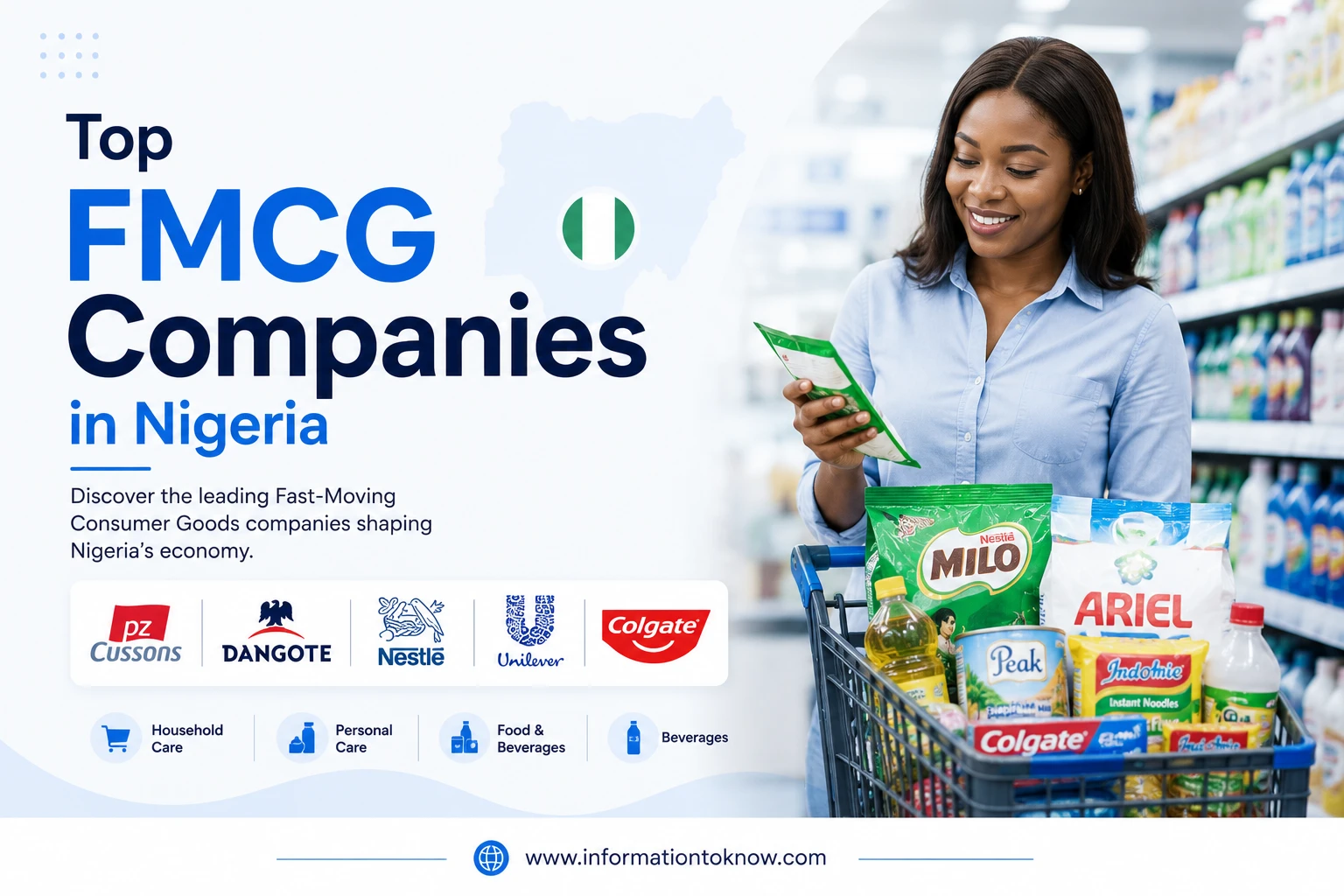
Short answer: The biggest FMCG company in Nigeria today is BUA Foods, which ended 2025 worth ₦14.38 trillion — the most valuable company on the entire Nigerian Exchange. But biggest depends on how you measure it: by revenue, Flour Mills of Nigeria leads. This guide ranks the top FMCG companies in Nigeria by both market cap and revenue, tells you exactly what each one makes, and explains the forces that reshuffles the list.
If you’ve searched for the top FMCG companies in Nigeria, you’ve probably found lists that were last updated in 2022 — full of names, short on numbers, and silent on the Naira crisis that turned the sector upside down. This one is different. Every ranking and figure below is dated and sourced, drawn from 2024–2026 company filings and Nigerian Exchange (NGX) data, so you can actually act on it — whether you’re job-hunting, investing, supplying these companies, or studying the market.
Jump To
What Counts as an FMCG Company (and Why the Nigerian List Keeps Changing)
FMCG (Fast-Moving Consumer Goods) are the everyday products that sell quickly at relatively low prices — food, drinks, toiletries, cleaning products, and over-the-counter medicines. In Nigeria, the companies that make them now form the single most valuable slice of the stock market.
At the end of 2025, the NGX Consumer Goods sector was worth ₦23.58 trillion — about 23.8% of the whole exchange — the most valuable sector on the market, according to Nairametrics reporting Sterling Asset Management data. Zoom out and the picture is just as striking: Nigeria’s FMCG market is worth roughly $25 billion and grew 54.1% in value in 2025, making it Africa’s fastest-growing FMCG market and the second-largest after South Africa, per NielsenIQ data reported in October 2025.
Here’s the catch that older lists miss: the ranking of these companies changed dramatically between 2023 and 2025. When the Naira was floated in June 2023, and its value fell against the dollar, companies with foreign-currency debts and imported raw materials took huge hits — while a few, like BUA Foods, pulled ahead. That’s why dates matter on every figure below, and why this list looks nothing like one from a few years ago.
Also read: Top Food and Beverage Companies in Nigeria.
Top FMCG Companies in Nigeria at a Glance (2025–2026 Ranking Table)
The quickest way to read the market is through two lenses: market capitalization (what investors think a company is worth) and revenue (how much it actually sells). They don’t produce the same order.
The table below ranks the 10 largest NGX-listed FMCG companies. Market caps are as of mid-2025; revenue figures are H1 2025 (January–June 2025).
NB: Slide left to view the table if you’re on mobile.
| # | Company | Market cap (mid-2025) | H1 2025 revenue | Ownership | Key products |
|---|---|---|---|---|---|
| 1 | BUA Foods | ₦9.9 trillion | ₦912.5 billion | Indigenous | Sugar, flour, pasta, rice, edible oils |
| 2 | Nigerian Breweries | ₦2.3 trillion | ₦738.1 billion | Multinational (Heineken) | Beer, malt (Star, Gulder, Maltina) |
| 3 | International Breweries | ₦2.3 trillion | ₦340.9 billion | Multinational (AB InBev) | Beer (Trophy, Hero, Budweiser) |
| 4 | Nestlé Nigeria | ₦1.6 trillion | ₦581.1 billion | Multinational | Maggi, Milo, Golden Morn, Nescafé |
| 5 | Dangote Sugar Refinery | ₦734 billion | ₦430.2 billion | Indigenous | Sugar |
| 6 | Guinness Nigeria | ₦366 billion | ₦259.6 billion | Multinational (Tolaram) | Stout, spirits, malt |
| 7 | NASCON (Dangote Salt) | ₦263 billion | ₦78.2 billion | Indigenous | Salt, seasoning, tomato paste |
| 8 | Honeywell Flour Mills | ₦204 billion | ₦179.6 billion | Indigenous | Flour, pasta, noodles |
| 9 | Unilever Nigeria | ₦440 billion | ₦98.1 billion | Multinational | Omo, Sunlight, Knorr, Close-Up |
| 10 | PZ Cussons Nigeria | ₦162 billion | ₦96.5 billion | Multinational | Premier, Morning Fresh, Cussons Baby |
Two things jump out. First, BUA Foods towers over the field — its mid-2025 market cap alone was more than half the entire sector’s value. Second, revenue rank and market-cap rank don’t match: Nigerian Breweries out-earns Nestlé but is valued similarly, and Flour Mills (whose different financial year keeps it off the H1 2025 table) actually books the most revenue of any FMCG company in the country. More on that below.

The 10 Biggest FMCG Companies in Nigeria and What They Make
These are the companies that dominate Nigerian shelves, fridges, and factories — with what they produce and why they rank where they do.
1. BUA Foods
What they make: sugar, flour, pasta, rice, and edible oils — and it’s now the biggest company on the entire Nigerian stock market. BUA Foods posted ₦1.5 trillion in full-year 2024 revenue with a ₦289 billion pre-tax profit, more than doubling revenue year-on-year. Its share price then surged through 2025: its market cap hit ₦12.5 trillion by October 2025, overtaking Dangote Cement and MTN, and reached ₦14.38 trillion by December 2025 — the most valuable stock on the entire exchange. BUA Foods is headquartered in Lagos and owned by businessman Abdulsamad Rabiu.
2. Nigerian Breweries
What they make: beer and malt drinks — Star, Gulder, Heineken, Maltina, and 33 Export. Nigeria’s oldest and largest brewer grew revenue to ₦1.08 trillion in 2024 — its first trillion-Naira year — yet still posted a ₦144.8 billion post-tax loss, driven by ₦157.5 billion in foreign-exchange losses. A Heineken subsidiary, it is headquartered in Iganmu, Lagos.
3. Nestlé Nigeria
What they make: the household staples Maggi, Milo, Golden Morn, and Nescafé. Nestlé Nigeria grew revenue to ₦958.8 billion in 2024, but a heavy finance-cost burden pushed it to a ₦221.6 billion pre-tax loss before it returned to profit in the fourth quarter. Its Nigerian head office is in Ilupeju, Lagos.
4. International Breweries
What they make: Trophy, Hero, and Budweiser beers. Part of global giant AB InBev, International Breweries earned ₦340.9 billion in H1 2025 revenue (up 53%), ranking among the sector’s largest players by both assets and sales.
5. Dangote Sugar Refinery
What they make: refined sugar — one of Nigeria’s biggest names by revenue, but also the clearest casualty of the currency crisis. Revenue grew to ₦665.7 billion in 2024, yet a ₦209.8 billion FX loss dragged it to a ₦270.9 billion pre-tax loss as its gross margin collapsed to 4.7%. It is part of the Dangote Group.
6. Flour Mills of Nigeria (Golden Penny)
What they make: flour, pasta, noodles, cereals, and edible oils under the Golden Penny brand — plus agro-allied products. Flour Mills is the largest FMCG company in Nigeria by revenue, at ₦2.29 trillion for its financial year ending March 2024, though thin margins left it with just ₦3.54 billion in profit after tax. Note that its financial year ends in March, so its figures aren’t directly comparable with the December year-ends above. It’s headquartered in Apapa, Lagos.
7. Guinness Nigeria
What they make: Guinness stout, spirits, and malt drinks. In one of 2024’s biggest sector shake-ups, Diageo sold its 58% stake to Nigeria’s Tolaram Group, handing a marquee multinational brand to local ownership. Guinness grew H1 2025 revenue 82% to ₦259.6 billion.
8. Unilever Nigeria
What they make: Omo, Sunlight, Knorr, Close-Up, and Lifebuoy. Unilever remains a household name in home and personal care, though in 2024 it ceased local production of its home-care and skincare lines to focus on higher-margin brands. Its head office is in Oregun, Lagos.
9. PZ Cussons Nigeria
What they make: Premier and Cussons Baby soaps, Morning Fresh, Mamador oil, and Robb. A British-owned personal-care and consumer-goods maker with deep roots in Nigeria, PZ Cussons posted ₦96.5 billion in H1 2025 revenue. It is headquartered in Ilupeju, Lagos.
10. Honeywell Flour Mills & NASCON
What they make: Honeywell produces flour, pasta, and noodles; NASCON (Dangote Salt) makes salt, seasoning, and tomato paste. Both are among the sector’s fastest growers — Honeywell’s H1 2025 revenue jumped 126% and NASCON’s rose 55%, per the H1 2025 sector ranking.
Biggest by Market Cap vs Biggest by Revenue vs Biggest Household Name
Ask “which is the biggest FMCG company in Nigeria?” and you’ll get three different right answers, depending on what you mean:
- Biggest by market value: BUA Foods (₦14.38 trillion at end-2025) — what investors are willing to pay for the business.
- Biggest by revenue: Flour Mills of Nigeria (₦2.29 trillion) — the company that actually sells the most.
- Biggest household presence: Nestlé, Unilever, and Nigerian Breweries — whose brands are in almost every Nigerian home, even if their share prices sit lower.
Keeping these three lenses separate is the difference between a useful answer and a misleading one — and it’s exactly where most competing lists blur the picture.
Indigenous vs Multinational FMCG Companies in Nigeria
Nigeria’s FMCG scene is split between homegrown giants and global multinationals, and the balance has been tilting toward local ownership.
Indigenous (Nigerian-owned): BUA Foods, Dangote Sugar, NASCON (Dangote Salt), Flour Mills of Nigeria, and Honeywell Flour Mills. Multinational: Nestlé, Unilever, PZ Cussons, Nigerian Breweries (Heineken), and International Breweries (AB InBev).
That line moved in 2024. As the Stren & Blan 2024 sector round-up documents, several multinationals exited or restructured: Diageo sold Guinness Nigeria to Tolaram, Heineken offloaded its majority stake in Champion Breweries, and Kimberly-Clark and Pick n Pay left the country entirely. The takeaway for readers: indigenous players are increasingly setting the pace at the top of the market.
Related: Complete List of Top Multinational Companies in Nigeria.
Are Nigeria’s FMCG Companies Actually Profitable? The FX Story Behind the Numbers
Revenue is booming, but profits have been brutalised — and the culprit is foreign exchange. This is the single most important thing to understand about the sector right now.
When the Naira was floated in mid-2023, companies had to revalue their dollar-denominated debts and import bills, triggering enormous paper losses. In FY2023, ten major consumer-goods firms recorded a combined ₦839 billion in FX losses — about 18% of their total revenue, according to Nairametrics. The pain continued into 2024: Nestlé, Dangote Sugar, BUA Foods, Nigerian Breweries, and Cadbury together lost roughly ₦859 billion to FX, as the Naira slid from about ₦461/$ at the start of 2023 to ₦1,535/$ by the end of 2024. On top of that, average production costs for major consumer-goods firms rose about 67% in the first half of 2024 versus a year earlier.
The lesson: don’t read revenue alone. BUA Foods is the standout precisely because it grew and stayed profitable through the storm, while revenue giants like Dangote Sugar and Nigerian Breweries slipped into the red.
Working in FMCG: Careers and Who’s Hiring
FMCG is one of Nigeria’s biggest white-collar employers, concentrated in Lagos — a genuine option if you’re building a career in sales, marketing, engineering, supply chain, or finance.
A quick, important caveat: you’ll find plenty of “highest-paying FMCG companies” salary tables online, but there is no reliable, up-to-date public salary benchmark for these employers, so treat those numbers with caution. What is documented is the scale of employment. In their 2023 annual reports, Flour Mills disclosed 5,404 staff and Nestlé Nigeria 2,375 staff — both among the largest listed employers in the country. The big brewers, Unilever and PZ Cussons, also run sizeable graduate and technical hiring programmes.
Related: Top Most Lucrative Jobs in Lagos State, Nigeria.
How to Start Your Own FMCG Business in Nigeria (Briefly)
If the sector’s growth has you thinking about launching your own consumer-goods brand, the path is straightforward even if the work isn’t:
- Pick a product niche — a specific fast-moving good with clear demand (a snack, a drink, a cleaning product).
- Write a business plan — costs, pricing, target margins, and how you’ll survive input-cost swings.
- Register the business — incorporate with the Corporate Affairs Commission (CAC) and obtain the relevant NAFDAC and product licences.
- Build distribution — FMCG lives or dies on getting products onto shelves, so line up wholesalers, retailers, and logistics early.
Related: How to Start a Fintech Company in Nigeria.
Use This List to Make Your Next Move in Nigeria’s FMCG Market
The headline is simple: BUA Foods is now Nigeria’s most valuable FMCG company by a wide margin, Flour Mills sells the most, and the whole sector is the biggest and fastest-growing on the NGX — but it’s still working through a serious currency shock. Let that shape your next step. If you’re investing, weigh market cap against real profitability (BUA Foods’ resilience versus the FX-driven losses at Dangote Sugar and Nigerian Breweries). If you’re job-hunting, target the largest employers — Flour Mills, Nestlé, and the brewers — and start with their graduate programmes. If you’re supplying or distributing, the indigenous giants are the ones expanding fastest. And if you’re starting your own brand, study how these leaders built distribution before you spend a Naira on production.
Frequently Asked Questions on FMCG Companies
Which is the biggest FMCG company in Nigeria?
By market value, BUA Foods is the biggest — it reached a ₦14.38 trillion market capitalisation at the end of 2025, making it the most valuable company on the entire Nigerian Exchange. By revenue, Flour Mills of Nigeria is the largest, with ₦2.29 trillion in its 2023/24 financial year.
What are the top 10 FMCG companies in Nigeria in 2025/2026?
BUA Foods, Nigerian Breweries, Nestlé Nigeria, International Breweries, Dangote Sugar, Flour Mills, Guinness Nigeria, Unilever Nigeria, PZ Cussons, and Honeywell Flour Mills/NASCON. Together, the top 10 earned about ₦3.71 trillion in H1 2025 revenue.
How many FMCG companies are there in Nigeria?
Nigeria has a large and fragmented FMCG landscape, but the formal, publicly tracked core is the 20 consumer-goods companies listed on the Nigerian Exchange (NGX) — the giants profiled in this guide sit at the top of that list, alongside many more privately held manufacturers and distributors.
What does FMCG mean?
FMCG stands for Fast-Moving Consumer Goods — everyday products that sell quickly at relatively low prices, such as food, drinks, toiletries, cleaning products, and over-the-counter medicines.
Which FMCG company has the highest revenue in Nigeria?
Flour Mills of Nigeria has the highest revenue, at ₦2.29 trillion for its financial year ending March 2024. BUA Foods (₦1.5 trillion) and Nigerian Breweries (₦1.08 trillion) followed in their 2024 financial years.
How big is Nigeria’s FMCG market?
Nigeria’s FMCG market is worth roughly $25 billion and grew 54.1% in value in 2025, making it Africa’s fastest-growing FMCG market and the second-largest after South Africa, according to NielsenIQ data reported in October 2025.
Are FMCG companies in Nigeria profitable?
Revenue is booming, but profits have been squeezed. After the 2023 Naira float, 10 major consumer-goods firms lost about ₦839 billion to foreign-exchange revaluations in 2023, and several posted large losses in 2024. BUA Foods was a notable exception, staying profitable with ₦289 billion pre-tax profit in 2024.
What are the multinational FMCG companies in Nigeria?
The main multinationals are Nestlé, Unilever, PZ Cussons, Nigerian Breweries (Heineken), and International Breweries (AB InBev) — plus Guinness Nigeria, which Diageo sold to Nigeria’s Tolaram Group in 2024.
What are the indigenous (Nigerian-owned) FMCG companies?
BUA Foods, Dangote Sugar, NASCON (Dangote Salt), Flour Mills of Nigeria (Golden Penny), and Honeywell Flour Mills are among the largest Nigerian-owned FMCG companies.
Which FMCG companies are the highest paying in Nigeria?
Verified, up-to-date salary data for individual FMCG employers isn’t publicly available, so treat any salary rankings you see with caution. What is documented is scale of employment: Flour Mills reported 5,404 staff and Nestlé Nigeria 2,375 staff in their 2023 annual reports — both among the biggest listed employers in the country.
Why did BUA Foods become Nigeria’s most valuable company?
BUA Foods combined strong revenue growth (₦1.5 trillion in 2024) with rare profitability during the FX crisis, and its share price rose sharply through 2025 — lifting its market cap from ₦9.9 trillion in August 2025 to ₦14.38 trillion by December, overtaking Dangote Cement and MTN Nigeria.
What products do the top FMCG companies in Nigeria make?
Sugar, flour, pasta and edible oils (BUA Foods, Dangote Sugar, Flour Mills); beer and malt drinks (Nigerian Breweries, International Breweries, Guinness); food and beverages like Maggi, Milo and Golden Morn (Nestlé); and home and personal care such as Omo, Sunlight and Premier soap (Unilever, PZ Cussons).
Where are most FMCG companies in Nigeria located?
Most have their head offices and major plants in and around Lagos (Ikeja, Apapa, Ilupeju, Ogba), Nigeria’s commercial hub, with production and distribution networks spread nationwide.
Is FMCG a good sector to work in or invest in?
It’s the most valuable sector on the NGX and the fastest-growing FMCG market in Africa, which makes it attractive — but the 2023–2024 FX losses show it carries real currency and cost risk, so profitability varies sharply from company to company.
What challenges are FMCG companies in Nigeria facing?
The biggest are Naira devaluation and FX losses, inflation, and rising input costs — production costs for major consumer-goods firms rose about 67% in the first half of 2024. These pressures pushed several multinationals, including Kimberly-Clark, Pick n Pay, Diageo and Heineken, to exit or restructure in 2024.