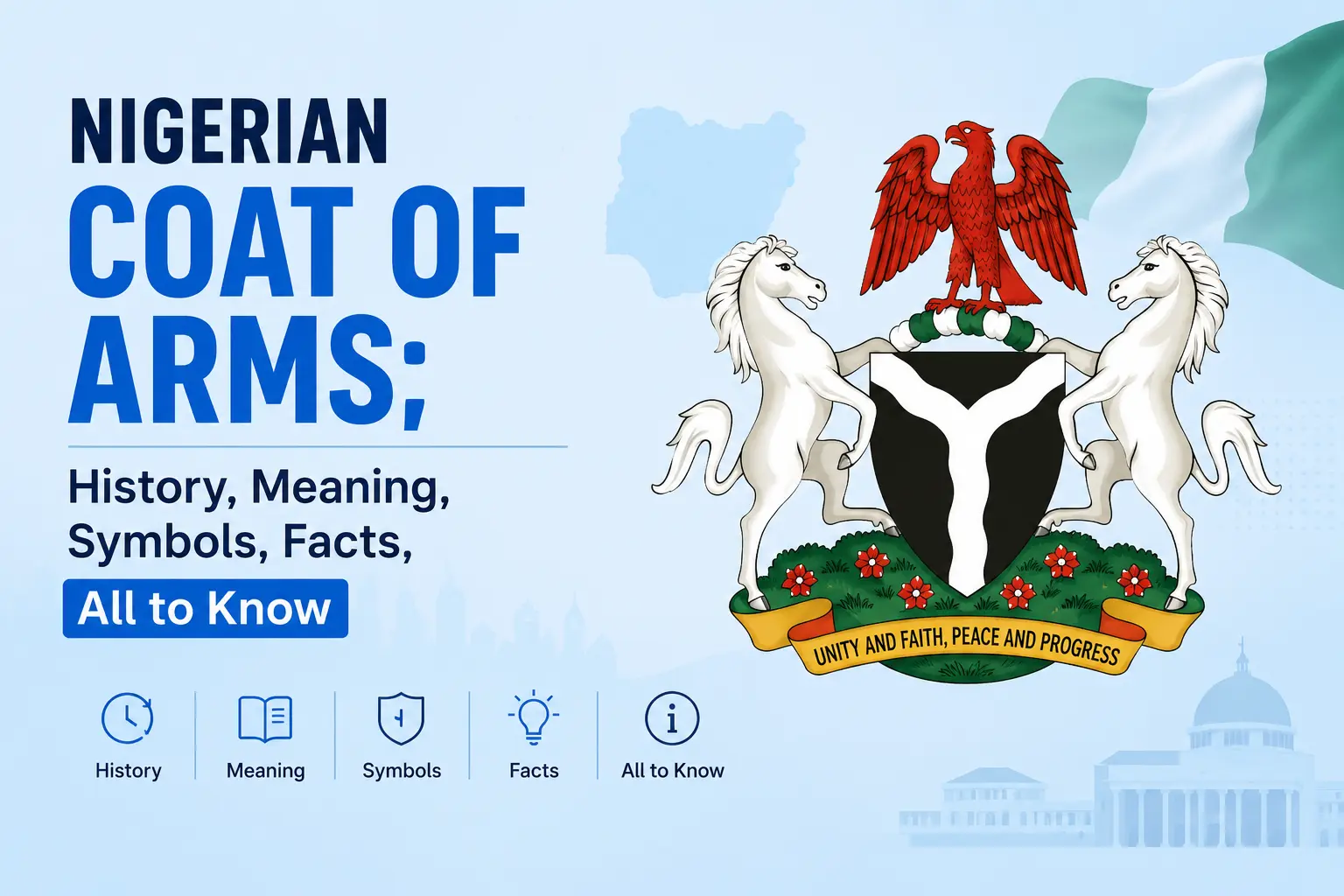
The Nigerian Coat of Arms is Nigeria’s official national emblem, a heraldic shield featuring a black escutcheon, two white horses, a red eagle, and the national motto “Unity and Faith, Peace and Progress.” Adopted on May 20, 1960, months before Nigeria’s independence on October 1, 1960, it was designed by Beverley Pick, a London-based designer. Every element carries specific meaning tied to Nigeria’s geography, strength, and national identity. This guide breaks down each symbol, the history behind the emblem, and facts most sources get wrong.
Jump To
Key Takeaways on Nigerian Coat of Arms
- The Nigerian Coat of Arms was officially adopted on May 20, 1960, and designed by Beverley Pick, not Taiwo Akinkunmi, who designed the Nigerian flag.
- The black shield represents Nigeria’s fertile soil, while the white Y-shaped pall represents the confluence of the River Niger and River Benue at Lokoja, Kogi State.
- Two white horses stand for dignity, and a red eagle atop the shield represents the nation’s strength.
- The flower at the base is Costus spectabilis (Yellow Trumpet), Nigeria’s national flower, not “Cactus spectabilis,” as many sources incorrectly report.
- The current national motto, “Unity and Faith, Peace and Progress,” was adopted in 1978, replacing an earlier motto from the original 1960 coat of arms.
- The Coat of Arms appears on Nigerian passports, Nigerian currency, government seals, and military insignia.
If you like information like this, join the Information to Know WhatsApp Channel for our Daily News Digest. Latest breaking news, music, movies, football, politics, business, economy, education, technology, security, sports, religious, entertainment, and other stories straight to your phone.
History of the Nigerian Coat of Arms
The Nigerian Coat of Arms was adopted on May 20, 1960, roughly four months before Nigeria gained independence from Britain on October 1, 1960. The emblem was part of a broader effort to establish a distinct national identity separate from colonial-era symbols.
Beverley Pick, a London-based designer, created the original design. A historical photograph from May 16, 1960, shows Pick holding the freshly approved coat of arms at his West End studio, as documented by ASIRI Magazine. This is an important distinction because many Nigerians confuse the coat of arms designer with Taiwo Akinkunmi, who designed the Nigerian national flag. The two are different people responsible for different national symbols.
The move to create a unique national emblem in 1960 was both symbolic and political — a statement that Nigeria would define itself on its own terms as it prepared for independence.
The Federal Ministry of Foreign Affairs lists the Coat of Arms among Nigeria’s official national symbols alongside the flag, the national anthem, and the national pledge.
Read: Construction Companies in Nigeria (2026 Updated)
Symbols on the Nigerian Coat of Arms and Their Meanings
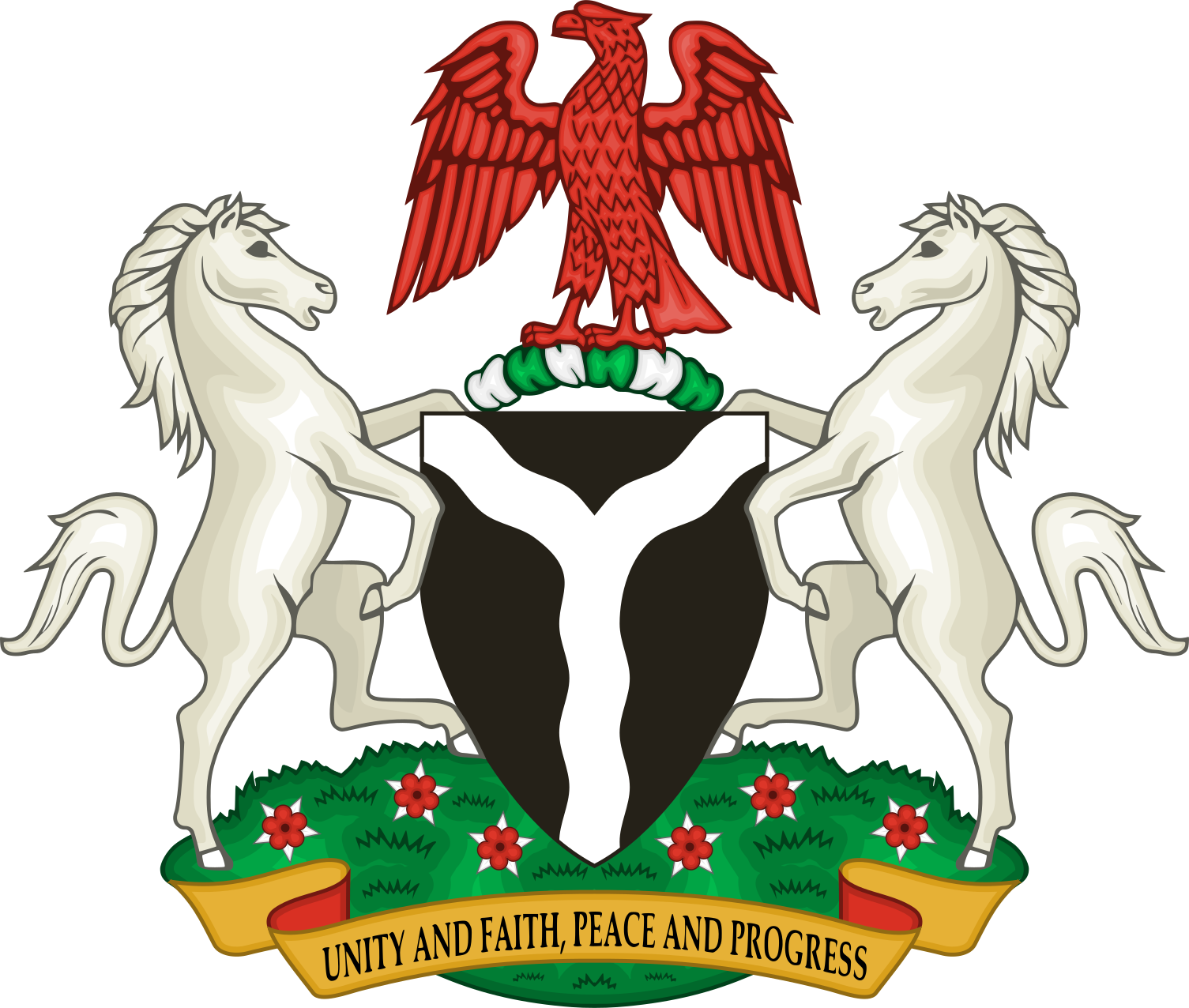
Each element on the Nigerian Coat of Arms carries a specific meaning tied to the country’s geography, values, and aspirations. Here is a breakdown of every symbol.
The Black Shield
The black shield (escutcheon) at the centre of the Coat of Arms represents Nigeria’s fertile soil. It symbolises the country’s agricultural wealth and the productive capacity of its land.
The White Y-Shaped Pall
The white Y-shaped band (called a pall in heraldic terms) running across the black shield represents the confluence of the River Niger and River Benue. These two major rivers meet at Lokoja in Kogi State, one of the most populated states in Nigeria. The Y-shape mirrors the actual geographic formation where these rivers join, making it one of the most geographically literal symbols on the coat of arms.
The River Niger itself is where the country gets its name; the word Nigeria was coined from it. So the river’s prominence on the national emblem is both historically and linguistically fitting.
The Two White Horses
Two white horses (called chargers in heraldic language) stand on either side of the shield, supporting it. They represent dignity, according to the Federal Ministry of Foreign Affairs.
The horses serve as the supporters in heraldic design, a standard feature in national coats of arms worldwide. In Nigeria’s case, their white colour and upright posture reinforce the idea of a nation that carries itself with pride and self-respect.
The Red Eagle
The red eagle perched on top of the shield serves as the crest of the Coat of Arms. It represents the strength of Nigeria as a nation. In Nigeria’s coat of arms, the eagle sits above all other elements, symbolising the overarching strength that holds the nation together.
The Costus Spectabilis (Yellow Trumpet)
The flowers placed at the base of the shield on both sides are Costus spectabilis, commonly known as the Yellow Trumpet. This is Nigeria’s national flower, and it represents the beauty of the nation.
An important correction: many websites and even some educational materials incorrectly write this as “Cactus spectabilis.” The correct name is Costus spectabilis; it has no botanical connection to cacti.
The Green and White Wreath
A wreath in green and white sits on top of the shield, directly beneath the red eagle. These are Nigeria’s national colours, the same green and white found on the Nigerian flag. This reinforces the visual connection between the two national symbols.
The National Motto: “Unity and Faith, Peace and Progress”
The band at the base of the coat of arms carries Nigeria’s national motto: “Unity and Faith, Peace and Progress.” This motto encapsulates the four pillars the nation aspires to uphold.
This was not always the motto. According to the CRW Flags vexillological reference, the original 1960 motto was “Unity and Faith,” while the Nigerian Tourism Development Authority records the former motto as “Peace, Unity, Freedom.” The expanded motto “Unity and Faith, Peace and Progress” was adopted in 1978, as part of the constitutional changes that accompanied Nigeria’s transition from military to civilian rule.
Read: Top Best Construction Companies in Lagos (Offices, Websites, CEOs & Projects)

The 1978 Modification of the Nigerian Coat of Arms
The Nigerian Coat of Arms was modified between its original adoption in 1960 and the version used today. The most notable change happened in 1978.
The original 1960 coat of arms carried an earlier motto recorded as “Unity and Faith” by the CRW Flags vexillological reference and as “Peace, Unity, Freedom” by the Nigerian Tourism Development Authority. In 1978, the motto was updated to “Unity and Faith, Peace and Progress.” This change accompanied broader constitutional reforms ahead of Nigeria’s transition to the Second Republic in 1979, after years of military rule and the Nigerian Civil War (1967–1970).
Beyond the motto, the overall composition of the coat of arms was refined. The post-1978 version is what Nigeria uses today, and it has remained unchanged since then.
This modification is often overlooked. Most articles about the Nigerian Coat of Arms present it as though it has been unchanged since 1960, which is not accurate. The 1978 update was a deliberate decision to embed broader national goals into the country’s most recognisable official emblem. The expanded motto reflected lessons learned from the Civil War era and the desire to signal a new chapter for the nation.
Where the Nigerian Coat of Arms Is Used
The Nigerian Coat of Arms is not just a decorative emblem. It appears on official documents and items that carry the authority of the Nigerian state.
- Nigerian passports: The coat of arms is printed on the cover of all Nigerian international passports, establishing the document’s authenticity as a product of the Nigerian government.
- Nigerian currency: You will find the coat of arms on Nigerian currency; both Naira banknotes and coins feature it prominently.
- Government seals and letterheads: Federal and state government offices use the coat of arms on official seals, letters, and publications.
- Military insignia: The coat of arms appears on military insignia used by the Nigerian Armed Forces. If you are researching Nigerian Navy ranks or other military branches, you will see the coat of arms incorporated into their official symbols. Various security agencies in Nigeria also use it.
- Government-issued certificates: The coat of arms appears on certificates and official correspondence from bodies like the Corporate Affairs Commission (CAC), etc.
Important Facts About the Nigerian Coat of Arms
Here are key facts about the Nigerian Coat of Arms that are worth knowing:
- The coat of arms was adopted before independence. Nigeria’s Coat of Arms was officially approved on May 20, 1960, more than four months before the country’s independence day on October 1, 1960.
- Beverley Pick designed it, not Taiwo Akinkunmi. Beverley Pick, a London-based designer, designed the coat of arms. Taiwo Akinkunmi designed the Nigerian flag. These are two different national symbols created by two different people.
- The “Y” on the shield is geographically accurate. The white Y-shape on the black shield traces the actual confluence of the River Niger and River Benue at Lokoja in Kogi State. It is one of the few national symbols worldwide that map directly to a country’s physical geography.
- The correct flower name is Costus spectabilis, not “Cactus spectabilis.” Many online sources misspell the national flower’s name. Costus spectabilis (Yellow Trumpet) is Nigeria’s national flower. It has nothing to do with cacti.
- The motto was updated in 1978. The original 1960 motto (recorded as “Unity and Faith” by some sources and “Peace, Unity, Freedom” by others) was replaced with “Unity and Faith, Peace and Progress” in 1978, ahead of Nigeria’s transition to the Second Republic in 1979.
- The coat of arms carries official authority. Its placement on government documents, currency, passports, and official seals means it functions as a mark of state authority, not just a decorative emblem.
- The horses represent dignity, not power. Some sources incorrectly claim the horses represent strength or power. They represent dignity.
- The coat of arms appears on every Nigerian passport. Alongside the country’s name, the coat of arms authenticates every Nigerian travel document issued for international use.
Explore More of Nigeria’s National Identity
The Nigerian Coat of Arms is more than a collection of symbols on a shield. It is a record of what Nigeria valued at its founding: fertile land, geographic unity, national strength, and beauty, and what it added as the nation matured: peace and progress.
Understanding these symbols connects you to the historical decisions that shaped the country. Whether you are a student preparing for an exam, a Nigerian abroad explaining your country’s identity, or someone researching Nigerian national symbols, the coat of arms tells a story that goes deeper than most summaries cover.
For more on Nigeria’s institutions and national identity, explore our guides on security agencies in Nigeria, Nigerian currency, and Nigerian Navy ranks.
Frequently Asked Questions on the Nigerian Coat of Arms
Who Designed the Nigerian Coat of Arms?
Beverley Pick, a London-based designer, designed the Nigerian Coat of Arms. A historical photograph from May 16, 1960, documented by ASIRI Magazine, shows Pick holding the approved design. Pick is often confused with Taiwo Akinkunmi, who designed the Nigerian flag, a completely different national symbol.
When Was the Nigerian Coat of Arms Adopted?
The Nigerian Coat of Arms was officially adopted on May 20, 1960, approximately four months before Nigeria’s independence from Britain on October 1, 1960. The emblem was created as part of the country’s effort to establish a distinct national identity ahead of independence, replacing colonial-era symbols. The original 1960 version was later modified in 1978, when the national motto was updated to “Unity and Faith, Peace and Progress.” The current version has been in continuous official use since 1978.
What Does the Black Shield on Nigeria’s Coat of Arms Represent?
The black shield (escutcheon) on the Nigerian Coat of Arms represents the country’s fertile soil. This symbol acknowledges Nigeria’s agricultural wealth and the productive capacity of its land. The shield sits at the centre of the coat of arms with a white Y-shaped pall running across it, representing the confluence of the River Niger and River Benue.
What Do the Two White Horses on the Nigerian Coat of Arms Mean?
The two white horses on the Nigerian Coat of Arms represent dignity. They are positioned on either side of the shield as heraldic “supporters.” Some sources incorrectly claim they represent strength or power, but the Federal Ministry of Foreign Affairs confirms that dignity is their official meaning. The horses’ white colour and upright posture symbolise a nation that carries itself with pride and self-respect.
What Is the National Motto of Nigeria?
Nigeria’s national motto is “Unity and Faith, Peace and Progress.” This motto is inscribed on the band at the base of the Nigerian Coat of Arms. The current motto was adopted in 1978, replacing an earlier motto from the original 1960 coat of arms, ahead of Nigeria’s transition to the Second Republic in 1979. The four pillars: unity, faith, peace, and progress represent the foundational values Nigeria aspires to uphold.
What Is the Difference Between the Nigerian Coat of Arms and the Nigerian Flag?
The Nigerian Coat of Arms and the Nigerian flag are two separate national symbols designed by different people. Beverley Pick designed the coat of arms, while Taiwo Akinkunmi, a Nigerian student at the time, designed the flag. The flag features three vertical bands (green-white-green), while the coat of arms is a heraldic emblem with a shield, horses, an eagle, flowers, and the national motto. Both were adopted in 1960.
What Flower Appears on the Nigerian Coat of Arms?
The flower on the Nigerian Coat of Arms is Costus spectabilis, commonly called the Yellow Trumpet. It is Nigeria’s national flower and represents the beauty of the nation. Many websites and educational materials incorrectly spell it “Cactus spectabilis,” but the correct name is Costus spectabilis; it has no botanical connection to cacti.