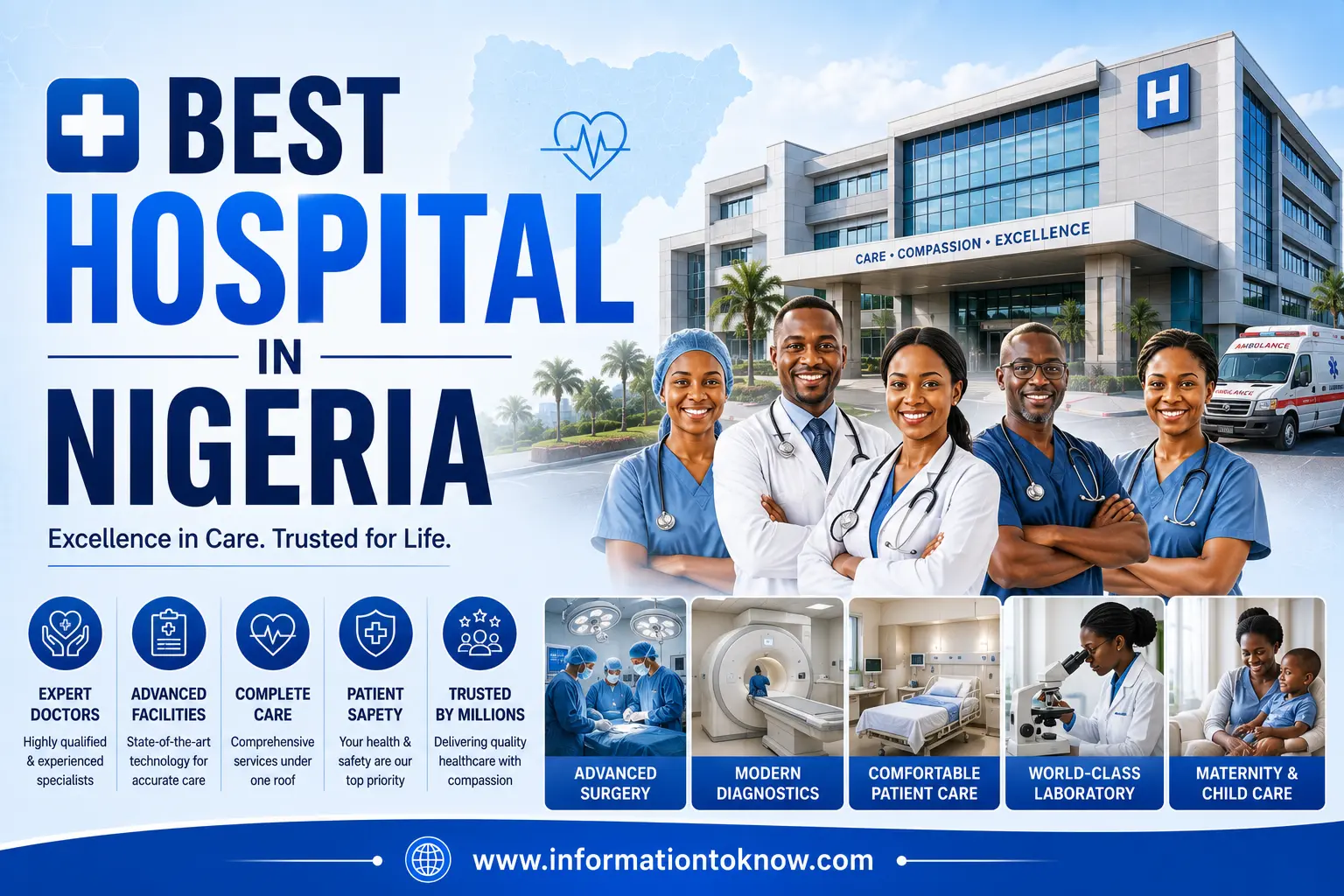
Short answer: There is no single hospital officially ranked the best in Nigeria. The names that come up most often for quality care are Lagoon Hospitals, Evercare Hospital Lekki, Reddington Hospital and St. Nicholas Hospital in Lagos, National Hospital Abuja, Cedarcrest and Nisa Premier in Abuja, and major teaching hospitals like LUTH (Lagos) and UCH (Ibadan). Which one is best for you depends on your condition, your city, your budget, and whether your insurance is accepted. This guide gives you an honest shortlist and a simple way to choose.
Choosing a hospital in Nigeria is not a casual decision. Whether you are planning surgery, expecting a baby, managing a serious diagnosis, or facing a sudden emergency, the hospital you pick can shape the outcome and the cost.
The problem is that almost every “best hospital in Nigeria” list online is written by a hospital promoting itself. Our guide is different: it names the hospitals most widely respected for quality care, explains what each is actually known for, and then gives you a practical method for choosing the right one for your situation. No hype, no single winner, because in reality there isn’t one.
Jump To
Why There’s No Single Best Hospital in Nigeria
No official body ranks Nigerian hospitals by clinical outcomes, so any best list is an informed editorial judgement based on reputation, specialist coverage, facilities and accreditation, not audited results. The honest answer is that the best hospital depends on what you need.
It also helps to understand the system you are choosing within, because it explains why picking carefully matters so much.
Nigeria has very few doctors for its population. As of 2022, the country had roughly 0.39 physicians per 1,000 people — about one doctor for every 2,600 Nigerians, according to World Bank data sourced from the WHO. The gap has been widened by emigration: the Nigerian Medical Association said in June 2026 that of more than 130,000 doctors registered with the Medical and Dental Council, only about 55,000 are actively practising in Nigeria. A 2025 peer-reviewed analysis put the ratio at fewer than one doctor per 2,600 people, well below global benchmarks.
That strain on specialist care is one reason so many Nigerians look abroad. The health minister has estimated that Nigeria loses as much as $2 billion a year to medical tourism, while the Central Bank tracked about $549 million in health-related foreign-travel spending in the first nine months of 2025 alone, according to reporting in The Punch. These are official estimates rather than an independently audited dataset. Still, the direction is clear: trust in the system is thin, and the strongest hospitals stand out precisely because they are the exception.
For patients, the takeaway is simple: choosing the right hospital — and knowing how to judge one — is worth the effort.
Top Hospitals in Nigeria at a Glance
Here is the shortlist this guide covers. It is an editorial selection built around specialist reputation, facilities, accreditation and geographic spread, not an official government ranking. Different hospitals lead in different areas.
NB: Slide left to view the table if you’re on mobile.
| Hospital | City | Type | Best known for |
|---|---|---|---|
| Evercare Hospital Lekki | Lagos | Private tertiary | Multi-specialty care, cardiology, ICU/NICU |
| Lagoon Hospitals | Lagos | Private tertiary | JCI accreditation, structured private care |
| Reddington Hospital | Lagos | Private tertiary | Cardiology, oncology, emergency care |
| St. Nicholas Hospital | Lagos | Private tertiary | Kidney transplant, internal medicine |
| Eko Hospital | Lagos | Private tertiary | General multi-specialty, long track record |
| Euracare Multi-Specialist | Lagos | Private tertiary | Cardiac and cancer diagnostics |
| National Hospital Abuja | Abuja | Public tertiary | Complex referral cases, oncology |
| Cedarcrest Hospitals | Abuja | Private tertiary | Orthopaedics, trauma |
| Nisa Premier Hospital | Abuja | Private | Maternity, fertility |
| Nizamiye Hospital | Abuja | Private | General multi-specialty |
| LUTH | Lagos | Teaching | Complex referrals, specialist training |
| UCH Ibadan | Ibadan | Teaching | Broad tertiary care, research |
| UNTH Enugu | Enugu | Teaching | Referral care for the South East |
| OAUTHC | Ile-Ife | Teaching | Referral care for the South West |
| AKTH Kano | Kano | Teaching | Referral care for the North West |
| UPTH | Port Harcourt | Teaching | Referral care for the South South |
Best Private Hospitals in Nigeria
Private hospitals dominate the conversation when the priority is speed, comfort, consultant-led attention and modern facilities. These are the names that come up most often.
Evercare Hospital Lekki (Lagos)
A modern private tertiary hospital in the Lekki environs, Evercare offers services spanning critical care, paediatrics, interventional cardiology, dialysis, and more, supported by CT, MRI, an ICU, NICU, and 24/7 emergency response. It draws patients seeking multi-specialty care under one roof, and is often mentioned for cardiac and oncology cases that would otherwise send families abroad. Best suited to patients who want consultant-led care in a modern private setting.
Lagoon Hospitals (Lagos)
Founded in 1986 and now operating several branches across Lagos, Lagoon is one of Nigeria’s most recognised private groups. Its clearest quality signal is international: Iwosan Lagoon Hospitals earned Joint Commission International (JCI) accreditation for a fifth time in 2024, having first achieved it in 2011, according to BusinessDay. Per the hospital’s own communications, it was the first in Sub-Saharan Africa to do so. Its managing director, Olubisi Oyeniran, framed the milestone around “ensuring that our patients receive the safest, most compassionate, and highest quality care.” Best for patients who prioritise structured private care with a verifiable accreditation.
Reddington Hospital (Lagos)
A multi-specialty private hospital well regarded for cardiology, oncology and emergency care, popular with patients on Lagos Island and the mainland alike. With locations in Victoria Island and Ikeja, it is a common choice for heart care and urgent cases, and runs specialist units that reduce the need to travel out of the country. Best for patients wanting round-the-clock private emergency and cardiac cover.
St. Nicholas Hospital (Lagos)
One of the oldest private hospitals in Lagos, St. Nicholas built its reputation on internal medicine and pioneering kidney transplantation in Nigeria. It is frequently cited for renal care, dialysis and organ transplant expertise built over decades, making it a reference point for patients managing kidney disease. Best for complex internal-medicine and transplant needs.
Eko Hospital (Lagos)
One of Nigeria’s earliest private hospital groups, Eko Hospital has a long general multi-specialty track record across Ikeja and other Lagos sites. It handles everything from routine consultations to surgery and maternity, and is a familiar, established option for families wanting dependable private care close to home.
Euracare Multi-Specialist Hospital (Lagos).
A newer premium player on Victoria Island, Euracare is known for advanced cardiac and cancer diagnostics and interventional procedures. It positions itself around imaging, catheterisation and oncology services that many local hospitals lack. Best for patients who need advanced diagnostics or interventional cardiology without leaving Lagos.
Best Hospitals in Abuja
If you are in the Federal Capital Territory, the hospitals most often named for quality care are:
National Hospital Abuja
A large federal public tertiary hospital that handles complex referral cases, including oncology, radiotherapy and specialist surgery. It is often the reference point for serious care in the capital, drawing patients from across the country, and combines national referral status with subsidised public pricing.
Cedarcrest Hospitals
A private group known for orthopaedics and trauma care, with modern imaging and surgical facilities. It has become a go-to name for bone, joint and accident cases in Abuja, and runs branches beyond the capital for patients needing structured private treatment.
Nisa Premier Hospital
Frequently mentioned for maternity and fertility services, including IVF and neonatal care. It is a popular private choice for expectant families in Abuja who want consultant-led delivery, well-equipped theatres and newborn support under one roof.
Nizamiye Hospital
A private multi-specialty hospital in Life Camp offering general medicine, surgery, paediatrics and diagnostics. Built to international standards, it is widely used by Abuja residents wanting comprehensive private care and shorter waiting times than the public system typically allows.
Abuja’s mix of a strong public tertiary hospital alongside established private options means you can often match the hospital to whether you value cost (National Hospital) or private-setting speed and comfort.
Best Teaching and Government Hospitals in Nigeria
Government teaching hospitals rarely win beauty contests, but they belong on any serious list. They manage many of the country’s most complex referral cases and train the specialist doctors that private hospitals then rely on, and they cost far less.
The most prominent include:
Lagos University Teaching Hospital (LUTH) — Lagos
One of Nigeria’s foremost referral centres, LUTH handles high-complexity cases across nearly every specialty and trains a large share of the country’s doctors. It is a first stop for serious conditions on the mainland, at heavily subsidised public rates.
University College Hospital (UCH) — Ibadan (Nigeria’s oldest teaching hospital)
Nigeria’s oldest and most storied teaching hospital, UCH is renowned for its breadth of specialties, research output and deep referral capacity. It remains a national reference point for difficult cases across the South West and beyond.
University of Nigeria Teaching Hospital (UNTH) — Enugu
The main tertiary referral hospital for the South East, UNTH offers a wide range of specialist services and surgical care. It anchors complex treatment for the geopolitical region and trains many of its resident doctors and consultants.
Obafemi Awolowo University Teaching Hospitals Complex (OAUTHC) — Ile-Ife
A leading South West referral complex, OAUTHC is respected for its specialist departments and teaching tradition. It manages complicated cases referred from surrounding states while remaining far more affordable than comparable private care.
Aminu Kano Teaching Hospital (AKTH) — Kano
The principal tertiary hospital for the North West, AKTH provides broad specialist and referral services to one of Nigeria’s most populous regions. It carries a heavy patient load and is central to specialist training in northern Nigeria.
University of Port Harcourt Teaching Hospital (UPTH) — Port Harcourt
The main referral hospital for the South-South, UPTH covers major specialties including surgery, oncology and maternal care. It serves the oil-producing region’s large population and remains a key destination for complex, subsidised treatment.
These hospitals anchor tertiary care across the country’s regions. The trade-offs are real, though: longer waiting times, heavier patient loads, and occasional disruption from industrial action (health workers going on strike). For complex or high-cost conditions where specialist depth matters more than comfort, they are often the right call.
Private vs. Teaching vs. General Hospital: Which Should You Choose?
The choice usually comes down to what you are looking for. Private hospitals lead on comfort, convenience and speed; teaching hospitals lead on case complexity, referral depth and specialist training; general and mission hospitals fill the everyday gap in between.
NB: Slide left to view the table if you’re on mobile.
| If your priority is… | Best fit | Why |
|---|---|---|
| Speed, comfort, short waits | Private tertiary hospital | Consultant-led, less crowded, faster admission |
| A complex or rare condition | Teaching hospital | Deepest specialist and referral capacity |
| Lower cost | Government/teaching or general hospital | Heavily subsidised compared with private care |
| Routine or nearby care | Reputable general/mission hospital | Adequate for common conditions, closer to home |
There is no wrong category, only the wrong match for a given need. A straightforward delivery, a heart bypass, and a broken arm each point to different places.
How to Choose the Best Hospital for Your Needs
Match the hospital to your specific situation using this checklist, in roughly this order:
- Match the specialty first. Confirm the hospital actually treats your condition and has the equipment for it (for example, a cath lab for cardiac work, dialysis, an NICU for high-risk delivery). A great general hospital is the wrong choice for a rare specialist procedure.
- Look for verifiable quality signals. International accreditation such as JCI, or teaching-hospital status, are stronger signals than marketing language. Nigeria has thousands of registered hospitals and clinics, but registration alone says nothing about quality or whether a facility is fully operational, so look for concrete signals rather than a licence on the wall.
- Weigh location and emergency access. For anything time-critical, the best hospital two hours away in traffic may be worse than a solid one nearby. Know your closest capable hospital before you need it.
- Get the cost in writing. Ask for a written estimate for your procedure, and don’t assume the most expensive hospital is the best for your case.
- Confirm your insurance is accepted. Check the hospital is on your HMO or NHIA provider network before treatment (more on this below).
- Ask for referrals. A recommendation from a doctor you trust, or from patients who have had your specific procedure there, beats any online list.
What It Costs and How Insurance Works (NHIA/NHIS)
Treatment costs in Nigeria vary enormously by hospital and procedure, and the bigger issue is who pays. About 75% of all health spending in Nigeria comes straight out of patients’ pockets, World Bank and WHO data reported by CJID shows — one of the highest out-of-pocket rates in the world. That means for most people, the hospital’s price list matters as much as its reputation.
Formal insurance is meant to cushion this, but coverage is still low. The National Health Insurance Authority (NHIA) Act, signed in May 2022, makes health insurance mandatory for all Nigerians and legal residents, replacing the older, non-mandatory NHIS scheme. Enforcement is still ramping up, though — fewer than 5% of Nigerians are formally enrolled, which is why so many still pay out of pocket.
Practical steps:
- If you have an HMO or NHIA plan, confirm the hospital is in your network and which services are covered before treatment.
- Budget for out-of-pocket extras even with insurance.
- If you don’t have cover yet, it’s worth understanding how much health insurance costs in Nigeria and comparing affordable insurance companies in Nigeria before an emergency forces the decision for you.
Emergency vs. Planned Care
For planned care — surgery, maternity, managing a chronic condition — you have time to shortlist, compare costs, check insurance and get referrals. Use it.
For an emergency, the priority flips to speed and capability: get to the nearest hospital with a functioning accident and emergency unit and the relevant specialty. This is exactly why you should identify your closest capable hospital in advance, before a crisis.
If you are in the diaspora arranging care for family back home, do the verification yourself: call the hospital, confirm the specialty and current capacity, and get a written cost estimate rather than relying on any website.
Shortlist Your Hospitals Before You Need Them
The single most useful thing you can do with this guide is act on it while you’re calm, not in a crisis. Pick two hospitals now — one for planned specialist care and one nearby for emergencies — confirm they treat the conditions your family is most likely to face, and check today whether your insurance or NHIA plan is accepted there. Save their emergency numbers in your phone.
Best isn’t a trophy a single hospital holds; it’s the hospital that fits your condition, your city, your budget and your cover, chosen before the pressure is on. Do that groundwork now, and you’ll never have to gamble on a Google search in the middle of an emergency.
Nigeria Best Hospital Frequently Asked Questions
1. What is the best hospital in Nigeria?
There is no single officially ranked best hospital in Nigeria. The names most consistently regarded for quality care include Lagoon Hospitals, Evercare Hospital Lekki, Reddington Hospital and St. Nicholas Hospital (Lagos), National Hospital Abuja, and teaching hospitals such as LUTH and UCH Ibadan. The best hospital for you depends on your condition, city, and budget.
2. What are the top 5 hospitals in Nigeria?
Frequently cited top hospitals are Evercare Hospital Lekki, Lagoon Hospitals, Reddington Hospital, National Hospital Abuja, and Lagos University Teaching Hospital (LUTH), a mix of private and teaching hospitals, because each leads in different areas.
3. What is the best hospital in Lagos?
In Lagos, the hospitals most often named for quality private care are Evercare Hospital Lekki, Lagoon Hospitals, Reddington, St. Nicholas, Eko Hospital and Euracare, while LUTH leads on complex referral cases.
4. What is the best hospital in Abuja?
In Abuja, the commonly cited hospitals are National Hospital Abuja (public tertiary), Cedarcrest Hospitals, Nisa Premier Hospital and Nizamiye Hospital.
5. Which is better: a private hospital or a government teaching hospital?
Private hospitals usually win on speed, comfort and convenience; government teaching hospitals win on complex, specialist and referral cases and are far cheaper, but can have longer waits and are affected by industrial action.
6. Is any Nigerian hospital internationally accredited?
Yes. Iwosan Lagoon Hospitals earned Joint Commission International (JCI) accreditation for a fifth time in 2024, first achieving it in 2011 — an international quality signal few Nigerian hospitals hold.
7. How much does treatment cost at top Nigerian hospitals?
Costs vary widely by hospital and procedure, and about 75% of health spending in Nigeria is paid out of pocket. Private tertiary hospitals cost far more than government hospitals; always request a written estimate and confirm what your insurance covers.
8. Does health insurance cover private hospitals in Nigeria?
It can, if the hospital is on your HMO or NHIA provider network. Formal coverage is still low — fewer than 5% of Nigerians are formally enrolled — so most patients pay out of pocket. Confirm the hospital accepts your plan before treatment.
9. What is the NHIA and is health insurance mandatory in Nigeria?
The National Health Insurance Authority (NHIA) Act, signed in May 2022, makes health insurance mandatory for all Nigerians and legal residents, replacing the older non-mandatory NHIS. Enforcement and enrollment are still expanding.
10. What is the biggest hospital in Nigeria?
Large federal facilities such as the University College Hospital (UCH) Ibadan, LUTH, and National Hospital Abuja are among the biggest by bed capacity and caseload, and are frequently cited among the country’s largest hospitals.
11. How do I choose the right hospital for my condition?
Match the hospital to your specific need: confirm it has the relevant specialty and equipment, check for accreditation or teaching-hospital status, weigh distance for emergencies, get a cost estimate, confirm insurance acceptance, and ask for referrals from a doctor you trust.