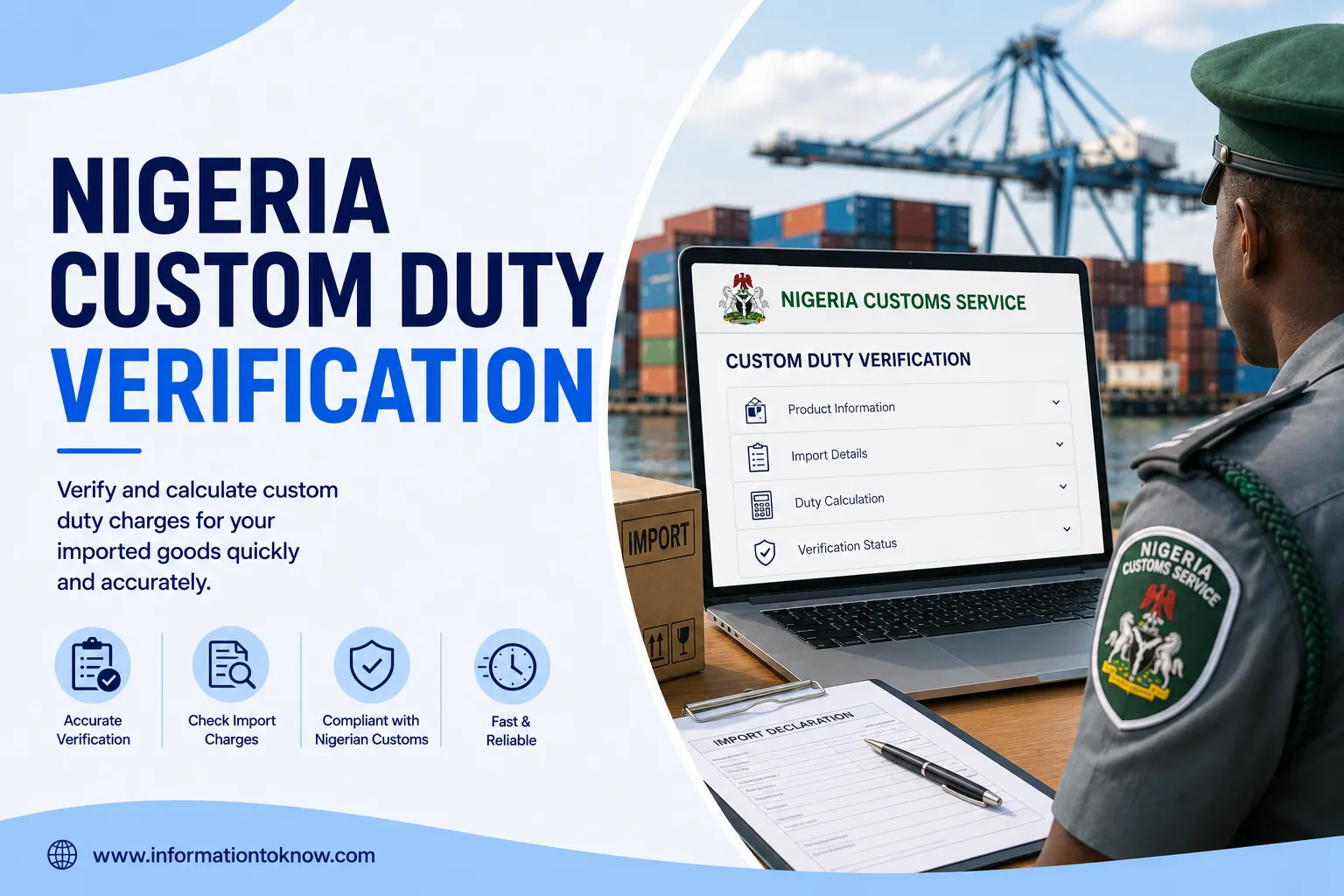
Short answer: You can now verify a car’s customs duty in Nigeria in minutes online through the official VREG National Vehicle Registry, instantly from any phone by dialling
*7031#, or the old way through the Nigeria Customs Service helpdesk or a Customs command office. All you really need is the vehicle’s VIN (chassis number). If the check returns no record or a different VIN, the duty papers are almost certainly fake; walk away before you pay.
If you searched Nigeria Custom Duty Verification, you are probably about to buy a used (Tokunbo) car, or you already own one and want to be sure its papers are genuine. This is the right instinct. A lot of older guides tell readers that they cannot check customs duty online in Nigeria. That advice is now outdated. This guide gives you every working method this year, from fastest to most thorough, plus how to read the result and avoid the scams that have grown around this exact problem.
Here’s how the five verification methods compare at a glance, so you can jump to the one that fits your situation.
NB: Slide left to view the table if you’re on mobile.
| Method | Speed | Cost | Best for |
|---|---|---|---|
| VREG portal (vreg.gov.ng) | Instant | Low (small fee for full report) | Anyone with internet who wants an official record |
*7031# USSD code | Instant | Free/cheap | Checking on the spot with no internet |
| VREG mobile app | Instant | Low | Buyers who want full history (theft, lien, accidents) |
| NCS helpdesk (phone/SMS) | Fast | Free | When you want a person to confirm the details |
| Customs Command Office | Slower | Free | Disputes, or when you need an official printout |
Jump To
What Customs Duty Verification Actually Means (and Why It Protects You)
Customs duty verification simply means confirming that the Nigeria Customs Service (NCS) has a record showing that the correct import duty was fully and legitimately paid for that exact vehicle. It is not about trusting a printed paper; it is about matching that paper against the Customs database using the car’s VIN.
This matters because unpaid, underpaid, or forged duty makes a car liable to seizure, even years after you buy it. The risk is not theoretical. Nigeria Customs said it seized 51 smuggled vehicles with a Duty Paid Value of ₦1.18 billion in just the first five months of 2026. Enforcement is also getting tougher: Customs recorded 298 seizures worth ₦7.69 billion in a single quarter of 2025, a 78% jump from the previous quarter. If a car’s duty isn’t clean, the loss lands on whoever is holding it, and that could be you.
Documents and Terms You Need Before You Verify Customs Duty
Before you check anything, get familiar with the few details that every verification method relies on. You’ll find most of them on the seller’s customs paperwork.
- VIN/chassis number — the 17-character code that uniquely identifies the vehicle. Customs values and records every car by its VIN, so this is the master key to verification. You’ll find it on the dashboard (driver’s side), the door jamb, or the engine bay.
- C-Number (Customs Reference Number) — the unique number assigned to the vehicle’s duty record. It sits in the top-right corner of the Single Goods Declaration form.
- SGD (Single Goods Declaration) form — the official document generated when duty is assessed and paid. It carries the C-Number, the port, and the payment details.
- Port of entry — the Customs command the car was cleared through (e.g., Tin Can Island or Apapa in Lagos, Onne in Port Harcourt). Learn more about seaports in Nigeria.
- Date of payment — the year the duty was paid.
You don’t need all of these for every method; the VIN alone is enough for the online checks, but having them ready makes the phone and in-person methods faster.
Where to find the VIN: it’s usually stamped on the driver-side dashboard (visible through the windscreen), on the driver-side door jamb, or in the engine bay. Always read the VIN off the car itself rather than trusting the number written on the papers; cloned or “cut-and-joined” cars are exactly where those two disagree.
What a genuine duty document shows: a real customs clearance record generally carries the Customs Reference Number (C-Number), the assessed duty amount paid, the date and port of payment, and an official stamp and officer’s signature. Spelling errors, blurry text, a missing reference number, or a port that doesn’t match the story you were told are all warning signs. However, the only reliable test is checking those details against the Customs database, not eyeballing the paper.
The Fastest Way: Verify Customs Duty Online With VREG
The quickest online method to verify customs duty is VREG, the government’s own vehicle registry. The VREG National Vehicle Registry provides duty payment validation and is the centralized database for all vehicles in Nigeria using their unique Vehicle Identification Numbers (VINs). Its Duty Status service confirms whether the appropriate duties and levies have been paid and flags outstanding obligations or under-declared imports.
VREG is legitimate and official. It was created by the Federal Ministry of Finance specifically to address the menace of customs duty evasion and vehicle theft, stemming from the absence of a centralized nationwide vehicular information system. It is connected to multiple agencies, including the Nigeria Customs Service and the Federal Road Safety Corps (FRSC).
How to verify customs duty with VREG:
- Go to vreg.gov.ng.
- Choose the VIN verification/Duty Status service.
- Enter the vehicle’s 17-character VIN.
- Review the result; it shows whether the VIN is valid and registered and its customs duty payment status.
A basic status lookup is inexpensive; a full vehicle history report may incur a small fee. Never pay a large instant fee to a random website claiming to be Customs; that’s a common scam (more on that below).
Verify From Any Phone With the *7031# USSD Code
If you don’t have internet, you can still check duty status in seconds using a USSD code. This VREG USSD code is built so you can access vehicle verification services from any mobile phone, no internet required. The code for this is *7031#. Dialling *7031# is the fastest way to check VIN and Duty status without internet, and it tracks accident history, customs duty clearance, and lien (loan) status. Codes and short-codes can change, so if *7031# doesn’t respond, use the VREG portal or app instead.
How to use VREG USSD code to verify customs duty
- Dial
*7031#on your phone. - Follow the prompts and enter the vehicle’s VIN.
- Read the response; it confirms whether the VIN is registered and whether Customs duty was paid.
This is the method to use while standing in front of a car at the point of sale or when you need it ASAP: no laptop, no data, just your phone.
The VREG App and Full Vehicle History Report
For buyers who want the complete picture, the VREG mobile app pulls the same duty status plus a broader vehicle history — ownership changes, accident and incident records, insurance status, and lien (loan) status. The official VREG app, developed under the mandate of the Federal Ministry of Finance, lets you perform immediate checks to confirm the Import Duty payment status (Cleared or Outstanding), so you can see in plain terms whether the car is clean. This is worth it for a big purchase: it tells you not just whether duty was paid, but whether the car is stolen, encumbered by a loan, or has a hidden accident history. Because Customs values a car from its VIN and not the seller’s invoice, the app also helps you spot when a car was cleared as a different (usually older or smaller-engine) vehicle than the one you’re being sold.
Verify Through the Nigeria Customs Service Helpdesk
The older phone/SMS/email helpdesk method still works and is useful when you want a human to confirm. You contact the Nigeria Customs Service helpdesk and provide the C-Number, the port/command where the duty was paid, and the date of payment. The officer enters those details into the Customs system and tells you whether they match a genuine record.
This process is usually quick, and the officer can often send a scanned copy of the record back to you.
Here are the Nigeria Customs Service helpdesk lines and emails:
- 07037891156
- 02018898888
- 02018898889
- info@customs.gov.ng
- helpdesk@customs.gov.ng
- pro@customs.gov.ng
Verify in Person at a Customs Command Office
For a dispute or when a car is expensive enough that you want an official printout, visit a Customs command office in person. This is the most reliable method because an officer checks the database directly against the car in front of them.
Bring:
- The car’s VIN (and let the officer read it off the vehicle).
- The customs duty papers provided by the seller.
- The bill of lading, if available.
- The plate number, if the car is already registered.
The officer will confirm whether the duty was paid legitimately and whether the papers match the vehicle, and you can request an official Duty Verification Printout as proof of clearance.
You can check the area commands for more details.
How to Read Your Verification Result (Real Red Flags)
A verification is only useful if you know what the result is telling you. The rule of thumb is simple: if the details you provide return no result at all, treat the customs paper as most likely fake or the duty as never paid. And if the check returns a VIN that is different from your car’s, then either the car’s VIN has been tampered with, or the customs document was forged for another vehicle.
Here’s how to act on each outcome:
- Duty paid, VIN matches → good. Get the printout/screenshot and keep it.
- No record found → treat the papers as fake or the duty as unpaid. Don’t pay until Customs confirms.
- VIN mismatch → the papers likely belong to another car. Walk away or verify in person before anything else.
- Under-declared / outstanding obligation flagged → duty was partly paid; you could inherit a demand notice. Resolve it with Customs first.
Watch Out for Fake Verification Portals and Scams
The rise of online verification has also created a wave of fake portals; use only official channels. We repeatedly warn against fake online Customs portals that promise instant verification for cheap, fake clearing agents offering discounted duty receipts, and Customs auction dealers selling supposedly seized cars at giveaway prices. Stick to VREG (vreg.gov.ng), the *7031# code, the official NCS helpdesk, or a physical command office. If a portal asks for a large upfront fee for an instant miracle result, it’s a red flag.
Current Car Import Duty Rates (So You Can Sanity-Check the Numbers)
Knowing the current rates helps you judge whether a duty amount even looks right. It’s noteworthy that in July 2026, the government cut the National Automotive Council (NAC) levy, a change confirmed by Nigeria Customs: the used-vehicle levy dropped from 15% to 5%, and the new-vehicle levy from 20% to 10%, effective 1 July 2026.
NB: Slide left to view the table if you’re on mobile.
| Charge | Used car (Tokunbo) | Notes |
|---|---|---|
| Import duty | 20% of CIF | ECOWAS Common External Tariff |
| NAC levy | 5% of CIF | Cut from 15% on 1 July 2026 (new cars: 10%) |
| VAT | 7.5% | Calculated on the stacked total |
| Green Tax | 0% / 2% / 4% | 0% under 2,000cc; 2% for 2,000–3,999cc; 4% for 4,000cc+ |
| Surcharge & ETLS/CISS | 7% surcharge on duty + small levies | Rates can vary |
Two things to remember. First, Customs values the car from its VIN-based CIF value, not the price on your invoice, so the duty is based on Customs’ own valuation of that year, make, and model. Second, Nigeria enforces a 12-year age limit (in force since 2022), which, for 2026, means model-year 2014 or newer; older imports risk seizure regardless of duty. Rates and the exchange rate change, so always confirm the current figure with the NCS.
What to Do if a Car Has No (or Fake) Customs Duty
If verification shows unpaid or forged duty, stop the purchase and regularise it through Customs; never through a “fixer.”
- For a car you already own, contact the NCS helpdesk or a command office to start the retrieval or regularisation process. You may be required to pay the assessed duty in full plus any penalty before you receive a genuine, verifiable clearance. There is no fixed public price for this; the amount depends on the car’s Customs-assessed value and how much (if any) duty was originally paid, so ask Customs directly for the demand notice rather than accepting a figure from an agent.
- For a car you’re about to buy, remember that a cheap car with an outstanding balance stops being cheap the moment that bill lands on you. Make clean, verified papers a condition of payment, or walk away.
Once the duty side is clean, the rest of the ownership chain becomes straightforward. You can register the vehicle and, if needed, renew your driver’s license and sort out plates. And if you’re importing rather than buying locally, choosing reputable shipping companies in Nigeria and clearing your car properly from the start avoids this whole problem.
Do Your Duty Check Before You Pay
Here’s the one action that matters: run the car’s VIN through VREG or *7031# before any money changes hands. It costs little to nothing, takes minutes, and is the single cheapest insurance against losing millions to a smuggled or fake-paper car. The old advice that you can’t verify customs duty online is dead; you now have official, instant tools, so use them. Get the VIN, run the check, confirm the result matches the car, and only then pay. If anything comes back “no result” or with a mismatched VIN, treat it as your cue to walk away and verify in person at a Customs office.
Frequently Asked Questions (FAQ) on Nigeria Customs Duty Verification
Can I check Nigeria customs duty online?
Yes. Since the launch of VREG (vreg.gov.ng), you can verify a vehicle’s customs duty status online or through the *7031# USSD code. The older “no online portal” advice is outdated.
What is the code to check customs duty in Nigeria?
Dial *7031#, enter the VIN, and you’ll get the VIN’s registration and customs duty payment status, no internet required.
How do I verify customs duty with my VIN or chassis number?
Enter the 17-character VIN on VREG or via *7031#. Customs values and records vehicles by VIN, so it returns whether duty was paid and flags mismatches or under-declarations.
What is a C-Number on customs duty papers?
The C-Number (Customs Reference Number) is the unique number assigned to your Single Goods Declaration (SGD) form. It’s found on the top-right of the SGD and identifies your vehicle’s duty record.
What is the SGD form?
The Single Goods Declaration (SGD) is the official customs document generated when duty is assessed and paid; it carries the C-Number, port, and payment details you use to verify.
How much is the customs duty on a car in Nigeria?
Used cars attract a 20% import duty plus a 5% NAC levy (cut from 15% on 1 July 2026), 7.5% VAT, and a Green Tax of 0–4% by engine size, calculated on the VIN-based CIF value, not your receipt.
Can Customs seize a car with unpaid or fake duty?
Yes. Customs routinely seizes vehicles with no, forged, or underpaid duty. 51 cars worth ₦1.18bn were seized in just five months of 2026, even from buyers who bought them innocently.
How long does customs duty verification take?
Online checks via VREG or *7031# are near-instant. The NCS helpdesk method is usually quick once you reach an officer, while a physical office visit takes longer but is best for disputes or when you need an official printout.
Is there a fee to verify customs duty?
The *7031# check and basic status lookups are cheap or free; a full VREG vehicle-history report may carry a small fee. Beware of portals charging high fees for instant results; many are scams.
What does it mean if my verification returns “no result”?
If the details you provide return no record, the customs paper is most likely fake or the duty was never paid. Don’t buy or pay until it’s resolved through Customs.
What if the VIN returned doesn’t match my car?
A mismatched VIN means either the car’s VIN was tampered with or the customs document was forged for a different vehicle. Treat it as a red flag and verify in person at a Customs office.
Do I need customs duty verification if the seller shows me papers?
Yes. Papers can be forged or belong to another car. Always confirm the papers against NCS records for that exact VIN before paying.
Where can I verify customs duty in person?
At the nearest Nigeria Customs Service command office. Go with the VIN, the seller’s duty papers, the bill of lading if available, and the plate number. Ask for an official Duty Verification Printout.
What is VREG, and is it official?
VREG is the National Vehicle Registry created by the Federal Ministry of Finance to curb customs duty evasion and vehicle theft. It’s the official platform (vreg.gov.ng) for registering and verifying vehicles nationwide.
Is the 15-year car age limit still correct?
No. Nigeria enforces a 12-year age limit (in force since 2022), so for 2026 that means model-year 2014 or newer; older imports risk seizure regardless of duty.