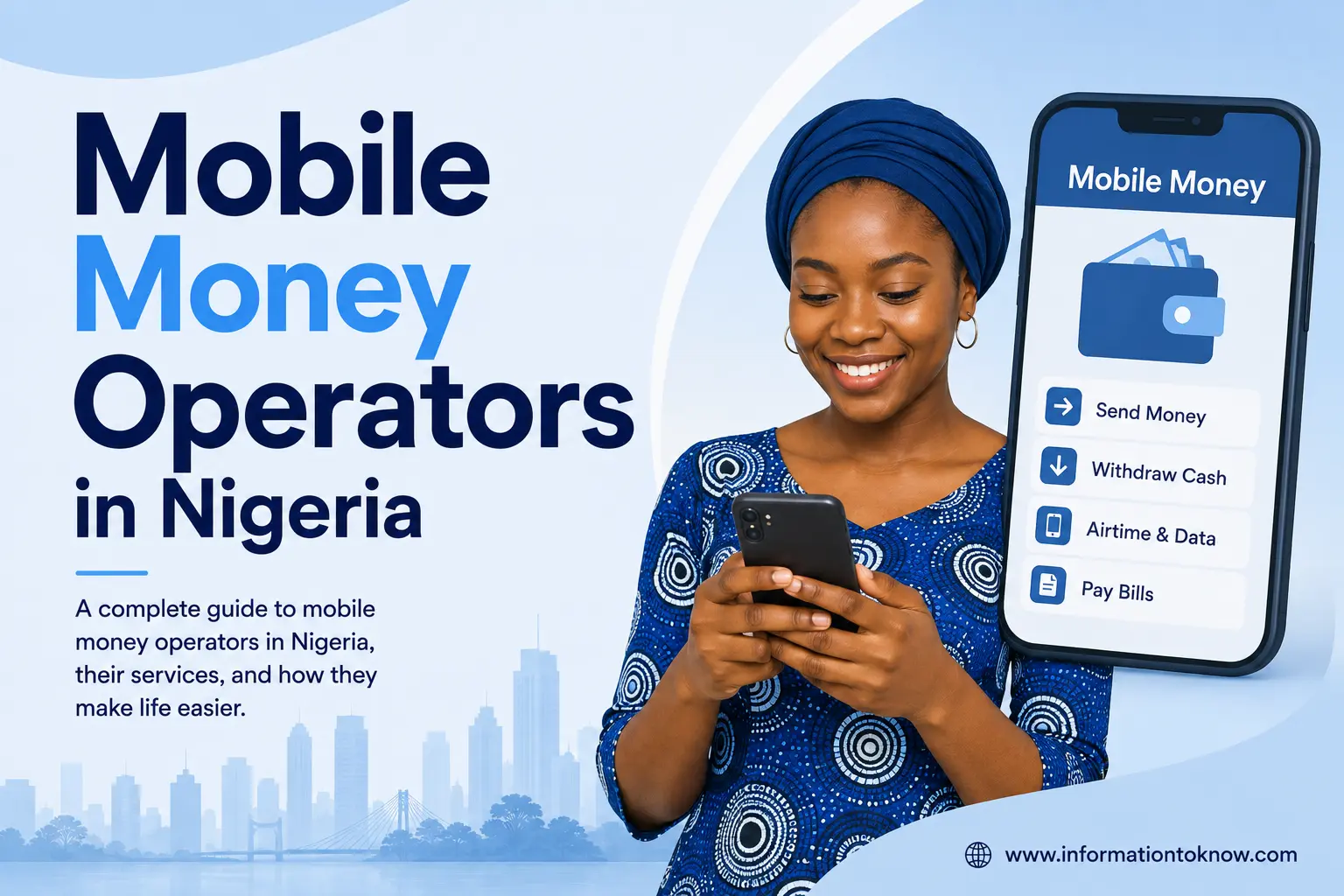
Quick answer: Mobile money operators (MMOs) in Nigeria are companies licensed by the Central Bank of Nigeria (CBN) to run digital wallets, transfers, bill payments and agent cash-in/cash-out. As of 2024 there were 17 CBN-licensed MMOs — led by OPay, PalmPay and Paga — alongside a separate set of telco-backed Payment Service Banks (PSBs) like MoMo and SmartCash.
If you’ve ever sent money on OPay, cashed out at a PalmPay POS stand, or wondered whether your wallet is actually safe, you’re already living inside Nigeria’s mobile money economy. The problem is that “mobile money operator” gets used loosely — people lump in banks, fintech apps, and POS agents as if they’re all the same thing. They aren’t, and the difference decides who can hold your money, who can lend, and who you should trust.
This guide gives you the current, plain-English map: what an MMO really is, the full list of licensed mobile money operators, how they differ from PSBs and fintechs, the latest numbers, and what the new 2026 agent rules mean if you want to cash in on the trend yourself.
Jump To
What Is a Mobile Money Operator (MMO) in Nigeria?
A mobile money operator is a CBN-licensed company that lets you store, send, and receive money through a mobile wallet — no traditional bank account required. In practice, that means transfers, airtime, bill payments, and a network of human agents who handle cash deposits and withdrawals on your behalf.
The key word is licensed. An MMO isn’t just any app that moves money; it holds a specific CBN mobile money operator licence and is regulated as such. That regulation is why your wallet balance is treated seriously and why operators must verify your identity before you transact. Mobile money is one slice of the wider world of fintech companies in Nigeria, but it’s the slice that most directly replaces cash and the naira in everyday life.
Related: What Currency Does Nigeria Use?
MMO vs PSB vs PSSP vs Fintech — The Categories That Actually Matter
Here’s the distinction most lists skip: not every mobile money brand holds the same licence, and the licence decides what the company is allowed to do. There are three CBN tiers worth knowing.
- Mobile Money Operator (MMO): Can issue wallets, process transfers and bill payments, and hold your funds. CBN rules require a minimum share capital of ₦2 billion. This is the tier built for consumer wallets, which is why the household-name apps you actually send money on — OPay and PalmPay — sit here rather than in the other categories.
- Payment Service Bank (PSB): Telco-backed and built for grassroots reach. A PSB can take deposits and run wallets, but as TechCabal notes, the licence “doesn’t allow them to offer loans, forex services, or invest beyond government-approved securities.” That makes it a place to store and move money, not to borrow — which is why telco-owned names like MoMo and SmartCash sit here.
- Payment Solution Service Provider (PSSP): A payment gateway/processor only — it can’t hold your money or issue wallets. Instead, it works behind the scenes to route and process payments for banks, apps, and merchants, so you’ll usually rely on a PSSP without ever seeing its brand on your phone.
This classification is why people get confused about Moniepoint‘s status, for instance. Moniepoint is a genuine fintech unicorn, but it operates mainly on a microfinance bank (MFB) licence, not a standalone MMO licence. The same is true of Kuda. They’re major payment players; they’re just not on the CBN’s mobile money operator list.
The practical lesson: don’t assume “app that moves money” equals “mobile money operator.” The licence is the line, and it decides whether a platform can hold your balance, lend to you, or simply route a payment. When you know which tier a brand sits in, you know what it can and can’t legally do with your money, and that’s more useful than any marketing claim.
Related: How to Start a Fintech Company in Nigeria
Full List of CBN-Licensed Mobile Money Operators in Nigeria (2026)
As of full-year 2024, there were 17 CBN-licensed mobile money operators, and a 2025 industry report puts the count at 18. The list mixes non-bank operators with bank-led services.
Here are the names that matter most, and what each is known for.
Leading non-bank MMOs
OPay
Nigeria’s most visible wallet-and-agent brand, and for many people, the default way to send money, buy airtime, pay bills, and cash out at a nearby stand. Its pull is convenience plus reach: a simple app, near-instant transfers, and one of the densest agent/POS networks in the country, which is why it’s so often the wallet people fall back on when bank apps stumble. Backed by Opera, OPay’s implied valuation reached about $2.75 billion at the end of 2024, derived from Opera’s US SEC filing valuing its 9.4% stake at $258.3 million.
Best for: Opay is best for everyday transfers and cash-out where agent density matters.
PalmPay
The rewards-led challenger is built around an easy app, cashback and referral perks, free or low-cost transfers, and a big merchant and agent footprint. It leans hard on incentives to win daily use, which makes it popular with younger, price-sensitive users who chase bonuses and instant transfers. PalmPay’s managing director, Chika Nwosu, told BusinessDay the platform served over 16 million monthly active users in 2024, from a base of 35 million-plus registered users and 1.2 million business users, and PalmPay has operated under a CBN mobile money operator licence since 2019.
Best for: Palmpay is best for users who want rewards and low fees on routine payments.
Paga
One of Nigeria’s pioneer mobile money platforms (Pagatech Ltd), around since 2009 and long trusted for transfers, bill payments and an agent network that predates the current app boom. It’s less about flashy perks and more about being a dependable rail that has been moving money for well over a decade.
Best for: Paga is best for users who value longevity and a proven track record over promotions.
Other licensed MMOs
Beyond the big three, the CBN’s mobile money operator category includes several names with smaller or more specialised footprints, but valid licences:
eTranzact International
One of Nigeria’s oldest electronic payment companies, established in 2003. eTranzact International is better known for powering transfers, card and web payments behind the scenes than for a consumer wallet. For most people, you’re more likely to use eTranzact indirectly — through a bank, biller, or merchant that runs on its rails — than to download an eTranzact app. It does offer consumer-facing services, but the company’s real strength is enterprise and government payment infrastructure rather than winning the everyday wallet war.
Chams Mobile
Part of the Chams group, whose core business spans identity management and payments, rather than a mass-market consumer app. Its wallet brand, KEGOW, is paired with an agent-banking footprint, but Chams is best understood as a technology and identity company that also holds a mobile money licence.
Parkway (ReadyCash)
Leans toward business, government, and enterprise payment solutions rather than everyday retail wallets. Parkway’s strength is powering payments, collections, and disbursements for organisations behind the scenes, so you may interact with its technology without ever seeing the brand. For an individual choosing a daily wallet, it isn’t really a direct rival to OPay or PalmPay — it plays a different, more institutional role in the payments chain.
Cellulant (Tingg)
A pan-African payments player whose Tingg platform focuses on collections, cross-border payouts, and merchant settlement across markets. Because it operates in many African countries, Cellulant is geared toward businesses that need to collect or send money across borders rather than the local person cashing out at a kiosk. If your needs are regional or business-to-business, it’s relevant; for simple day-to-day transfers within Nigeria, an app-first MMO will usually serve you better.
Fortis Mobile Money, Funds & Electronic Transfer Solutions and Teasy Mobile
Earlier-generation operators that hold licences but have a limited day-to-day consumer presence today. Many launched during Nigeria’s first mobile money wave and have since been overtaken by the app-first giants, so you’ll rarely see them promoted or find active agents nearby. Treat them as licensed-but-legacy names: worth knowing they exist, but not where most Nigerians are transacting in 2026.
The practical point: a valid MMO licence doesn’t guarantee a big consumer app — several of these serve businesses, billers, or partners rather than the person on the street.
Bank-led operators
Traditional banks also run their own mobile money and agent services, usually as an extension of the bank rather than a standalone fintech brand:
Firstmonie (First Bank)
The best-known bank-led mobile money operator, built on a nationwide agent network that lets people transact in communities without a full branch nearby. Because it sits under a long-established, major Nigerian bank, Firstmonie appeals to users who want agent-banking convenience without leaving the traditional banking system. For rural customers, a Firstmonie agent often doubles as their nearest “bank branch,” handling withdrawals, deposits, transfers, and bill payments where an actual branch would be impractical.
UBA (MONI/UBA agent banking)
Pairs the bank’s wide footprint with agent and wallet services for everyday deposits, withdrawals, and transfers. UBA’s wide branch and agent footprint means its services reach deep into everyday banking, but for local users, the appeal is simple: tap the bank you may already use through an agent close to home. It suits people who prefer keeping their wallet and their main bank account under the same familiar roof.
Access, Ecobank, Sterling, and Fidelity
Each runs wallet and/or agent-banking services that lean on existing account holders and branch infrastructure. These aren’t standalone fintech brands so much as digital and agent extensions of the banks themselves, aimed at keeping current customers inside the bank’s ecosystem. If you already bank with one of them, using its wallet or agent service can be the path of least resistance — fewer new sign-ups, and support you can chase at a branch.
These are backed by the same institutions you’ll find on our list of commercial banks in Nigeria, and they trade app polish for the reassurance of a familiar bank behind the wallet. For many first-time or cautious users, that trust is the whole point — even if the experience is less slick than OPay’s or PalmPay’s.
Payment Service Banks (PSBs): The Telco-Backed Players
PSBs are a separate licence class built to push financial services into rural and underbanked areas, usually powered by a telecom parent so they can reach people through existing SIM and airtime networks.
Here’s who they are and what each leans on:
MoMo PSB (MTN)
MTN’s payment bank designed to turn its huge subscriber base into wallet users for transfers, savings, and bill payments. On paper, it should dominate: MTN has a vast telecom subscriber base in Nigeria, and every SIM is a potential wallet. In practice, as the numbers below show, converting airtime customers into active, engaged wallet users has proven far harder than signing them up in the first place.
SmartCash PSB (Airtel)
Airtel’s equivalent, focused on MSMEs and grassroots inclusion; it was named Outstanding PSB of the Year 2024 (Fintech) at the New Telegraph Awards. Like MoMo, it leans on a telecom parent’s reach to bring wallets to underserved communities, and it has leaned into small-business use cases. If you’re an Airtel user in an area with few banks, SmartCash is the PSB most likely to have an agent and network coverage near you.
9PSB
An early-mover PSB that leans on wallet services and partner/API integrations. It grew out of the 9mobile ecosystem, but it’s a separately licensed Payment Service Bank regulated by the CBN — not a telecoms company. Rather than chase mass consumer branding, 9PSB has positioned itself as an infrastructure and partnerships player, powering wallets and services for other businesses. For a typical user, that means you might rely on 9PSB behind another app without ever installing a “9PSB” one yourself.
Hope PSB
Backed by Unified Payment and positioned around digital-first banking and technology partnerships. Unusually, Hope PSB isn’t telco-owned; its roots in an established payments company give it a more technology-and-banking flavour than a SIM-card one. It leans toward app-based, digital-first users rather than a vast physical agent army, so it suits people comfortable banking primarily from their phone rather than at a kiosk.
MoneyMaster PSB
Globacom’s payment bank, aimed at extending wallet and agent services across its subscriber base. As Glo’s entry into payment banking, it follows the same telco playbook as MoMo and SmartCash: use the mobile network to reach customers banks struggle to serve. If you’re a Glo subscriber, it’s the PSB most naturally tied to your line, though its footprint is smaller than the market-leading MMOs.
Remember the licence limits: a PSB can hold your deposits and run a wallet, but it can’t lend, deal forex, or invest beyond government securities — so it’s a place to store and move money, not to borrow.
PSBs have also found the model harder than expected. MoMo PSB is the clearest example: according to MTN’s FY2024 results reported by TechCabal, its active wallets peaked at 5.3 million at the end of 2023, then fell 46% to 2.8 million by the end of 2024, with cash deposits from wallet users roughly halving. The takeaway for you: the app-first MMOs (OPay, PalmPay) have been outgrowing the telco PSBs, even though PSBs were designed for exactly this job.
Comparison Table: Leading Operators at a Glance
Use this to match an operator to what you actually need.
NB: Slide left to view the table if you’re on mobile.
| Operator | Licence type | Owner/backer | Standout scale (latest) | Best for |
|---|---|---|---|---|
| OPay | Mobile Money Operator | Opera-backed | $2.75bn implied valuation (end-2024) | Everyday wallet + dense agent network |
| PalmPay | Mobile Money Operator | Transsion-backed | 16m+ monthly active users (2024) | Rewards, transfers, merchant payments |
| Paga | Mobile Money Operator | Pagatech Ltd | Pioneer since 2009 | Bill payments, long-standing trust |
| Firstmonie | Bank-led MMO | First Bank | Nationwide bank agent network | Bank-backed agent banking |
| MoMo PSB | Payment Service Bank | MTN | 2.8m active wallets (end-2024) | Telco-linked rural access |
| SmartCash PSB | Payment Service Bank | Airtel | Outstanding PSB of the Year 2024 (Fintech), New Telegraph Awards | Airtel users, grassroots reach |
| 9PSB | Payment Service Bank | 9mobile-linked | Limited public disclosures | Wallet/API partners |
How Big Is Mobile Money in Nigeria? (The Numbers)
Mobile money in Nigeria isn’t a niche — it’s now a core rail of the economy. The clearest proof is transaction value: According to NIBSS data reported by Nairametrics, Nigeria’s 17 licensed MMOs processed ₦71.5 trillion in 2024, a 53.4% jump from the year before, across 3.9 billion transactions. The prior year was itself explosive: According to Daily Trust, MMOs handled ₦46.6 trillion in 2023, up 140% as the naira-redesign cash crunch pushed millions onto wallets.
Why does this matter to you?
Because it reflects a genuine shift in access, not just hype. EFInA’s 2023 Access to Finance survey found formal financial inclusion rose to 64% of adults (from 56% in 2020), while the share of adults included specifically through non-bank formal channels like fintechs more than doubled, from 5% to 12%. Underpinning all of it is a vast agent network: industry data cited by fintech analyst Adedeji Olowe puts the SANEF-facilitated agent count at roughly 1.92 million by August 2024, present in all 774 local government areas. That density is why there’s almost always an agent within walking distance, even in towns where a traditional bank branch is hours away.
Put the numbers together, and a clear picture emerges: mobile money isn’t just growing; it’s absorbing the everyday transactions — school fees, market payments, transfers to family — that used to move as cash. That’s exactly why choosing the right operator matters more than it did a few years ago.
How to Choose a Mobile Money Operator You Can Trust
The short version: pick a CBN-licensed operator whose fees, reliability, and agent coverage fit how you actually move money. Don’t choose on brand noise alone. Run through this checklist:
- Licence: Confirm the operator is CBN-licensed (an MMO or PSB), not just a slick app.
- Deposit safety: Many wallets fall under NDIC coverage — check, and always complete your BVN/NIN verification, which operators now require.
- Fees: Compare transfer and withdrawal charges; they vary by operator and by transaction size.
- Agent density: If you cash out often, choose the operator with the most agents near you.
- Reliability and support: Test how fast failed transactions are reversed and how reachable support is.
If you want the wider banking picture too, our guide to commercial banks in Nigeria shows where these wallets fit alongside traditional accounts.
Want to Become a Mobile Money or POS Agent? What the 2026 CBN Rule Changes
If you’re eyeing agent banking as a side hustle, there’s one change you must plan around. New CBN agent-banking guidelines mean that from April 1, 2026, each POS/agent may work with only one principal — a single bank, microfinance bank, PSB, or MMO. The multi-operator setup, where one agent juggles several apps on several terminals, is being phased out.
For you, that means choosing your operator carefully before you commit, because switching later gets harder and the market is expected to consolidate around the biggest networks.
The practical steps still hold:
- Pick a licensed operator,
- Register your business with CAC (a business name is usually enough)
- Meet the operator’s onboarding and float requirements, and
- Get your terminal.
The float you keep, the commissions you earn, and the terminal you’re issued as a POS business owner all vary by operator, so treat the choice as a business decision, not just a sign-up.
One more practical tip: pick the operator whose agents are already busy in your area. High foot traffic usually means customers trust that brand’s terminals and reversals, which makes your own float turn over faster.
Your Next Move: Verify Before You Trust
Before you send your next naira, do one thing: confirm your chosen wallet is a CBN-licensed operator, then match it to your real need — dense agents for frequent cash-outs, low fees for regular transfers, or a bank-led option if you want your existing bank behind it. The market is large, fast-growing, and regulated, but the licensed part is what protects you.
And if you’re thinking of the agent side, decide on your single principal in line with the April 2026 one-operator rule, so you build on the right network from day one.
Found this useful? Drop your questions in the comments and share it with someone weighing up which mobile money operator to trust.
Mobile Money Operators Frequently Asked Questions
How many mobile money operators are licensed in Nigeria?
As of 2024, the CBN had licensed 17 mobile money operators; one 2025 industry report references 18. This is separate from Payment Service Banks and the 200+ broader fintechs.
Who are the CBN-licensed mobile money operators in Nigeria?
They include non-bank operators like OPay, PalmPay, and Paga, alongside bank-led services such as FirstMonie (First Bank) and UBA’s wallet, plus others like Chams Mobile, eTranzact, and Fortis Mobile Money.
Is OPay a mobile money operator?
Yes. OPay holds a CBN mobile money operator licence and runs one of Nigeria’s largest wallet and agent networks; its implied valuation reached about $2.75 billion at the end of 2024 based on Opera’s US SEC filing.
What is the difference between an MMO and a Payment Service Bank (PSB)?
An MMO issues wallets and processes transfers and bill payments. A PSB does similar wallet functions but is telco-backed and cannot lend, deal in forex, or invest beyond government securities.
Is 9PSB owned by 9mobile?
9PSB (9 Payment Service Bank) grew out of the 9mobile ecosystem but operates as a separately licensed Payment Service Bank regulated by the CBN, not as a telecoms company.
Is Moniepoint a mobile money operator?
Moniepoint is a licensed financial institution and fintech unicorn, but it operates primarily on a microfinance bank (MFB) licence rather than a standalone mobile money operator licence.
How much is a mobile money operator licence in Nigeria?
CBN rules require a mobile money operator to hold a minimum share capital of ₦2 billion, alongside application, licensing, and compliance requirements set by the regulator.
Which mobile money operator is the best in Nigeria?
There’s no single best — OPay and PalmPay lead in app users and agent reach, Paga is a long-standing pioneer, and telco PSBs suit rural reach. Choose based on fees, reliability, and agent availability near you.
Are mobile money wallets safe and insured in Nigeria?
Licensed operators are CBN-regulated, and many wallets fall under NDIC coverage. Always confirm a provider is CBN-licensed and complete BVN/NIN verification, which operators now require.
How much do mobile money operators process in Nigeria?
Nigeria’s 17 licensed MMOs processed ₦71.5 trillion in 2024, up 53.4% from ₦46.6 trillion in 2023, across 3.9 billion transactions.
What is the new CBN agent banking rule for 2026?
From April 1, 2026, CBN guidelines require each POS/agent to work with only one principal (a single bank, MFB, PSB, or MMO), ending multi-operator agent arrangements.
How do I become a mobile money agent in Nigeria?
Pick a licensed operator, register your business (a CAC business name is typical), meet the operator’s onboarding and capital requirements, and get your POS terminal — noting the one-principal rule from April 2026.
Is mobile money the same as a fintech app like Moniepoint or Kuda?
Not exactly. Mobile money operators hold a specific CBN MMO licence, while apps like Moniepoint and Kuda run mainly on microfinance bank licences — similar services, different licence category.