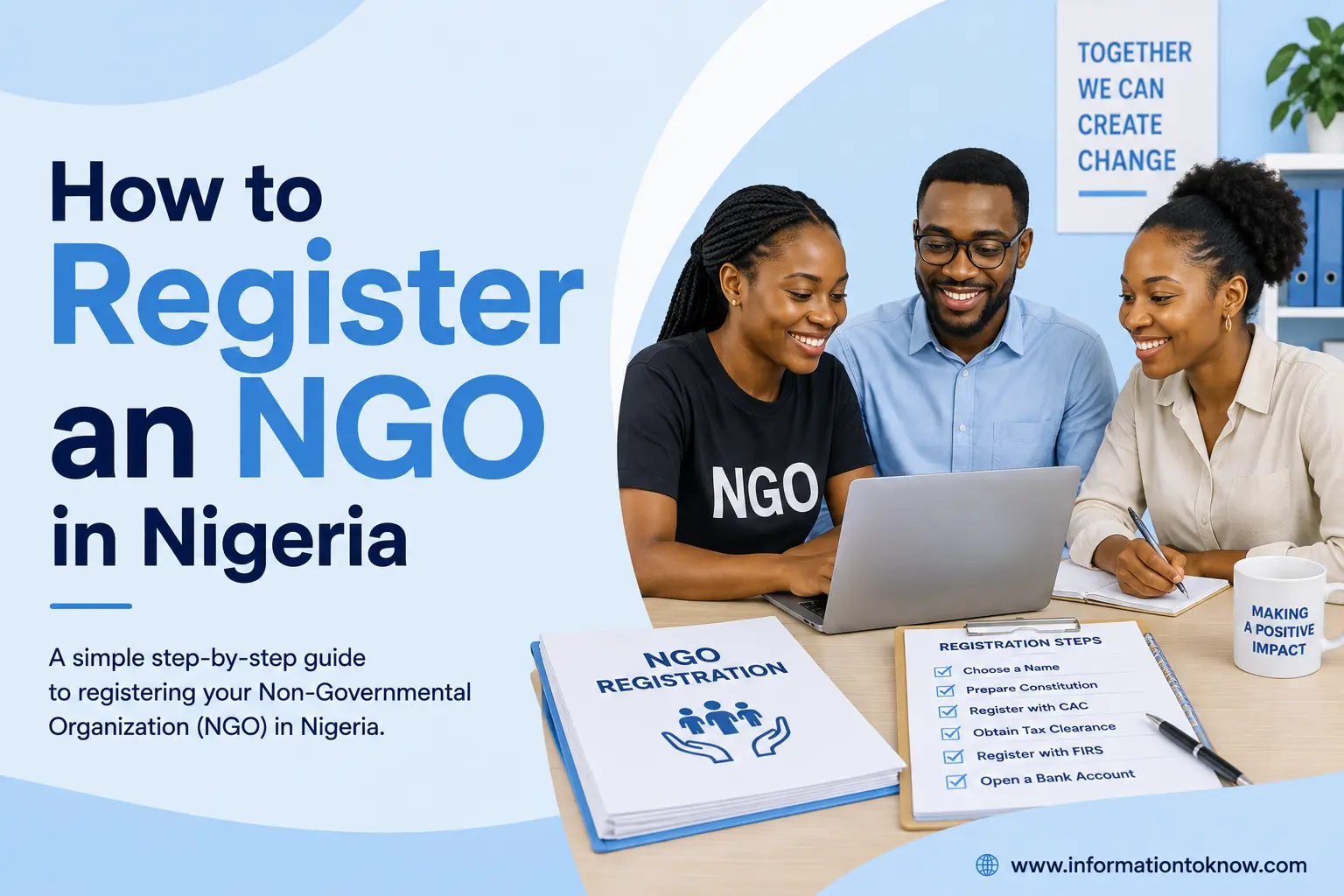
Short answer: To register an NGO in Nigeria, you register it as an Incorporated Trustee with the Corporate Affairs Commission (CAC) under Part F of the Companies and Allied Matters Act (CAMA) 2020. In practice that means reserving your name (RG’s Consent), drafting a constitution, publishing a notice in two newspapers (one national and one local or state paper), filing the CAC-IT01 form online with your trustees’ details, and paying the fees. The whole process usually takes about 6 weeks or more and the cost and how many days you spend on it depends on whether you’re doing it yourself or with an NGO CAC registration expert.
Contact Jogee Business Services on Whatsapp if you need an expert.
You have a cause — feeding out-of-school kids, running a health outreach, building a foundation in a late parent’s name — and you’ve hit the same wall every founder hits: your NGO isn’t real until the government says it is. Without registration, you can’t open a corporate bank account, you can’t legally receive most grants, and donors won’t take you seriously.
This guide walks you through exactly how to fix that: what an NGO is in the eyes of Nigerian law, the documents you need, the step-by-step CAC process, what it really costs in 2026, how long it takes, and the after-registration steps (like SCUML) that most guides quietly skip. The entire NGO registration process in Nigeria.
You’re not alone in this. Nigeria’s nonprofit sector is booming: registered NGOs (Incorporated Trustees) grew to 191,278 by November 2023, up more than 1,000% from 17,177 in 2019, according to CAC register figures reported by The Guardian. Getting your own organisation onto that register is very doable — here’s how.
Jump To
What is an NGO (Incorporated Trustee) in Nigeria?
An NGO in Nigeria is legally registered as an Incorporated Trustee, not as a company. NGOs are registered as Incorporated Trustees under Part F of CAMA 2020 (Sections 823–850), and the Corporate Affairs Commission (CAC) oversees their formation, regulation, and dissolution.
In plain terms: a group of people (the trustees) come together for a non-profit purpose — charity, education, religion, health, sport, human rights — and register the trustees as a corporate body on behalf of the organisation. Once registered, your NGO gets a certificate and a registration number. NGO registration numbers carry an “IT” prefix (rather than the “RC” used for companies), and anyone can verify a registration for free on the CAC public search portal.
Churches, mosques, foundations, clubs, alumni associations, and community groups all register under this same Incorporated Trustees framework.
Should You Register and Which Structure?
Yes, if you want your organisation to operate legally, hold property, open a bank account, and attract funding, you should register. Registration turns an informal group into a recognised legal person.
Registering as an Incorporated Trustee gives your NGO a separate legal personality, perpetual succession, the right to own property, and eligibility for grants — all under Part F of CAMA 2020. A registered NGO can sue and be sued in its own name, protect its name from being used by others, and can qualify for certain tax exemptions.
There are two legal structures for nonprofits, and it’s worth choosing correctly before you start:
NB: Slide left to view the table if you’re on mobile.
| Structure | Best for | Approval needed | Notes |
|---|---|---|---|
| Incorporated Trustees (Part F, CAMA 2020) | NGOs, churches, mosques, foundations, community groups | No Attorney-General approval | The standard, faster route for most NGOs |
| Company Limited by Guarantee (LTD/GTE) | Universities, professional associations, bodies needing global recognition | Requires Attorney-General of the Federation (AGF) approval | A Company Limited by Guarantee cannot be registered without the authority of the Attorney-General of the Federation (under CAMA 2020, Section 26(4)) — an extra step that lengthens the timeline |
For the vast majority of founders, Incorporated Trustees is the right choice — and it’s what the rest of this guide covers. (If you’re weighing a for-profit venture instead, that’s a different path — see our guide on registering a business with the CAC.)
Requirements Before You Start
Before you touch the portal, make sure you have the basics in place. Missing any of these is the fastest way to get a query or rejection.
To register an NGO under Incorporated Trustees, you need a minimum of two trustees (each at least 18 years old and of sound mind), a unique proposed name, clearly defined objectives, a verifiable physical address in Nigeria, valid trustee identification, and a detailed constitution. The CAC’s own service page confirms that at least two trustees are required, and they must meet the legal qualifications — over 18, sound mind, and not bankrupt.
Checklist of what you need ready for NGO CAC registration:
- Two or more trustees (18+, sound mind, not bankrupt) with their personal details.
- A unique name that isn’t identical or confusingly similar to an existing organisation.
- Clear objectives describing what your NGO will do.
- A verifiable Nigerian address for the organisation.
- Valid ID for each trustee (National ID/NIN, international passport, or driver’s licence).
- A constitution setting out governance and how the NGO will run.

Documents You’ll Need to Submit
The registration itself is a documentation exercise. Get these ready in clean, legible scans (PDF preferred).
The key documents include the minutes of the meeting where trustees are appointed, copies of the newspaper publications, trustee declaration forms, means of identification for trustees, passport photographs, and the NGO’s constitution.
- Minutes of the meeting appointing the trustees (signed by the chairman and secretary)
- Trustee declaration forms
- Means of identification for each trustee
- Passport photographs of trustees
- Copies of the two newspaper publications
- The NGO constitution
Step-by-Step: How to Register Your NGO with the CAC
Here is the full process from start to certificate. The whole thing is done online through the CAC portal; you don’t need to visit a CAC office. You also have the option of hiring an NGO CAC registration expert to assist you.
Step 1 — Reserve your name (RG’s Consent)
- Start by checking that your proposed name is available and reserving it. NGOs have a twist most people miss: for Incorporated Trustees, this name step is commonly known as the Registrar-General’s (RG’s) Consent.
- You submit three proposed names, pay the ₦5,000 fee, and the CAC reviews and approves the name before it’s reserved for 60 days.
- Unlike a business name, the CAC actually vets the name, so this can take a few days.
Expert Tip: Pick names that clearly signal your purpose (Foundation, Initiative, Trust) and avoid anything too close to an existing organisation.
Step 2 — Draft your constitution and gather documents
While you wait for name approval, prepare everything else. This is the most time-consuming stage. Your constitution must comply with CAMA 2020, and an incomplete or non-compliant constitution is one of the top reasons applications get queried, which resets your timeline.
Expert Tip: Consult and work with a registration specialist to ensure you get each step of the way right and avoid getting queried or resetting your timeline.
Step 3 — Publish a notice in two newspapers
This is the step that controls your timeline. You must advertise your intention to register in two newspapers — at least one national and one local or state paper — which opens a public objection window. A publication is made in two daily newspapers inviting the public to object, and any opposition must be submitted to the Commission within 28 days of the publication. You’ll keep copies of these adverts as part of your submission.
Step 4 — Complete the CAC-IT01 form and upload documents
Log in to the CAC’s Company Registration Portal and file the application. You fill out the CAC-IT01 form on the portal and upload all required documents, including your constitution and trustee details. Enter the trustees’ particulars carefully — one spelling mismatch against an ID can trigger a query.
Step 5 — Pay the filing fees
Pay the prescribed filing fees shown on your dashboard through the portal. Fees for Incorporated Trustees are higher than for a business name because of the extra documentation and review involved (see the cost breakdown below).
Step 6 — CAC review, then your certificate
The CAC reviews your application after the objection period and payment have been cleared. They may approve it or issue a query asking for corrections. Once approved, registration is completed end-to-end with an electronic Certificate of Incorporation and a Certified Extract of Registration Information. Your NGO is now a registered legal entity.
How Much Does It Cost to Register an NGO in Nigeria? (2026)
Here’s how the NGO registration costs break down:
NB: Slide left to view the table if you’re on mobile.
| Cost item | Estimated amount (2026) | Notes |
|---|---|---|
| Name reservation (RG’s Consent) | ₦5,000 | Government fee; three names submitted |
| Incorporation fee | ₦30,000 | Statutory CAC fee |
| Registration + Certified True Copy | ₦35,000 | Statutory CAC fee |
| Newspaper publication (×2) | ₦60,000–₦200,000+ | Varies by outlet; one national + one local/state paper required |
| CAC registration specialist/agent fee (optional) | ₦80,000–₦200,000+ | Only if you hire an accredited CAC agent to handle the entire process for you |
| Annual returns (ongoing) | ₦5,000/year | Filed yearly to stay in good standing |
Realistic totals: about ₦130,000–₦180,000 if you file it yourself, or ₦200,000–₦350,000+ with a professional. Because official fees are updated periodically and the CAC schedule changes, confirm the current fees before you pay.
How Long Does NGO Registration Take?
Plan for about 6–8 weeks from start to certificate. Incorporated Trustees take about 6 to 8 weeks, largely because of the mandatory 28-day newspaper publication period. This can easily get complicated and take more time if you’re queried along the way and your application is reset.
The basic timeline is driven less by CAC processing and more by three things you control: how fast you finalise a compliant constitution, the newspaper objection window that legally must run its course, and whether you get queried. Accurate documents, a clean constitution, and a careful application are the single biggest levers for avoiding delays.
After You’re Registered: SCUML, Bank Account, and Annual Returns
Getting your certificate is not the finish line. There’s one more registration most new NGOs don’t know about, and it’s the reason some founders can’t get a working bank account.
For NGOs and most incorporated trustees, there is a second mandatory registration before you can operate a functional corporate bank account: SCUML, the Special Control Unit Against Money Laundering, which operates under the EFCC because NGOs are classified as Designated Non-Financial Businesses and Professions.
So the real order of operations after your certificate is:
- Register with SCUML (via the EFCC) to satisfy anti-money-laundering rules.
- Open a corporate bank account in your NGO’s name — see our list of commercial banks in Nigeria to compare options.
- File annual returns with the CAC every year to keep your registration in good standing. Skipping annual returns is one of the most common and most penalised compliance failures.
Common Mistakes that Delay NGO Registration
- Choosing a weak or duplicate name. Because the CAC vets NGO names (RG’s Consent), a name too similar to an existing organisation gets rejected, costing you days.
- Submitting an incomplete constitution. A constitution that doesn’t meet CAMA 2020 requirements is queried and sent back, resetting your timeline.
- Mismatched trustee details. A name spelled differently on the form and the ID triggers a query.
- Forgetting SCUML. Founders celebrate the certificate, then discover the bank won’t fully activate the account until SCUML is done.
- Ignoring annual returns. Compliance doesn’t end at registration; unfiled returns attract penalties.
- Making other first-timer mistakes can also play a part, which is why businesses and NGOs hire CAC registration experts to handle the process for them.
Start Your NGO Registration This Week
Now that you know the full process, take the one action that unlocks everything else: go to the CAC portal and run a free name-availability search for your NGO. If your name is clear, submit it for RG’s Consent (three options, ₦5,000) and start drafting your constitution while the name is under review. That’s the two-track move that keeps your 6–8 week timeline on schedule. Line up your two trustees, their IDs, and a registered address, and you’re already most of the way there. Register properly once, add SCUML and annual returns to your calendar, and your NGO will be free to open accounts, receive grants, and do the work you started it for.
NGO CAC Registration Frequently Asked Questions
What is an NGO called legally in Nigeria?
An Incorporated Trustee. NGOs are registered as Incorporated Trustees under Part F of CAMA 2020 with the Corporate Affairs Commission (CAC).
Which body registers NGOs in Nigeria?
The Corporate Affairs Commission (CAC) handles the formation, regulation, and dissolution of NGOs in Nigeria.
How much does it cost to register an NGO in Nigeria?
About ₦130,000–₦180,000 if you file it yourself, or ₦200,000–₦350,000+ with a professional (2026 figures). Statutory CAC fees include name reservation ₦5,000, incorporation ₦30,000, and registration + Certified True Copy ₦35,000. Newspaper publication runs ₦60,000–₦200,000+. Confirm current fees on the CAC portal.
How long does NGO registration take?
Usually about 6–8 weeks, largely because of the mandatory 28-day newspaper objection period.
How many trustees do I need?
A minimum of two trustees, each at least 18 years old and of sound mind.
Do I need a lawyer to register an NGO?
No. You can register yourself on the CAC portal, but many founders use an accredited CAC agent or lawyer to avoid queries, delays, and complications.
What is RG’s Consent?
For NGOs, the name-reservation step is commonly called the Registrar-General’s (RG’s) Consent. You submit three names and pay ₦5,000, and the CAC reviews the name before approving it.
Do I have to publish in newspapers?
Yes. You must publish a notice of intention to register in two newspapers — at least one national and one local or state paper — which opens a 28-day window for public objections.
What is the difference between Incorporated Trustees and a Company Limited by Guarantee?
Incorporated Trustees (Part F, CAMA) is the standard NGO route and needs no Attorney-General approval. A Company Limited by Guarantee cannot be registered without the authority of the Attorney-General of the Federation (under CAMA 2020, Section 26(4)), which adds an extra step and lengthens the timeline.
What is SCUML, and do I need it?
SCUML is the Special Control Unit Against Money Laundering under the EFCC. NGOs must register with it before operating a functional corporate bank account.
Can I open a bank account for my NGO?
Yes. After CAC registration and SCUML registration, you can open a corporate account in your NGO’s name.
How do I check if my NGO name is available?
Use the free CAC public name-availability search on the CAC portal. NGO registration numbers carry an “IT” prefix.
Do NGOs file annual returns?
Yes. Every registered entity, including NGOs, must file annual returns with the CAC each year to stay in good standing.
Can a foreigner be a trustee of a Nigerian NGO?
Yes — there is no nationality restriction barring non-Nigerians from being trustees. However, in practice, foreign trustees need valid Nigerian identification — specifically a National Identification Number (NIN) — because registration and identity verification run through Nigeria’s digital infrastructure. Plan for this if you’re appointing a non-Nigerian trustee.